Downtown, Chico
Updated · 706 residents
Downtown Chico is a vibrant and highly walkable urban hub defined by its energetic atmosphere and dense concentration of local businesses. While the area offers excellent access to daily amenities and social spots, residents should expect a lively environment with frequent noise from nearby traffic and trains.
Key Highlights
About Downtown
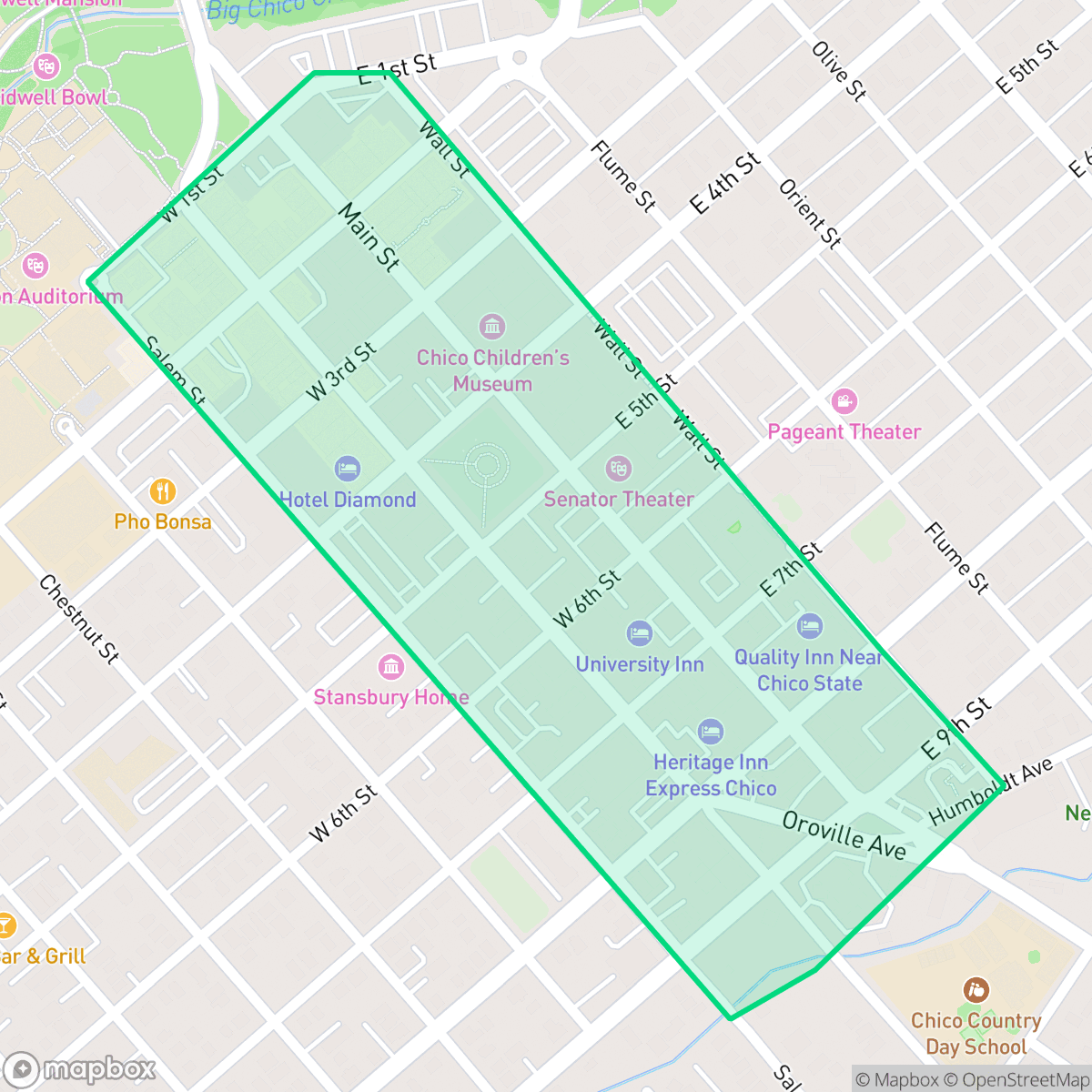
Downtown Chico serves as the historic commercial core of the city, established in 1860 on land acquired by founder John Bidwell. Its architectural character is defined by late 19th and early 20th-century brick commercial structures, many featuring large ground-floor display windows. Key landmarks include the City Plaza, a central public space integral to Bidwell’s original town plan, and the Senator Theatre, a prominent 1927 Art Deco venue. Other notable historic sites include the 1911 Old Municipal Building and the 1902 Morehead Building. Once known for its tree-lined streets that earned Chico the moniker 'City of Trees,' the neighborhood maintains a dense, walkable layout that has evolved from a 19th-century trade center into a vibrant cultural and business district anchored by long-standing local institutions and a preserved historic streetscape.
The neighborhood serves as a dynamic center for social and commercial activity, characterized by a high level of walkability and a dense, grid-based street layout. According to iHuus data, the area attracts a younger demographic, contributing to its energetic vibe and strong liberal lean. Residents enjoy convenient access to a wide array of dining and cultural destinations, all while benefiting from high rates of health insurance coverage. The architectural landscape maintains a modest, balanced aesthetic that blends residential homes with established commercial structures.
Living in this central district involves certain trade-offs, primarily regarding acoustic comfort and environmental awareness. The area experiences notable noise levels due to frequent traffic and proximity to railroad tracks. Additionally, while the neighborhood is well-connected, residents should remain mindful of moderate flood risks during heavy rain events. Families are served by the Chico Unified School District, which provides a range of educational options, though academic performance varies across the district's campuses. Overall, the area is best suited for those who prioritize an active, pedestrian-friendly lifestyle in the heart of the city.
Neighborhood Scores Across 15 Qualities
Residential spacing is consistent with the city average, offering a standard urban layout with moderate separation between structures. According to iHuus data, buildings are typically positioned with a moderate buffer between neighbors.
Pedestrians benefit from a predictable grid system with sidewalks on most streets and safe crossings. This level of walkability is higher than the average for Chico.
Standard residential structures feature simple architecture and small yards. According to iHuus data, the visual variety in this area is slightly lower than the Chico average.
Continuous sidewalks and tree-lined verges provide reliable walking routes for pets. According to iHuus data, the level of accessibility for dog walking is consistent with the rest of Chico.
Medium-density street layouts provide a blend of commercial structures and residential homes. This area feels less dense than the typical Chico neighborhood, offering a comparable amount of built environment and open space.
A diverse array of dining, social spots, and mid-rise buildings creates an energetic atmosphere that is significantly more active than the city average. According to iHuus data, the area offers a dense concentration of local destinations ranging from coffee shops to established restaurants.
Frequent disturbances from nearby railroad tracks and heavy traffic are common here. This level of acoustic activity is notably higher than the average for Chico.
Air quality in this area is consistent with the city average, presenting a mix of acceptable and unhealthy days that may occasionally concern sensitive groups.
Industrial activity and heavy warehouses are entirely absent from this area. According to iHuus data, this neighborhood is significantly more free of industrial facilities and hazardous sites than the Chico average.
Health insurance access is exceptionally high among residents, significantly exceeding the average seen across Chico. According to iHuus data, nearly all inhabitants of the area are covered by a health plan.
Voting patterns and census indicators show a significantly more liberal leaning than the rest of Chico, according to iHuus data.
A higher concentration of young adults characterizes this area, making the age distribution more skewed toward a younger demographic than the Chico average. According to iHuus data, this results in a population profile that is less diverse in age compared to the rest of the city.
Flood risk in this area is higher than the Chico average, as FEMA has not yet completed a detailed flood study for this specific location. Residents should remain aware of potential vulnerabilities during heavy rain events.
Address-Level Insights for Downtown


iHuus Neighborhood Intelligence Insights
Get address-level neighborhood insights for Downtown
- Street-level scores — see how individual blocks compare, not just neighborhood averages
- Micro-zone boundaries — identify quiet pockets, flood boundaries, and walkable clusters before you visit
- 15 dimensions in full — walkability, noise, air quality, school quality, insurance coverage, population age profile, urban/rural index, and more
- Boundary risk alerts — know if your address sits near a block boundary where scores drop, the kind of detail no listing will ever mention
- School insights — individual school ratings and insights, not just district-level data
- Compare before you commit — side-by-side data across neighborhoods, down to block precision
No credit card required
Compare with Any Neighborhood
| Dimension | Downtown | Chapmantown |
|---|---|---|
| 🚶 Walkabilityavg 8.2 | ||
| 🔊 Acoustic Comfortavg 3.52 | ||
| 🤫 Privacy Indexavg 6.02 | ||
| 🎨 Visual Appealavg 6.83 | ||
| 🐕 Dog Friendlinessavg 7.2 | ||
| 🗺️ Urban-Rural Indexavg 6.97 | ||
| ✨ Neighborhood Vibeavg 5.96 | ||
| 🏥 Health Insurance Coverageavg 7.27 | ||
| 🌿 Air Qualityavg 6 | ||
| 🏭 Industrial Proximityavg 9.02 | ||
| 🌊 Flood Safetyavg 5.17 | ||
| 🗳️ Ideological Leanavg 7.51 | ||
| 👥 Population Age Profileavg 4.64 | ||
| 🔥 Fire Safety | ||
| 🏫 School Quality |
Downtown Rankings
School Districts Serving Downtown
School Insights for Downtown
Below average outcomes; significant attendance and academic challenges.
School Insights
See what's really behind every school rating near Downtown
- Individual school ratings — each school's own score with outcome context, not just a district average
- Enrollment & class size data — student-to-teacher ratio and how it compares to the state average
- Full demographics breakdown — ethnicity and gender composition for every school in the enrollment zone
- Every school in the district — all schools within the enrollment boundary ranked by rating, not just the closest one
- Grade levels & benchmarks — elementary through high school, with below/above state-average flags
No credit card required