Panorama, Cathedral City
Updated · 19,205 residents
Panorama is a highly walkable residential community in Cathedral City known for its sweeping views of the San Jacinto Mountains and its vibrant annual holiday light displays. Residents benefit from excellent air quality and a well-connected grid of sidewalks that link homes to local parks and diverse dining options.
Key Highlights
About Panorama
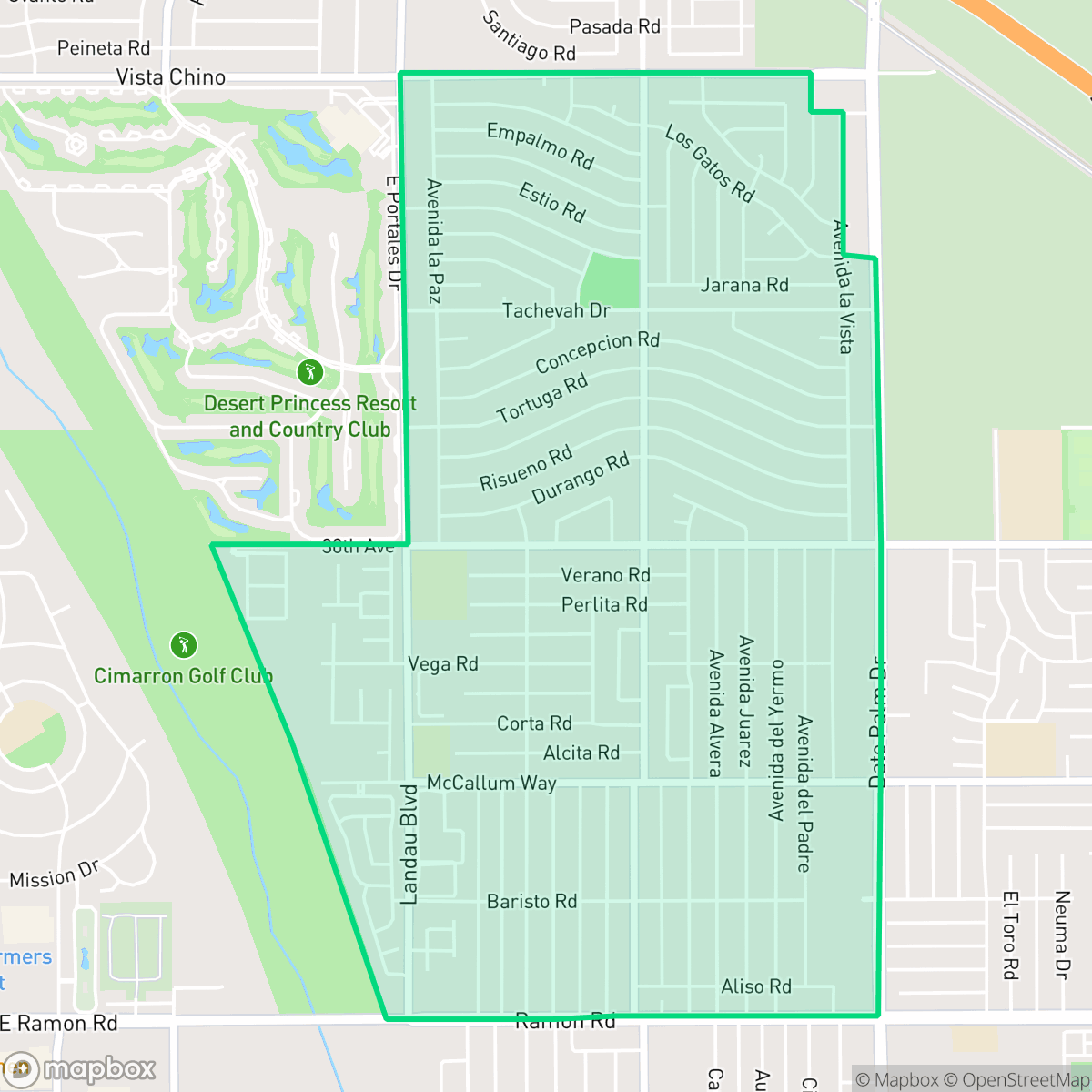
The Panorama neighborhood in Cathedral City, California, is a residential community designed in a distinct square layout with schools and commerce lining its outer edges, offering sweeping views of Mount San Jacinto. Developed primarily in the early 1980s, the neighborhood features a mix of Mediterranean, contemporary, and split-level home designs. At its center lies the 7.5-acre Panorama Park. Originally set aside in 1960 and dedicated in 1989, it is the city’s largest and one of its oldest public parks, now featuring a dedicated dog park opened in 2022. Panorama is culturally defined by Minerva Road, locally renowned as "Candy Cane Lane". Each December, residents of this signature street continue a long-standing holiday tradition, transforming their properties with elaborate, coordinated light displays that attract visitors from across the Coachella Valley.
The neighborhood features a dense suburban layout defined by a consistent grid of single-family homes, many of which include private pools and multi-car driveways. The area maintains a calm, suburban atmosphere, offering residents a blend of residential comfort and accessibility to local amenities. According to iHuus data, the community ranks well for walkability, with a comprehensive network of sidewalks and crosswalks that facilitate safe pedestrian movement throughout the residential core. The presence of diverse dining options and local social hubs adds to the neighborhood's functional appeal for daily living.
Prospective residents should consider that while the area provides high pedestrian connectivity and clean air, it faces specific environmental and educational challenges. The neighborhood is located within a zone of significant fire risk, and local schools within the Palm Springs Unified School District currently struggle with lower academic performance ratings. The area is best suited for those prioritizing a quiet, walkable suburban lifestyle who are prepared to navigate the trade-offs inherent in this specific desert environment.
Neighborhood Scores Across 15 Qualities
Housing density is slightly higher than the Cathedral City average, featuring detached single-family homes with standard suburban spacing. Most properties maintain moderate buffers between neighbors through the use of fenced backyards and private yards.
Sidewalks are widely available on both sides of residential streets and major roads, providing a more connected environment than the Cathedral City average. The gridded street network and marked crosswalks ensure safe movement, though the desert heat can impact comfort during midday.
Private backyard pools and large, well-maintained homes are common throughout this area. According to iHuus data, the visual quality of the neighborhood is slightly higher than the Cathedral City average.
Walking opportunities for pets vary by street, as some areas benefit from adjacent golf course greenery while others feature narrow sidewalks and limited public park access. According to iHuus data, the neighborhood offers slightly less access to public pet walking spaces than the Cathedral City average.
Open landscapes and scattered housing provide a semi-rural character that is consistent with the rest of Cathedral City. Residential areas often feature a mix of suburban street grids and proximity to vast open desert.
A mix of lively commercial blocks and quiet residential streets provides a steady variety of dining and essential services. This level of activity is roughly consistent with the average found throughout Cathedral City.
Steady traffic sounds from a nearby busy street are present; however, acoustic levels are more favorable than the average for Cathedral City according to iHuus data.
Air quality remains consistently high with rare instances of elevated readings, performing slightly better than the Cathedral City average according to iHuus data.
Residential and recreational uses dominate the area with an absence of heavy industry or warehouses. This lack of industrial proximity is slightly better than the Cathedral City average, according to iHuus data.
Health insurance access in Panorama is lower than the Cathedral City average, according to iHuus data. This indicates a higher proportion of uninsured residents compared to the rest of the city.
Voting patterns and census indicators reflect a very liberal leaning, which is closely aligned with the broader Cathedral City area.
Residents live alongside a balanced mix of young adults, families, and older populations. This demographic distribution is slightly more varied than the average found across Cathedral City, according to iHuus data.
Flood risk in this area is higher than the Cathedral City average, though the specific level of danger remains undetermined due to a lack of detailed federal studies. Residents should remain aware of potential drainage concerns during extreme weather events.
Address-Level Insights for Panorama


iHuus Neighborhood Intelligence Insights
Get address-level neighborhood insights for Panorama
- Street-level scores — see how individual blocks compare, not just neighborhood averages
- Micro-zone boundaries — identify quiet pockets, flood boundaries, and walkable clusters before you visit
- 15 dimensions in full — walkability, noise, air quality, school quality, insurance coverage, population age profile, urban/rural index, and more
- Boundary risk alerts — know if your address sits near a block boundary where scores drop, the kind of detail no listing will ever mention
- School insights — individual school ratings and insights, not just district-level data
- Compare before you commit — side-by-side data across neighborhoods, down to block precision
No credit card required
Compare with Any Neighborhood
| Dimension | Panorama | Alameda |
|---|---|---|
| 🚶 Walkabilityavg 8.27 | ||
| 🔊 Acoustic Comfortavg 3.4 | ||
| 🤫 Privacy Indexavg 5.69 | ||
| 🎨 Visual Appealavg 7.25 | ||
| 🐕 Dog Friendlinessavg 6.06 | ||
| 🗺️ Urban-Rural Indexavg 7.04 | ||
| ✨ Neighborhood Vibeavg 5.24 | ||
| 🏥 Health Insurance Coverageavg 6.86 | ||
| 🌿 Air Qualityavg 8.31 | ||
| 🏭 Industrial Proximityavg 9.61 | ||
| 🌊 Flood Safetyavg 3.61 | ||
| 🗳️ Ideological Leanavg 9.38 | ||
| 👥 Population Age Profileavg 5.58 | ||
| 🔥 Fire Safetyavg 0.17 | ||
| 🏫 School Quality |
Panorama Rankings
School Districts Serving Panorama
School Insights for Panorama
Below average outcomes; significant attendance and academic challenges.
School Insights
See what's really behind every school rating near Panorama
- Individual school ratings — each school's own score with outcome context, not just a district average
- Enrollment & class size data — student-to-teacher ratio and how it compares to the state average
- Full demographics breakdown — ethnicity and gender composition for every school in the enrollment zone
- Every school in the district — all schools within the enrollment boundary ranked by rating, not just the closest one
- Grade levels & benchmarks — elementary through high school, with below/above state-average flags
No credit card required