Carlsbad Ranch, Carlsbad
Updated · 385 residents
Carlsbad Ranch is a master-planned hub defined by its proximity to major family attractions like Legoland California and the seasonal Flower Fields. While the area offers access to high-performing schools and a lively commercial atmosphere, residents should expect notable road noise and a car-dependent lifestyle.
Key Highlights
About Carlsbad Ranch
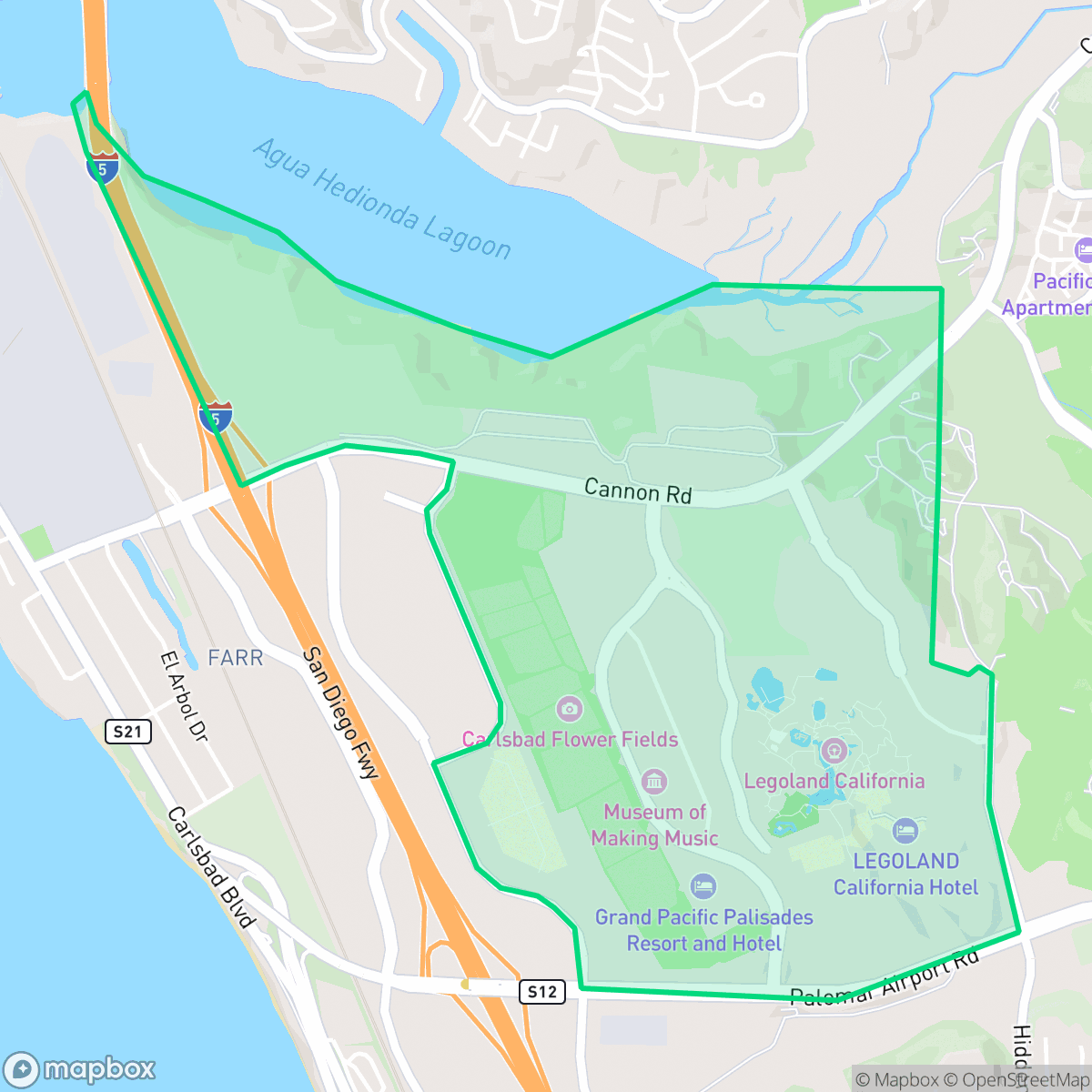
The Carlsbad Ranch neighborhood is historically rooted in Southern California’s coastal agricultural heritage. Originally part of the Mexican land grant Rancho Agua Hedionda, the area became synonymous with floriculture in the early-to-mid 20th century. In 1923, the Ecke family relocated their operations to the region, eventually utilizing the coastal hillsides of Carlsbad Ranch to cultivate poinsettias and the famous Tecolote giant ranunculus. In 1996, a major local coastal amendment transitioned much of the 423-acre Carlsbad Ranch from agricultural preserve to a master-planned commercial and tourism hub. This transformation paved the way for the opening of Legoland California in 1999. Today, Carlsbad Ranch retains its heritage through the iconic 55-acre Flower Fields at Carlsbad Ranch, which remain a working farm and seasonal landmark.
The neighborhood functions as a hybrid of tourist-focused infrastructure and suburban residential pockets, characterized by a mix of light industrial units, diverse dining options, and proximity to major transit corridors. According to iHuus data, the area maintains high levels of health insurance coverage and benefits from the stable, high-performing Carlsbad Unified School District, which is a significant draw for families. The landscape is a blend of active commercial daytime traffic and quieter residential streets, providing a unique environment that balances utility with suburban living.
Living in this area involves specific trade-offs between accessibility and environmental comfort. While the neighborhood provides excellent access to local amenities and green spaces, the high volume of road traffic results in significant noise levels. It is best suited for individuals who prioritize proximity to regional attractions and quality educational resources over secluded living. Prospective residents should also note that the area faces challenges regarding fire safety, which is a standard consideration for property stability in this part of Southern California.
Neighborhood Scores Across 15 Qualities
Residential spacing provides a moderate level of separation between neighbors. This balance of density and buffering is consistent with the average found across Carlsbad.
Sidewalks are available on one side of the streets with safe crossings provided. This level of pedestrian accessibility is lower than the average for the city of Carlsbad.
Large homes, spacious driveways, and frequent upscale amenities characterize the area. This level of visual appeal is consistent with the average found throughout Carlsbad.
Accessible green spaces and wide paths provide safe areas for pets, though overall amenities for dogs are slightly below the Carlsbad average according to iHuus data.
Frequent open land and scattered homes provide a more semi-rural feel than the more densely developed areas of Carlsbad. According to iHuus data, this area features more fields and woodland compared to the city average.
Residential life here is primarily quiet and subdued, with significantly less social activity than the Carlsbad average. Most areas consist of established housing and light industrial zones that lack concentrated social hubs, making the area feel more remote and car-dependent.
Frequent noise from nearby freeways and railroad tracks makes this area significantly louder than the average part of Carlsbad. According to iHuus data, residents can expect consistent acoustic disturbances throughout the day.
Air quality in this area is consistently good, with levels that are on par with the rest of Carlsbad. According to iHuus data, residents can expect mostly clean air with only rare instances of elevated readings.
Large power generation facilities and electrical substations are present in the southeastern quadrant. While much of the area remains residential, the presence of significant utility infrastructure makes industrial proximity higher than the Carlsbad average, according to iHuus data.
Health insurance access is nearly universal among residents, representing a significantly higher rate of coverage than the Carlsbad average according to iHuus data.
Political leanings in this area are evenly split between conservative and liberal residents, representing a more moderate landscape than the broader Carlsbad average.
Residents live alongside a varied demographic of young professionals, families, and seniors. This age distribution is more balanced than the average seen across Carlsbad, according to iHuus data.
Flood risk in this area is currently difficult to assess because FEMA has not completed a detailed study for this specific location. According to iHuus data, the level of risk is roughly in line with the average for the city of Carlsbad.
Extreme fire hazards are present in this area, which is slightly higher than the average for Carlsbad. Residents should be aware of significant wildfire risks according to iHuus data.
Address-Level Insights for Carlsbad Ranch


iHuus Neighborhood Intelligence Insights
Get address-level neighborhood insights for Carlsbad Ranch
- Street-level scores — see how individual blocks compare, not just neighborhood averages
- Micro-zone boundaries — identify quiet pockets, flood boundaries, and walkable clusters before you visit
- 15 dimensions in full — walkability, noise, air quality, school quality, insurance coverage, population age profile, urban/rural index, and more
- Boundary risk alerts — know if your address sits near a block boundary where scores drop, the kind of detail no listing will ever mention
- School insights — individual school ratings and insights, not just district-level data
- Compare before you commit — side-by-side data across neighborhoods, down to block precision
No credit card required
Compare with Any Neighborhood
| Dimension | Carlsbad Ranch | Altamira |
|---|---|---|
| 🚶 Walkabilityavg 9 | ||
| 🔊 Acoustic Comfortavg 3.85 | ||
| 🤫 Privacy Indexavg 5.75 | ||
| 🎨 Visual Appealavg 7.84 | ||
| 🐕 Dog Friendlinessavg 8.31 | ||
| 🗺️ Urban-Rural Indexavg 7.17 | ||
| ✨ Neighborhood Vibeavg 4.31 | ||
| 🏥 Health Insurance Coverageavg 8.68 | ||
| 🌿 Air Qualityavg 8.03 | ||
| 🏭 Industrial Proximityavg 9.58 | ||
| 🌊 Flood Safetyavg 5.71 | ||
| 🗳️ Ideological Leanavg 6.42 | ||
| 👥 Population Age Profileavg 5.23 | ||
| 🔥 Fire Safetyavg 0.69 | ||
| 🏫 School Quality |
Carlsbad Ranch Rankings
School Districts Serving Carlsbad Ranch
School Insights for Carlsbad Ranch
Below average outcomes; significant attendance and academic challenges.
School Insights
See what's really behind every school rating near Carlsbad Ranch
- Individual school ratings — each school's own score with outcome context, not just a district average
- Enrollment & class size data — student-to-teacher ratio and how it compares to the state average
- Full demographics breakdown — ethnicity and gender composition for every school in the enrollment zone
- Every school in the district — all schools within the enrollment boundary ranked by rating, not just the closest one
- Grade levels & benchmarks — elementary through high school, with below/above state-average flags
No credit card required