Calavera Hills, Carlsbad
Updated · 7,387 residents
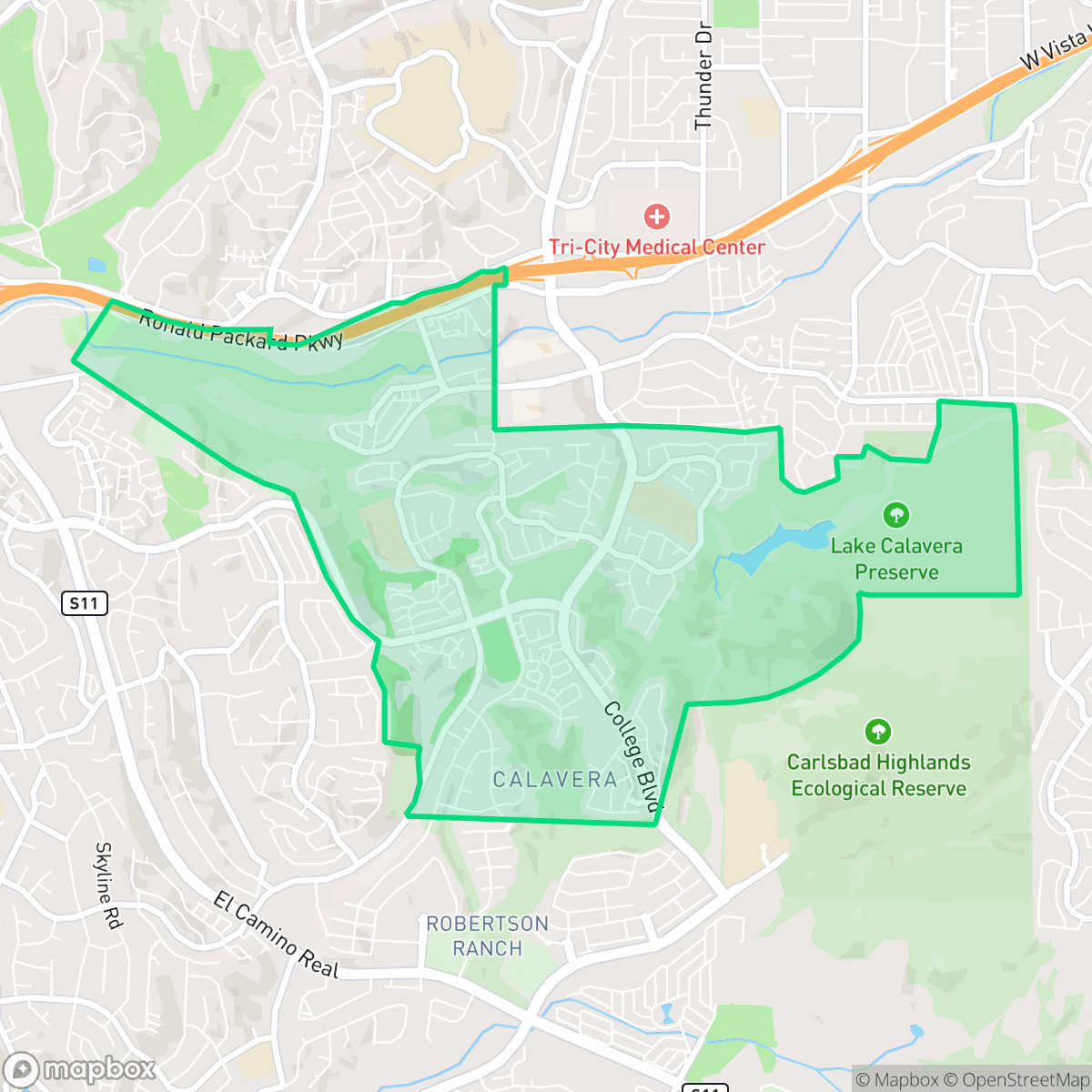
Calavera Hills is a quiet, master-planned community in Carlsbad defined by its proximity to natural landmarks like Mount Calavera and Calavera Lake. The area offers a highly walkable residential environment with expansive green spaces, though it remains primarily a car-dependent neighborhood for commercial needs.
Key Highlights
About Calavera Hills
The Calavera Hills neighborhood of Carlsbad, California, is defined by Mount Calavera (Cerro de la Calavera), a 22-million-year-old volcanic plug that is one of only three in Southern California. In the early 1900s, miners quarried its basaltic core for gravel, which was later used to construct the nearby Calavera Lake earthen dam in 1940. The area's early human history was shaped by prominent local ranching families, including the Marrons, Bordens, and Kellys. In 1896, they established the Calavera School, repurposing a building that originally served as a silkworm cocoonery. Though the school closed in 1919, its legacy is preserved at Calavera Park, which was built on the schoolhouse site in 1987.
The neighborhood is characterized by its affluent, suburban atmosphere, featuring large single-family homes, private pools, and professional landscaping. It maintains a strong connection to nature, with significant canyon buffers and trails that appeal to outdoor enthusiasts and dog owners. While residents enjoy excellent walkability within the residential tracts, the area lacks a dense commercial core, meaning most daily errands require a short drive to nearby business hubs. The environment is generally peaceful, though some parts of the community experience moderate noise levels due to surrounding road traffic.
This community is particularly well-suited for families and professionals who prioritize safety, health, and access to outdoor recreation. The local schools are part of the Carlsbad Unified School District, which provides stable educational options for residents. Prospective homeowners should note that while the area offers high air quality and excellent health insurance coverage, it is located in a region with elevated fire risk, a factor that is common across much of the surrounding coastal geography.
Neighborhood Scores Across 15 Qualities
Residential spacing is consistent with the city average, featuring a mix of detached homes and multi-family units with moderate buffers. Most properties maintain private backyards and standard setbacks between neighbors according to iHuus data.
Continuous sidewalks and well-connected crosswalks link residential cul-de-sacs to nearby commercial shopping centers. This level of pedestrian accessibility is consistent with the average for Carlsbad.
Large homes with professional landscaping and private pools define the area, which offers a visual quality comparable to the rest of Carlsbad. According to iHuus data, the presence of solar panels and well-maintained estates contributes to a polished streetscape.
Abundant grassy verges and nearby natural canyon trails provide ample space for pet owners. Wide sidewalks and interconnected green spaces offer a level of connectivity slightly above the Carlsbad average, according to iHuus data.
Natural hillsides and significant open space characterize this area. According to iHuus data, the landscape offers a balance of undeveloped terrain and residential pockets similar to the broader Carlsbad area.
Residential life here is characterized by a steady, calm pace with a subtle presence of local dining and service hubs. This level of activity is slightly higher than the typical Carlsbad average, offering a balanced mix of greenery and occasional social spots.
Frequent sounds from nearby transit corridors and flight paths contribute to lower acoustic comfort levels compared to the Carlsbad average, according to iHuus data.
Air quality remains consistently good with infrequent periods of elevated readings. This level of air purity is consistent with the average found throughout Carlsbad.
Industrial hazards and warehouses are entirely absent from this area, providing a landscape that is slightly cleaner of heavy industry than the Carlsbad average. The neighborhood consists primarily of residential streets, school zones, and open green spaces.
Health insurance accessibility in Calavera Hills is consistent with the average seen across Carlsbad. According to iHuus data, a significant majority of the local population maintains active coverage.
Political leaning in this area is slightly more liberal than the Carlsbad average. According to iHuus data, the neighborhood maintains a liberal majority with a modest opposing presence.
A balanced mix of young adults, families, and older residents defines the community. According to iHuus data, this demographic spread is closely aligned with the typical age distribution seen throughout Carlsbad.
Properties within this area are located inside a designated floodplain, which indicates a higher risk of flooding compared to the Carlsbad average. According to iHuus data, residents may find that flood insurance is typically required for homes in this zone.
Elevated wildfire hazards exist within this area, representing a significantly higher risk level than the Carlsbad average according to iHuus data.
Address-Level Insights for Calavera Hills


iHuus Neighborhood Intelligence Insights
Get address-level neighborhood insights for Calavera Hills
- Street-level scores — see how individual blocks compare, not just neighborhood averages
- Micro-zone boundaries — identify quiet pockets, flood boundaries, and walkable clusters before you visit
- 15 dimensions in full — walkability, noise, air quality, school quality, insurance coverage, population age profile, urban/rural index, and more
- Boundary risk alerts — know if your address sits near a block boundary where scores drop, the kind of detail no listing will ever mention
- School insights — individual school ratings and insights, not just district-level data
- Compare before you commit — side-by-side data across neighborhoods, down to block precision
No credit card required
Compare with Any Neighborhood
| Dimension | Calavera Hills | Altamira |
|---|---|---|
| 🚶 Walkabilityavg 9 | ||
| 🔊 Acoustic Comfortavg 3.85 | ||
| 🤫 Privacy Indexavg 5.75 | ||
| 🎨 Visual Appealavg 7.84 | ||
| 🐕 Dog Friendlinessavg 8.31 | ||
| 🗺️ Urban-Rural Indexavg 7.17 | ||
| ✨ Neighborhood Vibeavg 4.31 | ||
| 🏥 Health Insurance Coverageavg 8.68 | ||
| 🌿 Air Qualityavg 8.03 | ||
| 🏭 Industrial Proximityavg 9.58 | ||
| 🌊 Flood Safetyavg 5.71 | ||
| 🗳️ Ideological Leanavg 6.42 | ||
| 👥 Population Age Profileavg 5.23 | ||
| 🔥 Fire Safetyavg 0.69 | ||
| 🏫 School Quality |
Calavera Hills Rankings
School Districts Serving Calavera Hills
School Insights for Calavera Hills
Below average outcomes; significant attendance and academic challenges.
School Insights
See what's really behind every school rating near Calavera Hills
- Individual school ratings — each school's own score with outcome context, not just a district average
- Enrollment & class size data — student-to-teacher ratio and how it compares to the state average
- Full demographics breakdown — ethnicity and gender composition for every school in the enrollment zone
- Every school in the district — all schools within the enrollment boundary ranked by rating, not just the closest one
- Grade levels & benchmarks — elementary through high school, with below/above state-average flags
No credit card required