Pruneyard, Campbell
Updated · 317 residents
Pruneyard is defined by its namesake landmark shopping center, offering an exceptionally walkable environment with diverse dining and retail options. While the area provides high levels of convenience and visual appeal, residents must contend with significant noise levels from nearby road traffic.
Key Highlights
About Pruneyard
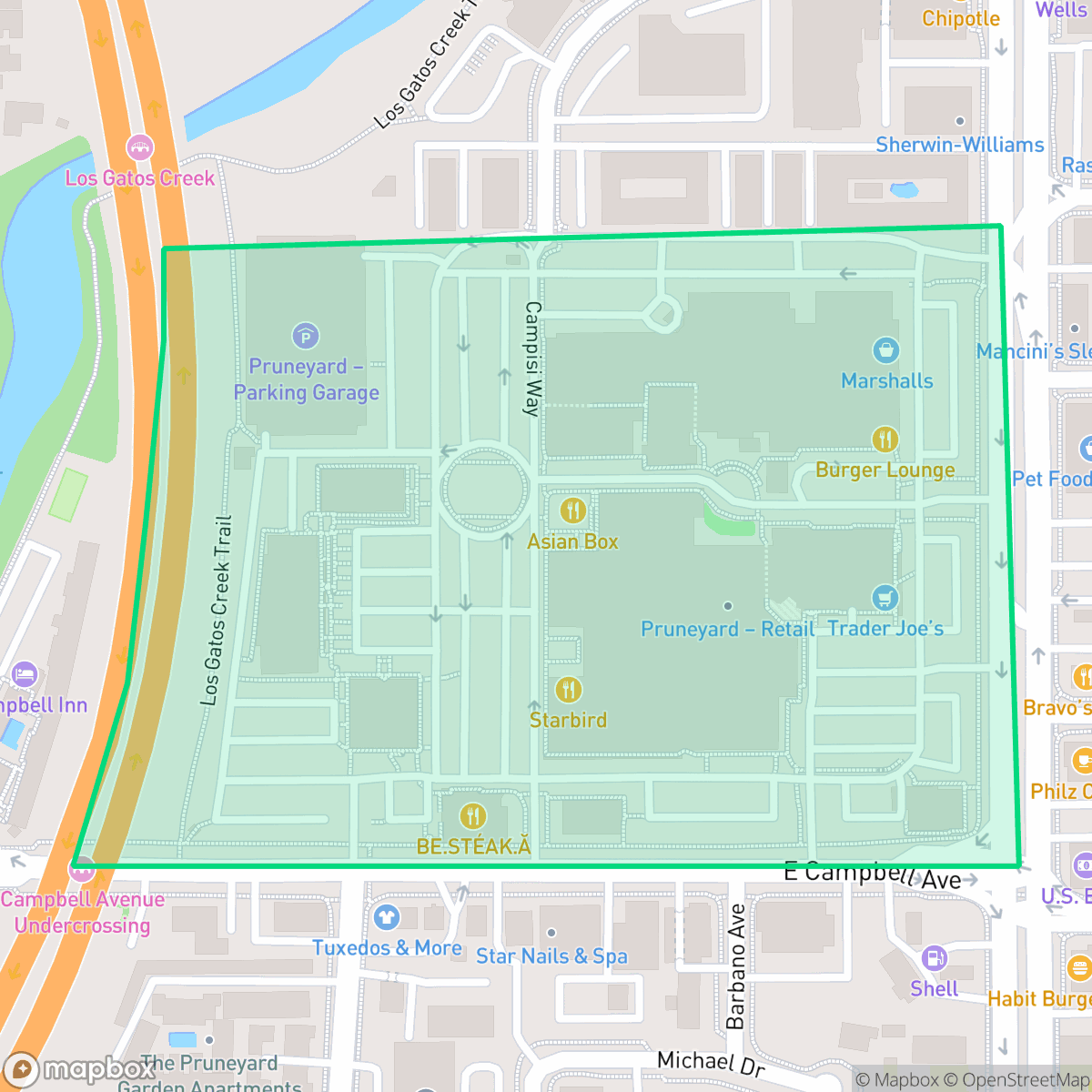
The Pruneyard neighborhood in Campbell, California, is centered around the landmark mixed-use development of the same name. Originally the 27-acre Brynteson Ranch—a sprawling orchard of pears and prunes—the site was purchased in 1968 by developer Fred Sahadi and completed in 1970. Designed in the Mission Revival architectural style, the open-air complex features retail shops, a movie theater, and three prominent office towers, one of which stands as the tallest building in the area outside of downtown San Jose. The neighborhood holds a significant place in American legal history as the site of the landmark 1980 U.S. Supreme Court case Pruneyard Shopping Center v. Robins. This ruling established that the California Constitution protects the right to peacefully exercise free speech in privately owned shopping centers that are open to the public.
The neighborhood functions as a vibrant hub of activity in Campbell, blending a high-density commercial center with accessible suburban streets. It maintains a strong sense of visual appeal and is notably dog-friendly, making it a popular destination for those who prioritize immediate access to amenities. The area is characterized by its blend of light commercial activity and residential spaces, fostering a lively atmosphere that distinguishes it from quieter surrounding districts.
Prospective residents should note that the area experiences elevated noise levels due to its proximity to major roadways, which may impact acoustic comfort. While the neighborhood boasts excellent walkability, it faces challenges regarding flood and fire safety, and the local elementary school district shows a significant performance gap between its campuses. It is best suited for individuals who value a high-energy, pedestrian-friendly lifestyle over absolute quiet or suburban seclusion.
Neighborhood Scores Across 15 Qualities
Building spacing and density are consistent with the average across Campbell. Residents can expect a mix of proximity and buffer between neighboring structures.
Pedestrian infrastructure is exceptional, featuring wide sidewalks and ample crossings that prioritize foot traffic. According to iHuus data, these amenities are slightly above the Campbell average.
Large homes and frequent upscale amenities characterize the area, though overall visual appeal is slightly below the Campbell average according to iHuus data.
Accessible green spaces and wide paths provide safe environments for walking pets. According to iHuus data, the area offers slightly better connectivity for dog owners than the Campbell average.
Open land and scattered homes amid greenery characterize this area. This landscape aligns with the typical urban-rural balance found throughout Campbell.
A high concentration of eateries, cafes, and wellness spots creates a more energetic atmosphere than the typical Campbell neighborhood. According to iHuus data, these lively commercial clusters provide steady local activity alongside suburban green spaces.
Continuous noise from nearby transportation infrastructure is a primary feature of this area. According to iHuus data, acoustic comfort is significantly lower than the average found throughout Campbell.
Air quality levels in this area fluctuate between acceptable and unhealthy, presenting occasional concerns for sensitive groups. This falls slightly below the average for Campbell, according to iHuus data.
Heavy industrial activity is absent from this area, which consists primarily of residential zones and light commercial use. According to iHuus data, the neighborhood contains slightly more commercial density than the typical Campbell area, though no industrial hazards are present.
Health insurance coverage among residents is high, though slightly lower than the Campbell average, according to iHuus data.
Voting patterns and census indicators reflect a deeply liberal political leaning that is consistent with the broader Campbell area.
Residents live alongside a balanced mix of young professionals, families, and seniors. This demographic spread is very similar to the broader Campbell area, according to iHuus data.
Significant flood risk exists here as the area sits within a designated 100-year floodplain. According to iHuus data, this risk level is notably higher than the average for Campbell.
Address-Level Insights for Pruneyard


iHuus Neighborhood Intelligence Insights
Get address-level neighborhood insights for Pruneyard
- Street-level scores — see how individual blocks compare, not just neighborhood averages
- Micro-zone boundaries — identify quiet pockets, flood boundaries, and walkable clusters before you visit
- 15 dimensions in full — walkability, noise, air quality, school quality, insurance coverage, population age profile, urban/rural index, and more
- Boundary risk alerts — know if your address sits near a block boundary where scores drop, the kind of detail no listing will ever mention
- School insights — individual school ratings and insights, not just district-level data
- Compare before you commit — side-by-side data across neighborhoods, down to block precision
No credit card required
Compare with Any Neighborhood
| Dimension | Pruneyard | Central Campbell |
|---|---|---|
| 🚶 Walkabilityavg 9.39 | ||
| 🔊 Acoustic Comfortavg 2.69 | ||
| 🤫 Privacy Indexavg 5.5 | ||
| 🎨 Visual Appealavg 6.95 | ||
| 🐕 Dog Friendlinessavg 6.61 | ||
| 🗺️ Urban-Rural Indexavg 6.55 | ||
| ✨ Neighborhood Vibeavg 4.74 | ||
| 🏥 Health Insurance Coverageavg 8.18 | ||
| 🌿 Air Qualityavg 6.6 | ||
| 🏭 Industrial Proximityavg 8.86 | ||
| 🌊 Flood Safetyavg 2.68 | ||
| 🗳️ Ideological Leanavg 9.51 | ||
| 👥 Population Age Profileavg 4.93 | ||
| 🔥 Fire Safety | ||
| 🏫 School Quality |
Pruneyard Rankings
School Districts Serving Pruneyard
School Insights for Pruneyard
Below average outcomes; significant attendance and academic challenges.
School Insights
See what's really behind every school rating near Pruneyard
- Individual school ratings — each school's own score with outcome context, not just a district average
- Enrollment & class size data — student-to-teacher ratio and how it compares to the state average
- Full demographics breakdown — ethnicity and gender composition for every school in the enrollment zone
- Every school in the district — all schools within the enrollment boundary ranked by rating, not just the closest one
- Grade levels & benchmarks — elementary through high school, with below/above state-average flags
No credit card required