Rancho, Burbank
Updated · 2,851 residents
The Rancho is a distinct equestrian enclave in Burbank known for its grid-patterned streets and exceptional walkability. Residents enjoy a quiet, suburban atmosphere defined by well-manicured properties and direct access to the Griffith Park trail system.
Key Highlights
About Rancho
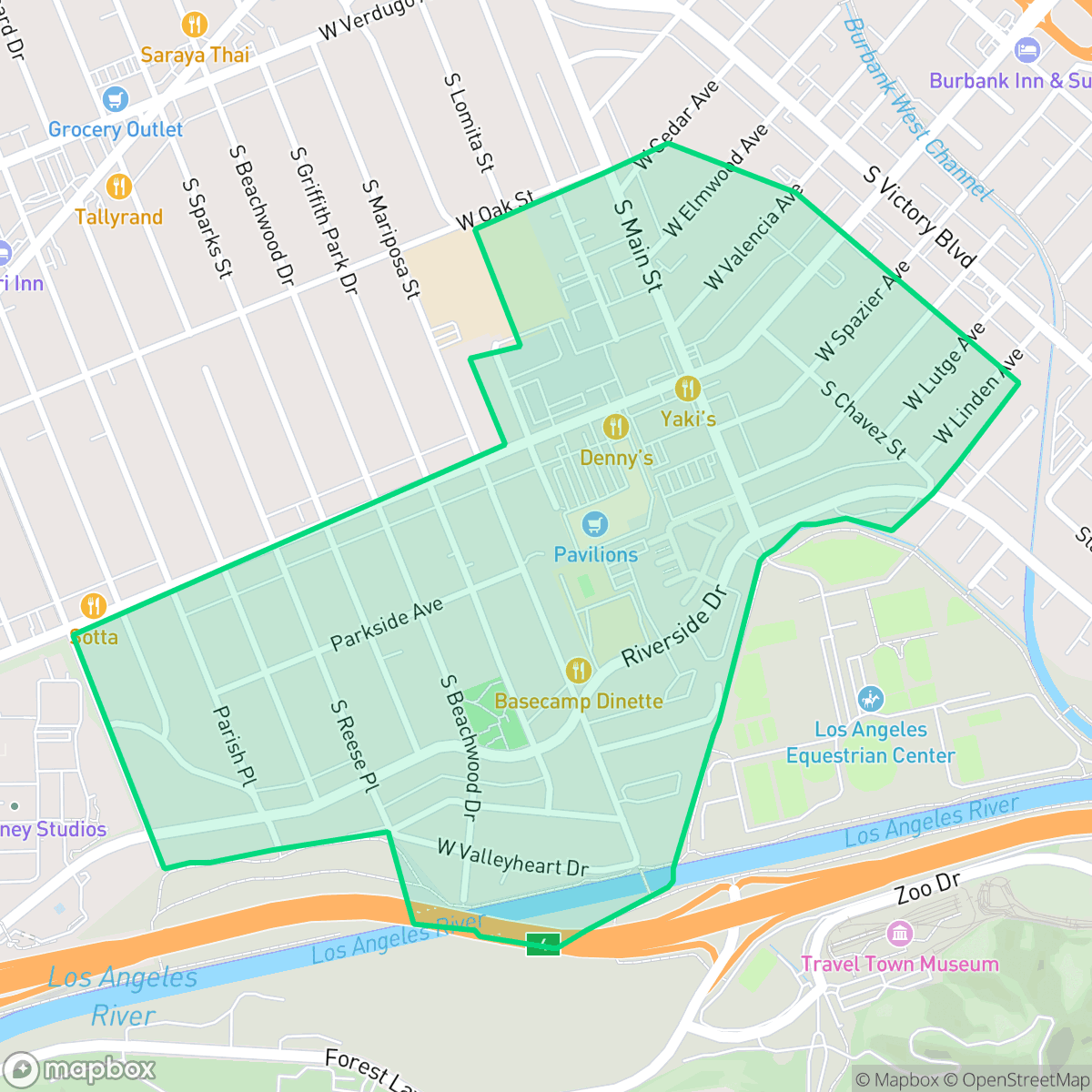
The Burbank Rancho neighborhood is a historic equestrian enclave in Burbank, California, taking its name from the 19th-century Rancho San Rafael and Rancho Providencia land grants. Situated along the Los Angeles River, the Rancho is a rare surviving center of urban equestrianism and the only neighborhood in Burbank that permits residential horse keeping, a practice officially codified in 1950. Its equestrian lifestyle was historically sustained by its proximity to major film studios and the Western movies shot in neighboring Griffith Park. A key local landmark is the historic Mariposa Street Bridge. Built in 1939 and listed on the National Register of Historic Places in 2024, the bridge connects the neighborhood’s riders directly to the extensive trail network of Griffith Park.
The area maintains a unique balance between residential comfort and light industrial utility, characterized by its grid layout and high visual appeal. With a walkability score that stands out in the region, the neighborhood features consistent sidewalks and easy access to local amenities. While the environment is largely quiet, residents are situated near commercial zones, which provide a practical mix of dining and services.
Prospective residents should consider that while the neighborhood offers a high standard of living, it is subject to moderate road traffic noise. Families may look toward the nearby William McKinley Elementary, which holds a strong rating, while navigating the broader educational landscape of the Glendale and Burbank school districts. Given the local climate and infrastructure, fire safety remains a significant consideration for homeowners in this part of Southern California.
Neighborhood Scores Across 15 Qualities
Residential spacing is comparable to the Burbank average, featuring a mix of detached homes with moderate setbacks and more densely packed structures near industrial zones. Backyard fencing and varying distances between neighbors provide a standard level of separation between properties.
Continuous sidewalks and marked crosswalks define much of the street network, offering a level of pedestrian connectivity that is slightly above the Burbank average. While the grid is well-connected, proximity to industrial zones and the major highway can impact walking comfort in certain sections.
Large homes on well-maintained lots and a high frequency of private backyard pools make this area more visually appealing than the Burbank average. According to iHuus data, the neighborhood features many manicured properties and spacious driveways.
Access to public parks and wide green verges is below the Burbank average. While some areas feature a central park with baseball fields, much of the neighborhood consists of narrow sidewalk verges and private backyards.
Residential grids and green spaces are balanced with commercial and light industrial blocks. This layout provides a typical suburban experience that is very similar to the Burbank city average, according to iHuus data.
Suburban streets and light industrial pockets provide a calm atmosphere, though the area is less active than the Burbank average. Most daily needs require a vehicle, as local dining and services are interspersed with warehouses and significant green space.
Persistent noise from nearby freeways and railroad tracks characterizes this area. While more disruptive than the Burbank average, iHuus data indicates the level of acoustic disturbance remains lower than many other heavily trafficked sectors of the city.
Air quality remains generally good with rare instances of elevated readings. According to iHuus data, the air quality in this area is slightly better than the Burbank average.
Light industrial and warehouse facilities are interspersed with residential areas, resulting in a higher presence of commercial activity than the Burbank average. While some pockets remain purely residential, proximity to large-scale warehouses and a major highway interchange can introduce increased traffic and noise.
Health insurance accessibility is notably higher in Rancho than in the rest of Burbank, according to iHuus data. Most residents in this area have access to comprehensive medical coverage.
Voting patterns and census indicators reflect a predominantly liberal political leaning, which is very similar to the broader Burbank area according to iHuus data.
A balanced mix of young adults, families, and older residents characterizes this area. According to iHuus data, this demographic spread is more varied than the average across Burbank.
Flood risk levels for this area remain uncertain because FEMA has not yet completed a detailed study of the neighborhood. According to iHuus data, the risk level is consistent with the average found throughout Burbank.
Fire safety risks in this area are consistent with the average levels found throughout Burbank. According to iHuus data, there are no notable deviations in fire safety performance compared to the rest of the city.
Address-Level Insights for Rancho


iHuus Neighborhood Intelligence Insights
Get address-level neighborhood insights for Rancho
- Street-level scores — see how individual blocks compare, not just neighborhood averages
- Micro-zone boundaries — identify quiet pockets, flood boundaries, and walkable clusters before you visit
- 15 dimensions in full — walkability, noise, air quality, school quality, insurance coverage, population age profile, urban/rural index, and more
- Boundary risk alerts — know if your address sits near a block boundary where scores drop, the kind of detail no listing will ever mention
- School insights — individual school ratings and insights, not just district-level data
- Compare before you commit — side-by-side data across neighborhoods, down to block precision
No credit card required
Compare with Any Neighborhood
| Dimension | Rancho | Burbank Center |
|---|---|---|
| 🚶 Walkabilityavg 8.7 | ||
| 🔊 Acoustic Comfortavg 0.94 | ||
| 🤫 Privacy Indexavg 4.91 | ||
| 🎨 Visual Appealavg 6 | ||
| 🐕 Dog Friendlinessavg 6.08 | ||
| 🗺️ Urban-Rural Indexavg 6.12 | ||
| ✨ Neighborhood Vibeavg 5.05 | ||
| 🏥 Health Insurance Coverageavg 6.28 | ||
| 🌿 Air Qualityavg 6 | ||
| 🏭 Industrial Proximityavg 8.15 | ||
| 🌊 Flood Safety | ||
| 🗳️ Ideological Leanavg 9.8 | ||
| 👥 Population Age Profileavg 4.59 | ||
| 🔥 Fire Safety | ||
| 🏫 School Quality |
Rancho Rankings
School Districts Serving Rancho
School Insights for Rancho
Below average outcomes; significant attendance and academic challenges.
School Insights
See what's really behind every school rating near Rancho
- Individual school ratings — each school's own score with outcome context, not just a district average
- Enrollment & class size data — student-to-teacher ratio and how it compares to the state average
- Full demographics breakdown — ethnicity and gender composition for every school in the enrollment zone
- Every school in the district — all schools within the enrollment boundary ranked by rating, not just the closest one
- Grade levels & benchmarks — elementary through high school, with below/above state-average flags
No credit card required