Lakeview, Bakersfield
Updated · 12,667 residents
Lakeview is a dense, grid-based neighborhood in Bakersfield characterized by its tight residential spacing and proximity to industrial and logistics hubs. While it offers a quiet suburban atmosphere with diverse local dining, residents face challenges regarding privacy and high traffic noise from nearby arterial roads.
Key Highlights
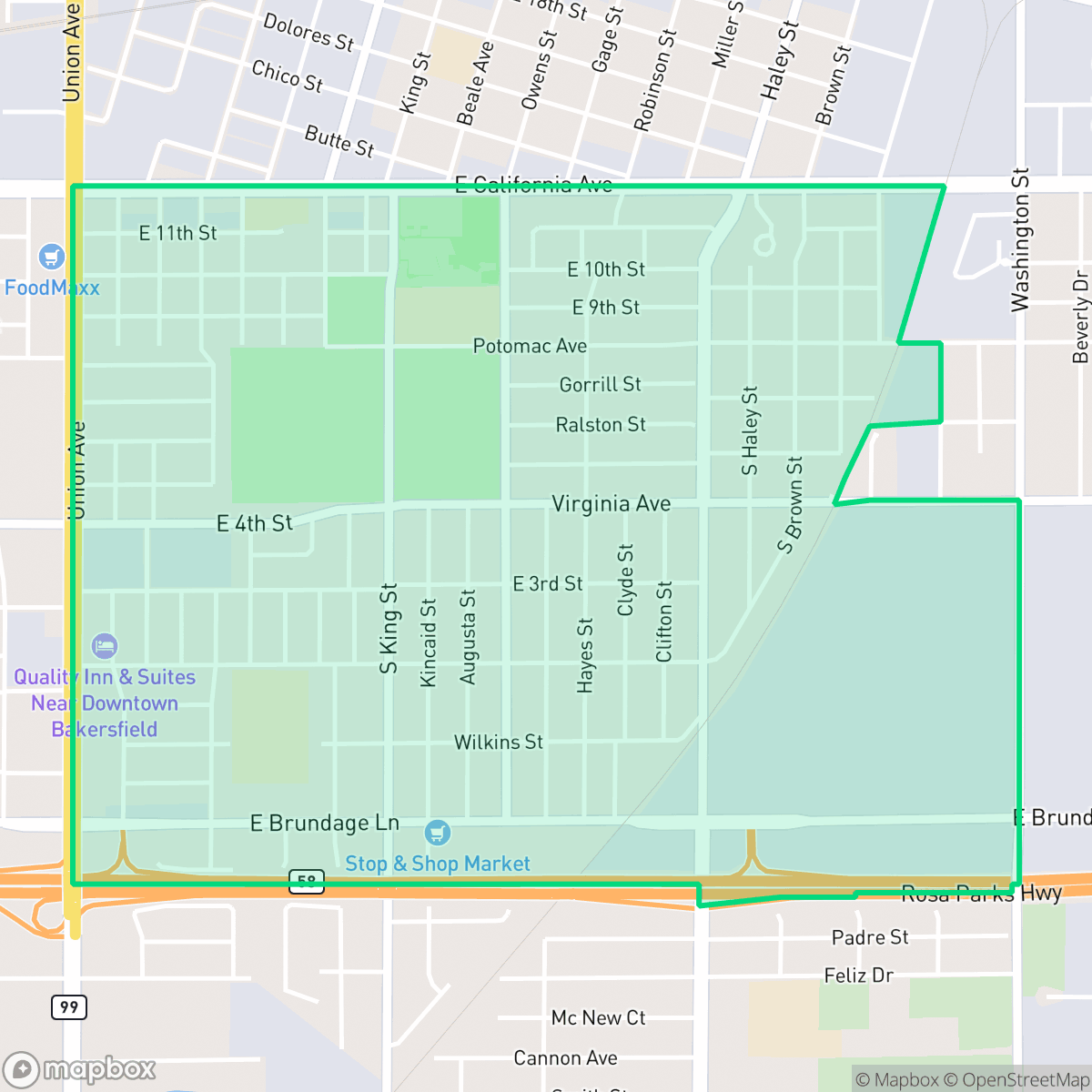
About Lakeview
Historically situated within the Sunset Mayflower District of Southeast Bakersfield, the Lakeview neighborhood is anchored by Lakeview Avenue (now Dr. Martin Luther King, Jr. Boulevard). In the 1930s, pioneering Black business owner Russell D. Grimes Sr. successfully petitioned to rename the thoroughfare from Cottonwood Road. From the 1940s through the 1970s, the area evolved into a vital cultural and musical hub for Bakersfield's African American community. This gave rise to the "Lakeview Sound," a vibrant blues, soul, and jazz counterpart to the city's famous country music scene. Operating as a key stop on the Chitlin' Circuit, local juke joints like the Cotton Club and the Delwood Club hosted legendary performers including B.B. King, Etta James, and Little Richard. Today, this rich heritage is commemorated at the neighborhood's Sunset Mayflower Park.
The area functions as a dense, low-rise residential grid that integrates single-family homes with light industrial and logistics facilities. The layout features a consistent sidewalk network, though pedestrian movement is often constrained by major highways and large-scale industrial blocks. According to iHuus data, the neighborhood maintains a calm, suburban rhythm where residents have access to local services and diverse restaurants, though the overall environment is marked by high-density housing with limited private outdoor space. The neighborhood serves as a functional, no-frills residential area that remains closely tied to the city's broader industrial landscape.
Prospective residents should note that the neighborhood presents specific trade-offs regarding environmental and structural factors. The area experiences elevated noise levels primarily from road traffic, and the housing stock consists largely of compact tract homes with minimal setbacks. While the neighborhood benefits from decent air quality, iHuus analysis indicates significant concerns regarding flood and fire safety, as well as lower rates of health insurance coverage. It is best suited for those prioritizing proximity to local employment centers and a straightforward residential environment.
Neighborhood Scores Across 15 Qualities
Residential spacing varies across the area, featuring both tightly packed clusters and sections with more open distance between homes. According to iHuus data, privacy levels are slightly lower than the Bakersfield average due to several high-density blocks where houses sit very close to one another.
Sidewalks are widely available for pedestrian access, though heavy industrial traffic and major highway proximity make walking less comfortable than in other parts of Bakersfield. According to iHuus data, high-speed intersections and industrial blocks can occasionally interrupt a continuous walking path.
Uniform, high-density tract housing dominates the landscape, featuring small lots and minimal greenery. According to iHuus data, the area lacks the lush yards and diverse architectural features found more frequently across Bakersfield.
Public green space is primarily concentrated around a large central park and cemetery, though residential sidewalks often lack wide verges or greenery. Walking conditions for dogs are below the Bakersfield average due to narrow paths and fragmented vegetation near high-traffic roads.
Frequent open land and scattered homes amid fields characterize this area, which is very similar to the broader Bakersfield landscape according to iHuus data.
A low level of activity defines this area, which primarily functions as a quiet, industrial-suburban zone with limited social density. While some dining options exist, the neighborhood is less lively than the Bakersfield average and relies heavily on vehicle travel for most errands.
Frequent noise from nearby freeways and railroad tracks characterizes the area. This level of acoustic disturbance is higher than the Bakersfield average, according to iHuus data.
Air quality remains mostly clear with only infrequent periods of higher readings, though it is slightly lower than the Bakersfield average according to iHuus data.
Active commercial zones and light industrial units exist alongside residential streets, making this area less industrial than the Bakersfield average. While large-scale heavy industry is absent, residents may encounter daytime commercial traffic and warehouse-related activity in certain sectors.
Health insurance coverage among residents is notably lower than the Bakersfield average, according to iHuus data.
Voting patterns and census indicators in Lakeview show a much more liberal leaning than the Bakersfield average, according to iHuus data.
Residents live alongside a varied demographic of young adults, families, and seniors. According to iHuus data, this age distribution is slightly lower than the Bakersfield average, indicating a less concentrated population of any single age group.
Significant flood hazards exist in this area, placing it well above the Bakersfield average for risk. Residents should anticipate elevated or potentially prohibitive flood insurance costs according to iHuus data.
Address-Level Insights for Lakeview


iHuus Neighborhood Intelligence Insights
Get address-level neighborhood insights for Lakeview
- Street-level scores — see how individual blocks compare, not just neighborhood averages
- Micro-zone boundaries — identify quiet pockets, flood boundaries, and walkable clusters before you visit
- 15 dimensions in full — walkability, noise, air quality, school quality, insurance coverage, population age profile, urban/rural index, and more
- Boundary risk alerts — know if your address sits near a block boundary where scores drop, the kind of detail no listing will ever mention
- School insights — individual school ratings and insights, not just district-level data
- Compare before you commit — side-by-side data across neighborhoods, down to block precision
No credit card required
Compare with Any Neighborhood
| Dimension | Lakeview | Amberton |
|---|---|---|
| 🚶 Walkabilityavg 8.36 | ||
| 🔊 Acoustic Comfortavg 3.78 | ||
| 🤫 Privacy Indexavg 5.57 | ||
| 🎨 Visual Appealavg 6.61 | ||
| 🐕 Dog Friendlinessavg 6.03 | ||
| 🗺️ Urban-Rural Indexavg 6.87 | ||
| ✨ Neighborhood Vibeavg 4.25 | ||
| 🏥 Health Insurance Coverageavg 6.62 | ||
| 🌿 Air Qualityavg 8.49 | ||
| 🏭 Industrial Proximityavg 8.26 | ||
| 🌊 Flood Safetyavg 3.54 | ||
| 🗳️ Ideological Leanavg 5.07 | ||
| 👥 Population Age Profileavg 4.44 | ||
| 🔥 Fire Safetyavg 0.11 | ||
| 🏫 School Quality |
Lakeview Rankings
School Districts Serving Lakeview
School Insights for Lakeview
Below average outcomes; significant attendance and academic challenges.
School Insights
See what's really behind every school rating near Lakeview
- Individual school ratings — each school's own score with outcome context, not just a district average
- Enrollment & class size data — student-to-teacher ratio and how it compares to the state average
- Full demographics breakdown — ethnicity and gender composition for every school in the enrollment zone
- Every school in the district — all schools within the enrollment boundary ranked by rating, not just the closest one
- Grade levels & benchmarks — elementary through high school, with below/above state-average flags
No credit card required