West Anaheim, Anaheim
Updated · 73,309 residents
West Anaheim is a culturally diverse neighborhood known for its unique Arab-American business district and accessible suburban layout. Residents benefit from a highly walkable street grid, though the area is characterized by dense housing and notable traffic noise.
Key Highlights
About West Anaheim
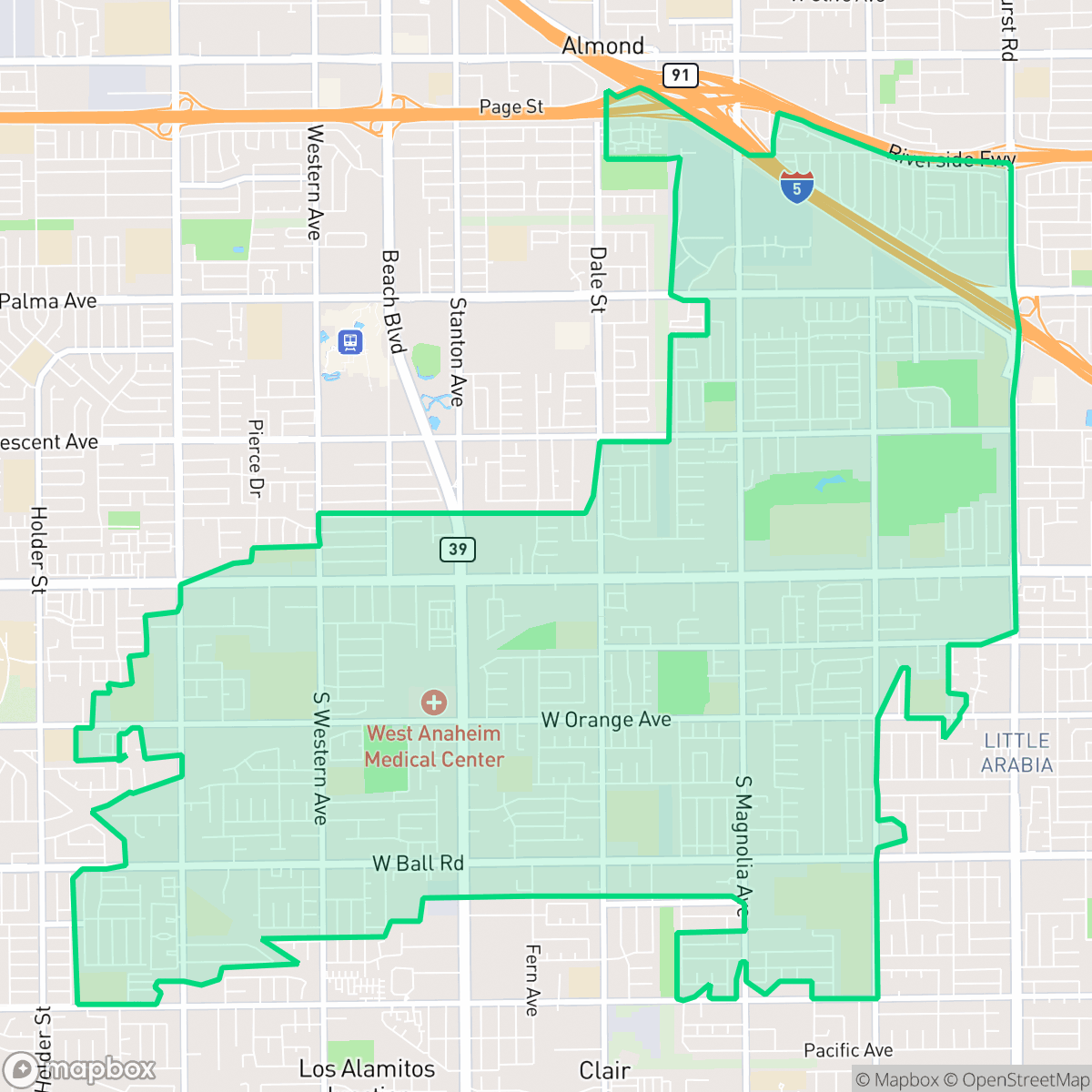
West Anaheim, extending from Euclid Street west to the Cypress border, originated as a 19th-century farming community settled by Midwestern, German, and Dutch immigrants. Initially known by names like Loara, Manchester, and Fairview, the area was anchored by agricultural operations, orange groves, and Benjamin F. Kellogg’s 1869 Fairview settlement. In 1875, the Southern Pacific Railroad built its first local depot here, later renamed the West Anaheim Station. The neighborhood underwent a dramatic transformation following the 1955 opening of nearby Disneyland, which triggered a massive population boom and rapid suburbanization as orange groves were cleared for mid-century tract housing. Today, West Anaheim is culturally diverse, home to the "Little Gaza" Arab-American business district, the Adventure City amusement park, and Western High School, famously attended by golfer Tiger Woods.
This neighborhood serves as a dense, residential hub defined by its diverse cultural landscape and consistent suburban infrastructure. The area features a comprehensive sidewalk network that makes daily navigation on foot convenient, connecting residents to local parks and various dining spots. Its architectural character is primarily composed of mid-century tract housing and multi-family apartment complexes, creating a high-density environment that fosters a steady, community-focused rhythm.
Prospective residents should consider that the neighborhood experiences significant road traffic noise, which impacts acoustic comfort. While the area offers excellent access to local amenities and schools, the high-density development results in limited private outdoor space for many properties. It is well-suited for individuals who prioritize walkability and cultural variety over quiet, secluded living, though families should research specific school attendance zones due to performance variances in the local districts.
Neighborhood Scores Across 15 Qualities
Housing layouts vary from shared-wall apartment complexes to closely spaced single-family homes, resulting in a privacy level that is roughly in line with the city average.
Extensive sidewalk networks and clear pedestrian crossings are available on both residential and arterial streets. According to iHuus data, the area offers superior connectivity for pedestrians compared to the Anaheim average.
Uniform tract housing and apartment complexes define the landscape, offering a consistent but modest visual environment. According to iHuus data, the area features slightly less visual variety than the broader Anaheim average.
Access to large public parks and greenway trails provides reliable space for dog walking. According to iHuus data, the availability of green space for pets is slightly above the city average.
Residential layouts consist of a mix of single-family homes, multi-story apartment complexes, and commercial zones. This level of suburban density is consistent with the city average for Anaheim.
A steady rhythm of residential life and dining exists alongside industrial pockets, though activity levels are roughly in line with the rest of Anaheim. Most areas remain calm and suburban, often requiring a car for errands as many local businesses are not within walking distance.
Frequent noise from nearby freeways and railroad tracks characterizes this area. According to iHuus data, acoustic comfort in West Anaheim is consistent with the city average.
Air quality remains mostly clean with rare instances of elevated readings. According to iHuus data, the air quality in this area is slightly lower than the city average.
Residents can expect a primarily residential environment with very few heavy industrial hazards or large warehouses. This lack of significant industrial activity is slightly better than the city average for Anaheim.
Health insurance coverage levels in this area are nearly consistent with the broader Anaheim average, according to iHuus data.
Political leanings in this area trend more liberal than the Anaheim average. According to iHuus data, the neighborhood contains a liberal majority with a modest opposing presence.
Residents live alongside a balanced mix of young adults, families, and older individuals. This demographic distribution is consistent with the broader Anaheim area according to iHuus data.
Significant flood hazards exist in this area, which is notably higher than the city average. Residents should anticipate elevated or potentially prohibitive flood insurance costs according to iHuus data.
Address-Level Insights for West Anaheim


iHuus Neighborhood Intelligence Insights
Get address-level neighborhood insights for West Anaheim
- Street-level scores — see how individual blocks compare, not just neighborhood averages
- Micro-zone boundaries — identify quiet pockets, flood boundaries, and walkable clusters before you visit
- 15 dimensions in full — walkability, noise, air quality, school quality, insurance coverage, population age profile, urban/rural index, and more
- Boundary risk alerts — know if your address sits near a block boundary where scores drop, the kind of detail no listing will ever mention
- School insights — individual school ratings and insights, not just district-level data
- Compare before you commit — side-by-side data across neighborhoods, down to block precision
No credit card required
Compare with Any Neighborhood
| Dimension | West Anaheim | Anaheim Hills |
|---|---|---|
| 🚶 Walkabilityavg 8.73 | ||
| 🔊 Acoustic Comfortavg 2.38 | ||
| 🤫 Privacy Indexavg 4.69 | ||
| 🎨 Visual Appealavg 6.56 | ||
| 🐕 Dog Friendlinessavg 5.82 | ||
| 🗺️ Urban-Rural Indexavg 6.49 | ||
| ✨ Neighborhood Vibeavg 4.29 | ||
| 🏥 Health Insurance Coverageavg 6.54 | ||
| 🌿 Air Qualityavg 8.7 | ||
| 🏭 Industrial Proximityavg 8.17 | ||
| 🌊 Flood Safetyavg 2.02 | ||
| 🗳️ Ideological Leanavg 7.03 | ||
| 👥 Population Age Profileavg 4.79 | ||
| 🔥 Fire Safetyavg 0.06 | ||
| 🏫 School Quality |
West Anaheim Rankings
School Districts Serving West Anaheim
School Insights for West Anaheim
Below average outcomes; significant attendance and academic challenges.
School Insights
See what's really behind every school rating near West Anaheim
- Individual school ratings — each school's own score with outcome context, not just a district average
- Enrollment & class size data — student-to-teacher ratio and how it compares to the state average
- Full demographics breakdown — ethnicity and gender composition for every school in the enrollment zone
- Every school in the district — all schools within the enrollment boundary ranked by rating, not just the closest one
- Grade levels & benchmarks — elementary through high school, with below/above state-average flags
No credit card required