Southwest Anaheim, Anaheim
Updated · 48,208 residents
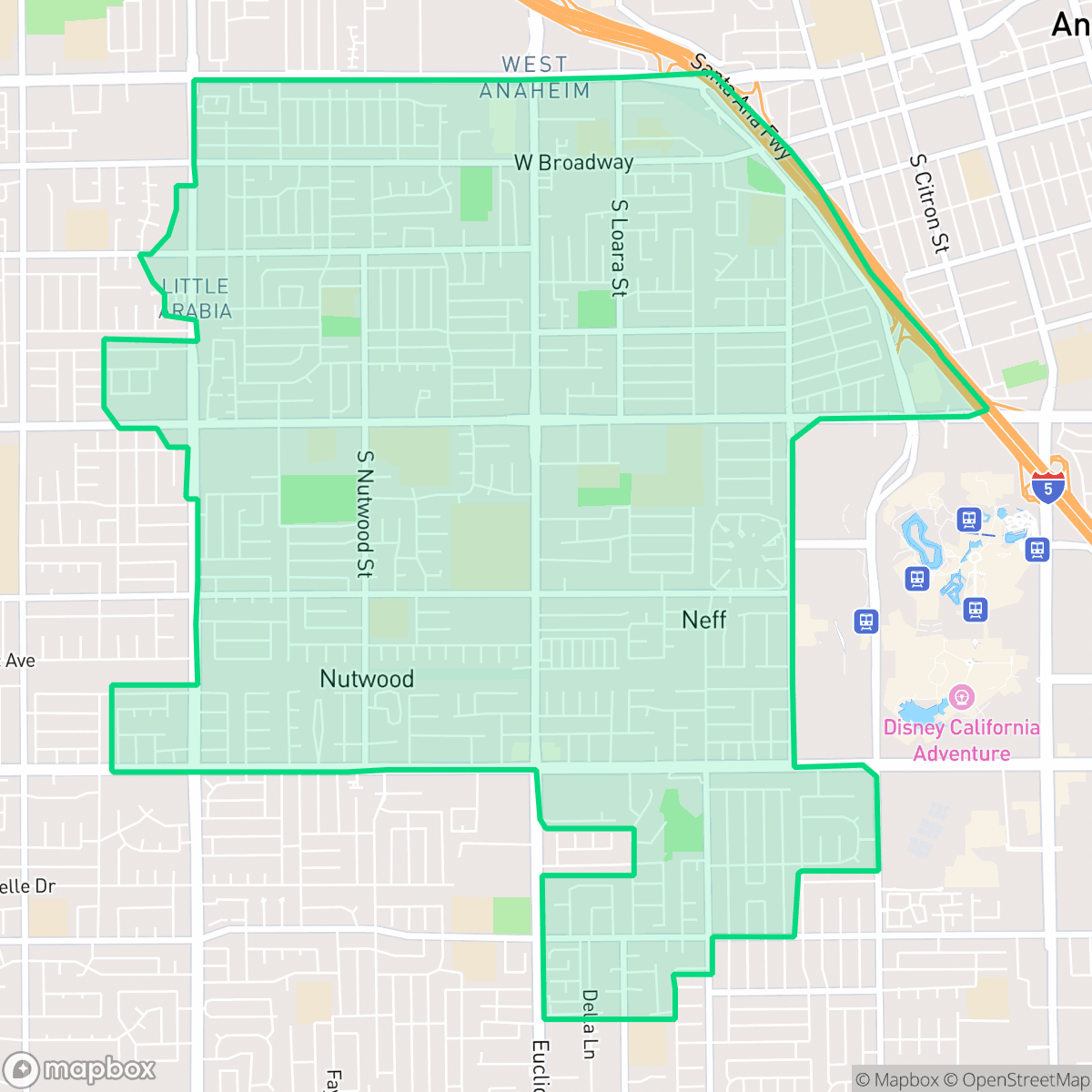
Southwest Anaheim is a vibrant, culturally diverse community known for its dense suburban layout and the bustling commercial corridor of Little Arabia along Brookhurst Street. While the area offers high walkability and convenient access to local landmarks, residents experience a high-density living environment with significant road noise. According to iHuus data, the neighborhood provides a unique mix of mid-century residential character and active, multi-cultural commercial hubs.
Key Highlights
About Southwest Anaheim
Southwest Anaheim, historically known as "Anaheim Island," consists of unincorporated pockets of Orange County land that were bypassed during mid-20th-century municipal annexations. Residential development in the neighborhood surged in the 1950s, spurred by the opening of Disneyland, which included the 171-home "House and Garden Homes" tract built by Tobin Developers in 1955. By the 1990s, the neighborhood's cultural identity underwent a major transformation with a significant influx of Arab immigrants. They established a thriving commercial corridor of Middle Eastern markets, cafes, and restaurants along Brookhurst Street, earning the business district the moniker "Little Gaza" (now widely recognized as Little Arabia). Today, Southwest Anaheim is a highly diverse community that is also home to local family-friendly landmarks like Modjeska Park and the Adventure City theme park.
The neighborhood is characterized by a dense suburban fabric that blends single-family residential tracts with mid-sized apartment complexes and commercial zones. Its layout is highly walkable, featuring a consistent network of sidewalks that connect residents to local amenities, diverse dining options, and public spaces like Modjeska Park. The area maintains a distinct urban energy, particularly along its major thoroughfares where light industrial units and commercial plazas contribute to a lively, if busy, atmosphere. The cultural identity of the region is anchored by the thriving businesses of Little Arabia, which serve as a central social and economic hub for the community.
Prospective residents should consider that the area presents specific livability trade-offs, particularly regarding acoustic comfort and residential privacy. Due to the high-density nature of the housing and proximity to major roadways, noise levels are elevated compared to the city average. Furthermore, the local school landscape is varied, ranging from high-performing districts like Garden Grove to campuses facing significant academic challenges, making it essential for families to research specific attendance zones. The neighborhood is best suited for those who prioritize cultural vibrancy, accessibility to local services, and a connected, urban-suburban lifestyle over the seclusion of traditional, low-density residential developments, as noted in iHuus analysis.
Neighborhood Scores Across 15 Qualities
Residential spacing varies from shared walls in apartment complexes to detached homes with small yards. This level of density is slightly higher than the city average, resulting in limited buffers between many neighboring structures.
Continuous sidewalks and marked crosswalks are present on both residential and arterial streets, making this area more pedestrian-friendly than the Anaheim average. While a major highway interchange creates a notable barrier for movement, the internal street grid remains highly connected for those on foot.
Well-maintained properties and a high frequency of private backyard pools create a polished appearance that is consistent with the city average. Many residential streets feature uniform landscaping and large homes, contributing to a stable and aesthetically pleasing environment.
Access to public parks and grassy sidewalk verges for walking is slightly below the city average. While many areas feature large central parks and continuous sidewalks, other pockets of the neighborhood rely primarily on private backyards for greenery.
Residential blocks feature a consistent suburban layout with a mix of single-family homes, multi-family complexes, and commercial plazas. This landscape is largely consistent with the typical density found across Anaheim.
Diverse dining and local services provide a balanced energy that is more active than the city average. Residents experience a steady mix of quiet residential pockets and lively social hubs, though accessibility varies depending on proximity to major transit corridors.
Frequent noise from nearby freeways and railroad tracks characterizes this area, resulting in acoustic levels that are slightly higher than the Anaheim average. According to iHuus data, residents may experience consistent ambient sounds from heavy transit corridors.
Air quality in this area is generally good with only rare instances of elevated readings. According to iHuus data, the air quality is slightly lower than the average for the wider city.
Residential and light commercial uses dominate the area, with very little heavy industry or large-scale warehousing. This level of industrial proximity is roughly in line with the city average according to iHuus data.
Health insurance access is relatively high in this area, performing slightly above the Anaheim city average according to iHuus data.
Political leanings in this area skew liberal, appearing slightly more progressive than the Anaheim average according to iHuus data.
Residents live alongside a balanced variety of young adults, families, and older populations. This age distribution is largely consistent with the broader Anaheim area, according to iHuus data.
Significant flood risk exists here due to being in a coastal high-hazard zone with potential wave action. Residents should prepare for elevated or prohibitive insurance costs, as the risk level is notably higher than the Anaheim average.
Address-Level Insights for Southwest Anaheim


iHuus Neighborhood Intelligence Insights
Get address-level neighborhood insights for Southwest Anaheim
- Street-level scores — see how individual blocks compare, not just neighborhood averages
- Micro-zone boundaries — identify quiet pockets, flood boundaries, and walkable clusters before you visit
- 15 dimensions in full — walkability, noise, air quality, school quality, insurance coverage, population age profile, urban/rural index, and more
- Boundary risk alerts — know if your address sits near a block boundary where scores drop, the kind of detail no listing will ever mention
- School insights — individual school ratings and insights, not just district-level data
- Compare before you commit — side-by-side data across neighborhoods, down to block precision
No credit card required
Compare with Any Neighborhood
| Dimension | Southwest Anaheim | Anaheim Hills |
|---|---|---|
| 🚶 Walkabilityavg 8.73 | ||
| 🔊 Acoustic Comfortavg 2.38 | ||
| 🤫 Privacy Indexavg 4.69 | ||
| 🎨 Visual Appealavg 6.56 | ||
| 🐕 Dog Friendlinessavg 5.82 | ||
| 🗺️ Urban-Rural Indexavg 6.49 | ||
| ✨ Neighborhood Vibeavg 4.29 | ||
| 🏥 Health Insurance Coverageavg 6.54 | ||
| 🌿 Air Qualityavg 8.7 | ||
| 🏭 Industrial Proximityavg 8.17 | ||
| 🌊 Flood Safetyavg 2.02 | ||
| 🗳️ Ideological Leanavg 7.03 | ||
| 👥 Population Age Profileavg 4.79 | ||
| 🔥 Fire Safetyavg 0.06 | ||
| 🏫 School Quality |
Southwest Anaheim Rankings
School Districts Serving Southwest Anaheim
School Insights for Southwest Anaheim
Below average outcomes; significant attendance and academic challenges.
School Insights
See what's really behind every school rating near Southwest Anaheim
- Individual school ratings — each school's own score with outcome context, not just a district average
- Enrollment & class size data — student-to-teacher ratio and how it compares to the state average
- Full demographics breakdown — ethnicity and gender composition for every school in the enrollment zone
- Every school in the district — all schools within the enrollment boundary ranked by rating, not just the closest one
- Grade levels & benchmarks — elementary through high school, with below/above state-average flags
No credit card required