Northwest Anaheim, Anaheim
Updated · 31,690 residents
Northwest Anaheim is a dense suburban community defined by its mid-century residential character and the historic La Palma Park. While the area offers a consistent sidewalk network, residents should expect notable noise levels from nearby highway infrastructure and high-density housing layouts.
Key Highlights
About Northwest Anaheim
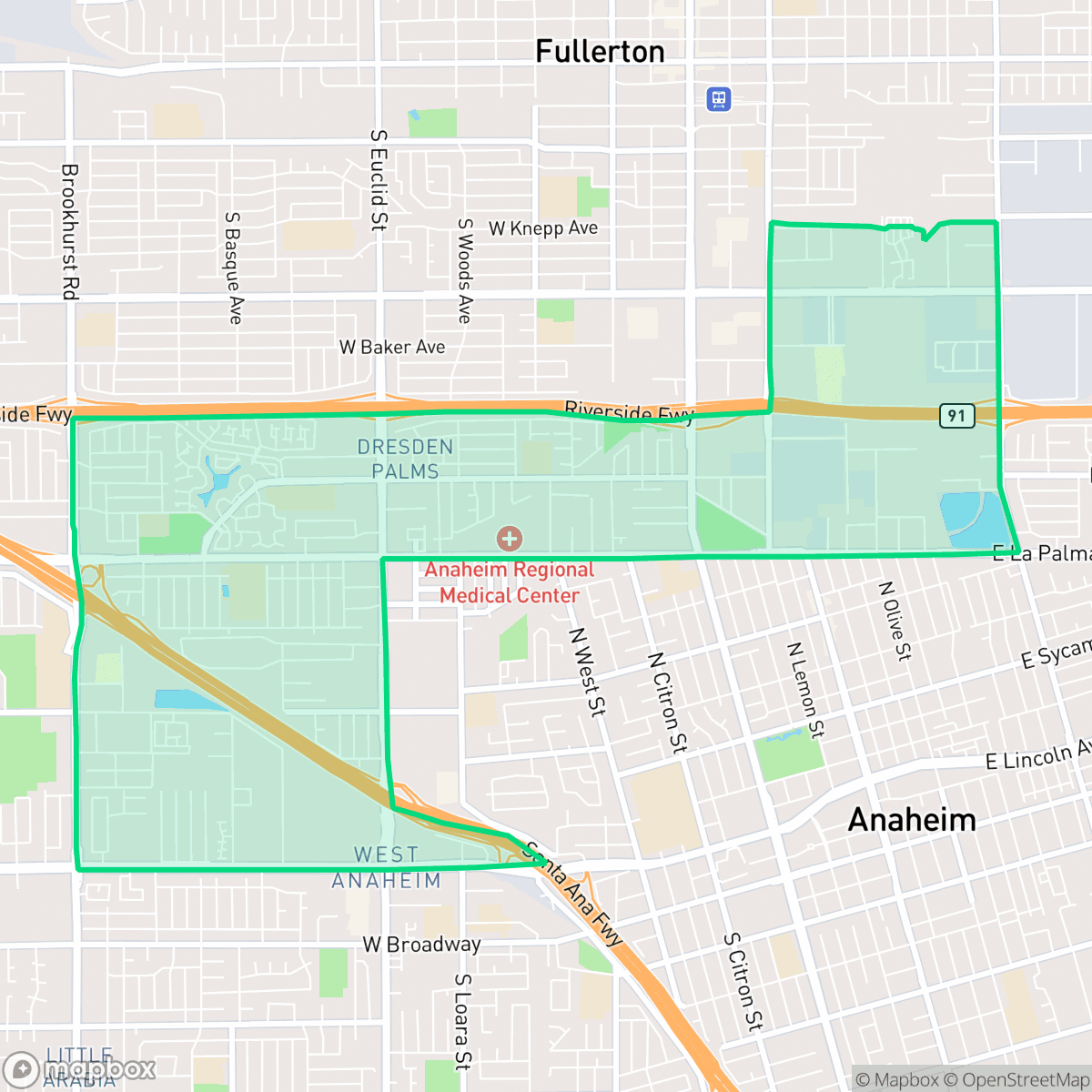
Northwest Anaheim is a ten-square-mile neighborhood characterized by postwar ranch-style homes and wide, magnolia-shaded streets. The area's most prominent historical landmark is the 21-acre La Palma Park, Anaheim's second-oldest park, which opened in 1939. Built using Great Depression-era Works Progress Administration (WPA) funding, the park features Glover Stadium and Dee Fee Field. This historic venue served as the spring training home for Major League Baseball teams, including the Philadelphia Athletics in the early 1940s and the St. Louis Browns in 1946. Notably, baseball pioneer Jackie Robinson filmed scenes for The Jackie Robinson Story at the park in 1950. Today, Northwest Anaheim maintains its mid-century residential character while serving as a key community hub centered around this historic green space.
The neighborhood functions as a dense suburban hub where single-family homes, apartment complexes, and light industrial zones intersect. Residents benefit from consistent sidewalk connectivity throughout the residential grid, providing access to local amenities and diverse dining options along major arteries. The area maintains a steady pace of life, balanced by the presence of community-focused spaces and local retail services that cater to the surrounding population.
Prospective residents should weigh the benefits of this central location against specific environmental trade-offs. The area experiences high levels of ambient noise from nearby multi-lane freeways and logistics hubs, which also contribute to a high-density living environment with limited privacy between properties. Furthermore, the local school system faces significant fiscal and academic challenges, making the area a better fit for those prioritizing proximity to regional transit and central Anaheim over quiet, low-density suburban living.
Neighborhood Scores Across 15 Qualities
Residential spacing varies between detached homes and dense apartment complexes with shared walls. According to iHuus data, this level of proximity to neighbors is slightly higher than the average for Anaheim.
Extensive sidewalk networks and clear crosswalks make most residential streets easy to navigate on foot. While the area is nearly as walkable as the rest of Anaheim, a major highway bisects the neighborhood and can disrupt continuous pedestrian routes.
Uniform tract housing and apartment complexes define the landscape, which features slightly less visual variety than the Anaheim average. Residential areas often include small yards and various private or shared pools, though some pockets sit near industrial zones.
Public parks and green fields are available for dog walking in certain pockets, but some areas lack accessible green space and feature narrow sidewalks. Overall, pet-friendly infrastructure in this neighborhood is slightly below the Anaheim average according to iHuus data.
Landscape features a blend of dense suburban residential areas and large-scale industrial warehouses. This level of development is typical for the city of Anaheim.
A balanced mix of residential streets, light industrial units, and diverse dining options provides a steadier pace of activity than the Anaheim average. While some pockets offer lively social hubs near railways or parks, much of the area maintains a quiet, suburban atmosphere with services dispersed along major corridors.
Persistent noise from nearby major freeways and railroad corridors makes this area louder than most parts of Anaheim. According to iHuus data, residents can expect significant acoustic disruptions due to proximity to heavy transit infrastructure.
Air quality in this area is excellent and remains slightly higher than the Anaheim average. Residents can expect consistently clear air with minimal health concerns, according to iHuus data.
Primarily residential and light commercial in nature, this area lacks the heavy industrial hazards or large-scale logistics hubs found in other parts of the city. Residents can expect a landscape mostly composed of housing and retail, with very little exposure to heavy manufacturing or large warehouse traffic.
Health insurance accessibility is below the Anaheim average, with a notable portion of the population lacking coverage. According to iHuus data, residents may face higher out-of-pocket medical expenses compared to other parts of the city.
Political leanings in this area are notably more liberal than the Anaheim average. Residents will find a community with a strong liberal majority and a modest opposing presence, according to iHuus data.
Residents live alongside a balanced spread of young adults, families, and older individuals, mirroring the broader demographic distribution found across Anaheim.
Properties in this area are situated within a 100-year floodplain, making flood insurance a common requirement for residents. According to iHuus data, the risk level here is slightly higher than the Anaheim city average.
Address-Level Insights for Northwest Anaheim


iHuus Neighborhood Intelligence Insights
Get address-level neighborhood insights for Northwest Anaheim
- Street-level scores — see how individual blocks compare, not just neighborhood averages
- Micro-zone boundaries — identify quiet pockets, flood boundaries, and walkable clusters before you visit
- 15 dimensions in full — walkability, noise, air quality, school quality, insurance coverage, population age profile, urban/rural index, and more
- Boundary risk alerts — know if your address sits near a block boundary where scores drop, the kind of detail no listing will ever mention
- School insights — individual school ratings and insights, not just district-level data
- Compare before you commit — side-by-side data across neighborhoods, down to block precision
No credit card required
Compare with Any Neighborhood
| Dimension | Northwest Anaheim | Anaheim Hills |
|---|---|---|
| 🚶 Walkabilityavg 8.73 | ||
| 🔊 Acoustic Comfortavg 2.38 | ||
| 🤫 Privacy Indexavg 4.69 | ||
| 🎨 Visual Appealavg 6.56 | ||
| 🐕 Dog Friendlinessavg 5.82 | ||
| 🗺️ Urban-Rural Indexavg 6.49 | ||
| ✨ Neighborhood Vibeavg 4.29 | ||
| 🏥 Health Insurance Coverageavg 6.54 | ||
| 🌿 Air Qualityavg 8.7 | ||
| 🏭 Industrial Proximityavg 8.17 | ||
| 🌊 Flood Safetyavg 2.02 | ||
| 🗳️ Ideological Leanavg 7.03 | ||
| 👥 Population Age Profileavg 4.79 | ||
| 🔥 Fire Safetyavg 0.06 | ||
| 🏫 School Quality |
Northwest Anaheim Rankings
School Districts Serving Northwest Anaheim
School Insights for Northwest Anaheim
Below average outcomes; significant attendance and academic challenges.
School Insights
See what's really behind every school rating near Northwest Anaheim
- Individual school ratings — each school's own score with outcome context, not just a district average
- Enrollment & class size data — student-to-teacher ratio and how it compares to the state average
- Full demographics breakdown — ethnicity and gender composition for every school in the enrollment zone
- Every school in the district — all schools within the enrollment boundary ranked by rating, not just the closest one
- Grade levels & benchmarks — elementary through high school, with below/above state-average flags
No credit card required