Anaheim Resort, Anaheim
Updated · 18,442 residents
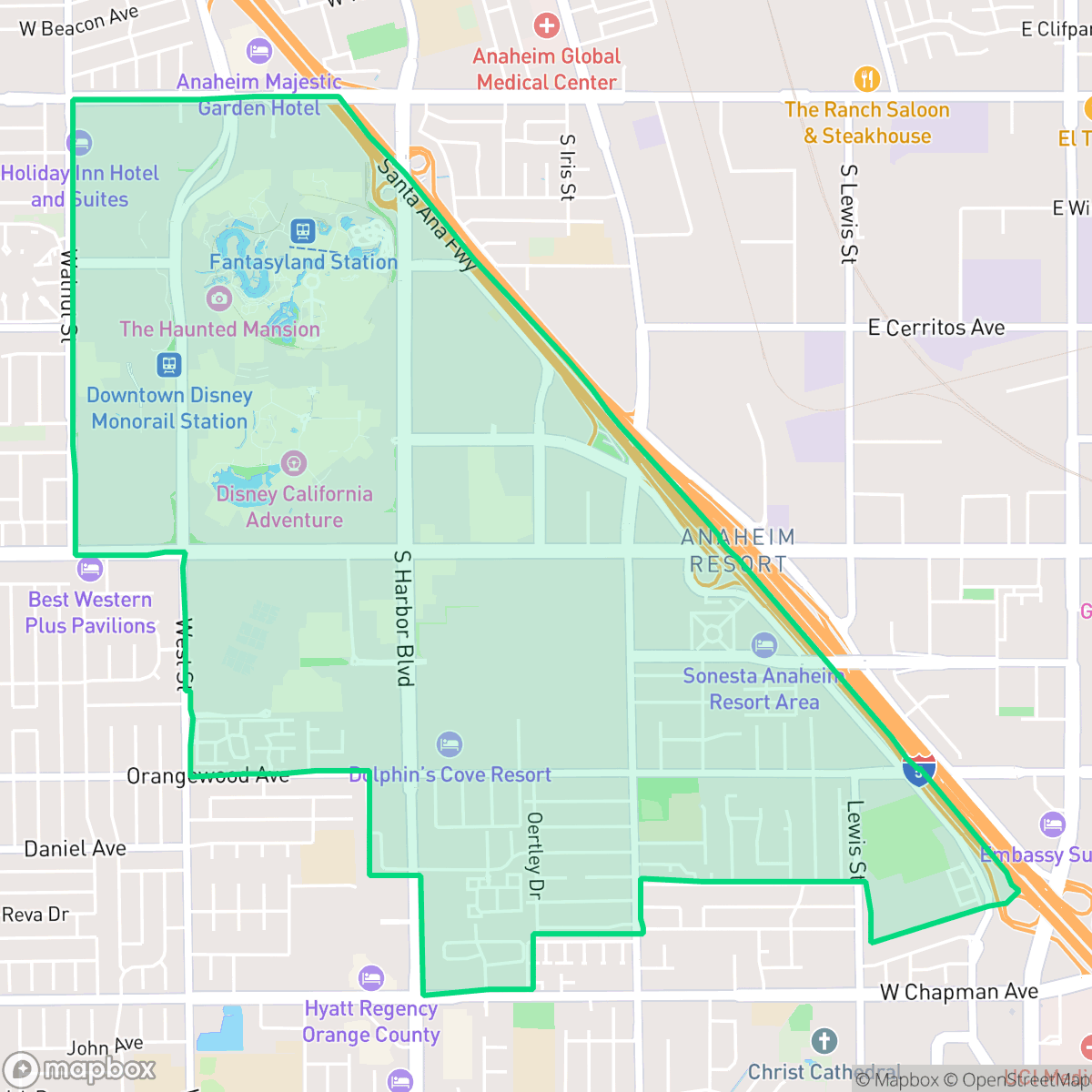
The Anaheim Resort is a high-density, tourist-oriented district anchored by the Disneyland Resort and the Anaheim Convention Center. The area features a mix of mid-rise hotels, retail centers, and residential blocks, characterized by notable road traffic noise and a bustling, commercial atmosphere.
Key Highlights
About Anaheim Resort
The Anaheim Resort neighborhood was once a quiet expanse of orange and walnut groves before the 1955 opening of Disneyland sparked a massive tourism and commercial boom. The rapid, uncoordinated proliferation of motels and neon signs eventually led to visual clutter, prompting the City of Anaheim to take action. In 1994, the city adopted the Anaheim Resort Specific Plan to comprehensively guide the development of the 1,100-acre district, which includes the theme parks and the Anaheim Convention Center. This culminated in a massive $5 billion public-private revitalization completed in 2001. The project transformed the neighborhood into a cohesive, pedestrian-friendly destination by widening streets into tree-lined boulevards, removing chaotic neon signage, and planting over 15,000 trees and shrubs to establish a lush, uniform resort aesthetic.
The Anaheim Resort functions as the primary tourism and commercial hub of the city. It is defined by its massive footprint of hotels, restaurants, and entertainment venues that cater to millions of visitors annually. The infrastructure reflects this focus, with wide arterial roads and dense commercial corridors that prioritize high-volume traffic and pedestrian access to major attractions. The neighborhood maintains a high-energy character, with a wide variety of local restaurants and social spots that create a lively environment during both the day and evening hours.
Living in the area requires balancing proximity to major employment and entertainment centers with the realities of a high-density environment. Residents experience significant road noise and limited privacy due to the close proximity of buildings and high-traffic corridors. While the area offers convenient access to local services, it is best suited for those who prioritize a central location and an active urban lifestyle over a quiet, secluded residential setting. Prospective residents should be aware of the dense urban mix and the prevalence of commercial activity throughout the district.
Neighborhood Scores Across 15 Qualities
Residential spacing is consistent with the city average, featuring a mix of shared-wall apartments and detached homes with limited separation. Residents can expect varying levels of proximity to neighbors depending on the specific block.
Pedestrian infrastructure is well-established throughout most residential and commercial blocks, though large highway interchanges and massive parking lots create notable barriers to movement. While sidewalk connectivity is strong, the area is slightly less walkable than the broader Anaheim average due to these significant arterial disruptions.
Standard tract housing and apartment complexes define the landscape, featuring boxy rooflines and tightly spaced lots. This area offers slightly less visual variety than the Anaheim average, though many properties include private or shared swimming pools.
Public parks and sports fields offer decent walking areas, though the availability of wide sidewalk verges is below the city average. According to iHuus data, many residential streets feature narrower sidewalks or limited public greenery compared to other parts of Anaheim.
Developed landscapes featuring a mix of multi-story hotels, apartment complexes, and large-scale commercial structures define this area. This level of density is largely consistent with the broader Anaheim area.
Dynamic dining pockets and high-energy blocks exist alongside quieter, industrial-edged streets, resulting in a level of activity that is higher than the Anaheim average. According to iHuus data, the area offers a mix of lively amenities and calm residential spaces, though much of the vibrancy is concentrated near major highways and is largely car-dependent.
Persistent sound from nearby freeway traffic and railroad tracks defines the local environment. This level of acoustic disturbance is notably higher than the average for Anaheim.
Air quality remains mostly clean with only rare instances of elevated readings. This level of air purity is slightly lower than the city average, according to iHuus data.
Heavy industrial presence is minimal here, though some large-scale warehouses and distribution centers are located near residential zones. This area contains slightly more warehouse and large-scale retail activity than the typical Anaheim neighborhood, according to iHuus data.
Health insurance access among residents is notably lower than the Anaheim average, according to iHuus data.
Political leanings in this area lean significantly more liberal than the Anaheim average. Residents may find a community profile characterized by a liberal majority with a modest opposing presence, according to iHuus data.
A varied demographic of young adults, families, and seniors resides here, reflecting a population age profile that is slightly more varied than the city average according to iHuus data.
Property within the 100-year floodplain carries a significant risk of flooding, which typically necessitates flood insurance. According to iHuus data, this level of risk is consistent with the city average.
Address-Level Insights for Anaheim Resort


iHuus Neighborhood Intelligence Insights
Get address-level neighborhood insights for Anaheim Resort
- Street-level scores — see how individual blocks compare, not just neighborhood averages
- Micro-zone boundaries — identify quiet pockets, flood boundaries, and walkable clusters before you visit
- 15 dimensions in full — walkability, noise, air quality, school quality, insurance coverage, population age profile, urban/rural index, and more
- Boundary risk alerts — know if your address sits near a block boundary where scores drop, the kind of detail no listing will ever mention
- School insights — individual school ratings and insights, not just district-level data
- Compare before you commit — side-by-side data across neighborhoods, down to block precision
No credit card required
Compare with Any Neighborhood
| Dimension | Anaheim Resort | Anaheim Hills |
|---|---|---|
| 🚶 Walkabilityavg 8.73 | ||
| 🔊 Acoustic Comfortavg 2.38 | ||
| 🤫 Privacy Indexavg 4.69 | ||
| 🎨 Visual Appealavg 6.56 | ||
| 🐕 Dog Friendlinessavg 5.82 | ||
| 🗺️ Urban-Rural Indexavg 6.49 | ||
| ✨ Neighborhood Vibeavg 4.29 | ||
| 🏥 Health Insurance Coverageavg 6.54 | ||
| 🌿 Air Qualityavg 8.7 | ||
| 🏭 Industrial Proximityavg 8.17 | ||
| 🌊 Flood Safetyavg 2.02 | ||
| 🗳️ Ideological Leanavg 7.03 | ||
| 👥 Population Age Profileavg 4.79 | ||
| 🔥 Fire Safetyavg 0.06 | ||
| 🏫 School Quality |
Anaheim Resort Rankings
School Districts Serving Anaheim Resort
School Insights for Anaheim Resort
Below average outcomes; significant attendance and academic challenges.
School Insights
See what's really behind every school rating near Anaheim Resort
- Individual school ratings — each school's own score with outcome context, not just a district average
- Enrollment & class size data — student-to-teacher ratio and how it compares to the state average
- Full demographics breakdown — ethnicity and gender composition for every school in the enrollment zone
- Every school in the district — all schools within the enrollment boundary ranked by rating, not just the closest one
- Grade levels & benchmarks — elementary through high school, with below/above state-average flags
No credit card required