Anaheim Hills, Anaheim
Updated · 47,396 residents
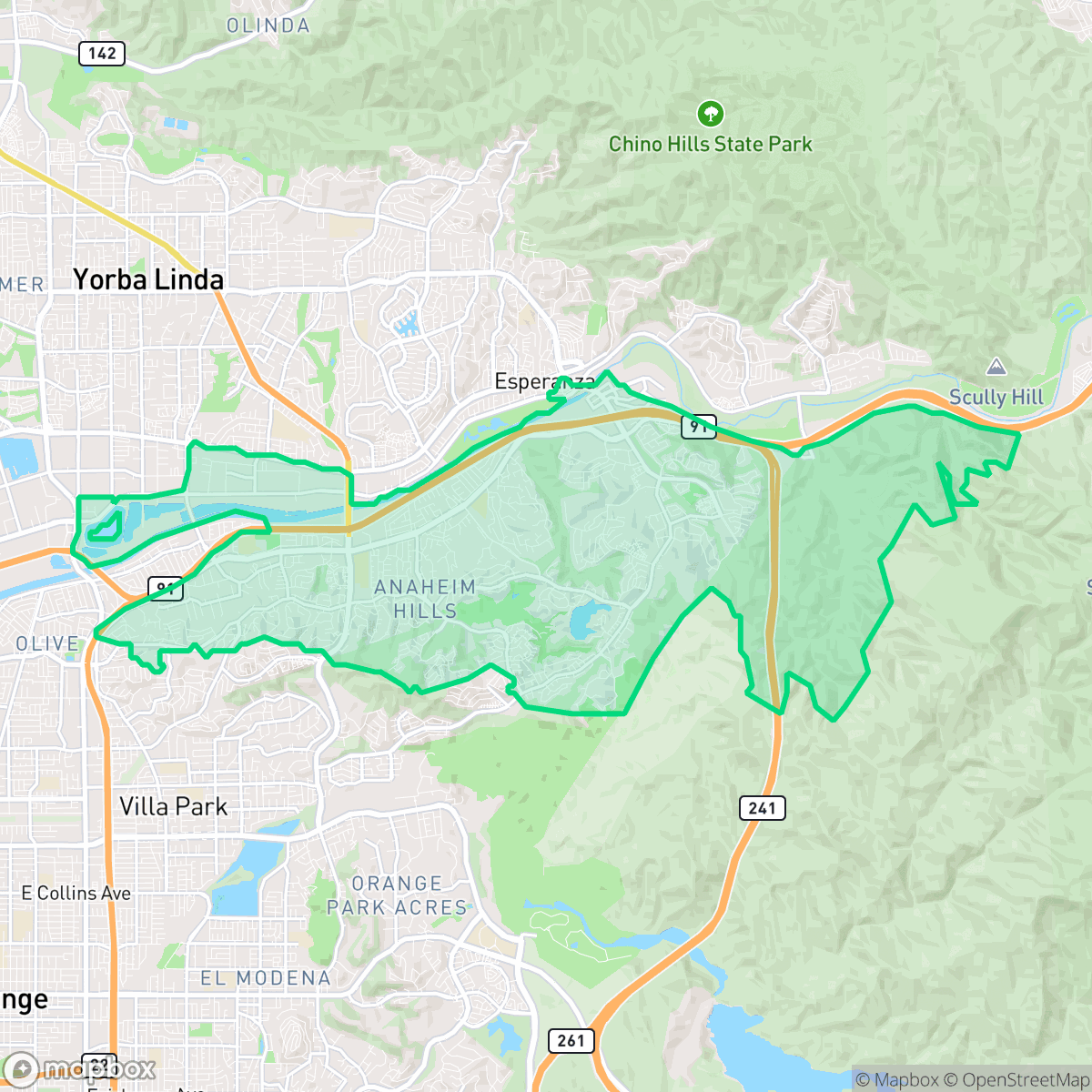
Anaheim Hills is characterized by its hilly, master-planned suburban landscape and affluent, large-lot estates that prioritize residential privacy. The area offers high air quality and excellent access to top-rated schools, though residents remain reliant on personal vehicles for daily errands due to limited local commercial density.
Key Highlights
About Anaheim Hills
Once part of the 1810 Rancho Santiago de Santa Ana, the area now known as Anaheim Hills served as a 19th-century outlaw lookout dubbed "Robbers' Peak". In 1943, rancher Louis Nohl purchased 5,000 acres of this pastureland, which he sold in 1970 to developers, including Texaco Industries, who envisioned an upscale, master-planned community. Beginning construction in 1971, Anaheim Hills became the first residential development to utilize "Landform Grading," shaping the hillsides to mimic natural contours. It was designed as a low-density, rural alternative to dense Orange County subdivisions, featuring hiking trails, estates, and a golf course. The neighborhood's premier historical landmark is the Ramon Peralta Adobe, built in 1871, which stands as the Santa Ana Canyon's only remaining intact adobe structure.
This community serves as a distinct, upscale residential enclave in eastern Anaheim, defined by its complex topography and well-manicured suburban tracts. The neighborhood features a high concentration of top-performing schools, including Nohl Canyon and Running Springs Academy, which contribute to its appeal for families seeking academic stability. Residents benefit from a quiet environment with high air quality and minimal industrial presence, creating a serene atmosphere that stands in contrast to the denser urban corridors found elsewhere in Orange County. While the area excels in aesthetic appeal and educational opportunities, it presents specific trade-offs for prospective residents. The layout is largely car-dependent, with few walkable commercial hubs, and the region faces significant environmental considerations, particularly regarding fire safety. Those considering a move to this area should prioritize its quiet, residential focus while acknowledging the necessity of commuting for most daily services and the inherent risks associated with its hillside location.
Neighborhood Scores Across 15 Qualities
Residential spacing varies across the area, with many homes situated near one another while others benefit from buffers near open hillsides. According to iHuus data, this level of separation is higher than the average for the city of Anaheim.
Consistent sidewalks and low-traffic cul-de-sacs provide a safe environment for walking, though major highway and rail infrastructure can interrupt continuous routes. This level of walkability is slightly below the Anaheim average.
Manicured landscapes, large multi-car garages, and high pool density contribute to a visual environment that is notably more polished than the Anaheim average. According to iHuus data, the area is characterized by substantial homes with complex architectural features and well-maintained properties.
Extensive trail systems, wide grassy verges, and proximity to golf courses and open hillsides provide significantly more pet-friendly space than the Anaheim average. Many residential streets feature continuous sidewalks and access to natural paths that are separated from heavy traffic.
Expansive hilly terrain and significant open canyon lands provide a more open, natural feel than the typical suburban density found elsewhere in Anaheim. According to iHuus data, this area features more frequent open space and scattered residential pockets compared to the city average.
Suburban tranquility and vast open spaces define this area, though many residents will find that daily errands and dining require a vehicle. The neighborhood lacks a dense commercial core, offering a more serene atmosphere than the city average at the expense of walkable amenities.
Frequent sound disturbances from nearby freeway proximity and transit corridors are present. According to iHuus data, noise levels in this area are higher than the city average.
Air quality remains consistently high with minimal health concerns. According to iHuus data, the atmosphere in this area is notably cleaner than the city average.
Industrial activity and heavy warehouses are virtually nonexistent here, offering a much cleaner landscape than the Anaheim average. Residents can enjoy a landscape consisting almost entirely of residential and natural areas without the presence of large-scale logistics hubs or industrial hazards.
Health insurance access is exceptionally high among residents, significantly surpassing the average seen across the city of Anaheim. According to iHuus data, the vast majority of the population maintains comprehensive coverage.
Conservative residents form a significant majority in this area, representing a notable shift from the more progressive leaning found across the rest of Anaheim.
A varied mix of young adults, families, and seniors resides here, creating a demographic spread that is slightly more balanced than the Anaheim average. According to iHuus data, no single age group dominates the local population.
Flood risk levels remain difficult to determine because FEMA has not completed a detailed study for this area. According to iHuus data, the potential for flooding is higher here than the average found across the rest of Anaheim.
Wildfire danger is exceptionally high in this area due to the surrounding canyon terrain; according to iHuus data, this level of fire hazard is even more significant than the average for Anaheim.
Address-Level Insights for Anaheim Hills


iHuus Neighborhood Intelligence Insights
Get address-level neighborhood insights for Anaheim Hills
- Street-level scores — see how individual blocks compare, not just neighborhood averages
- Micro-zone boundaries — identify quiet pockets, flood boundaries, and walkable clusters before you visit
- 15 dimensions in full — walkability, noise, air quality, school quality, insurance coverage, population age profile, urban/rural index, and more
- Boundary risk alerts — know if your address sits near a block boundary where scores drop, the kind of detail no listing will ever mention
- School insights — individual school ratings and insights, not just district-level data
- Compare before you commit — side-by-side data across neighborhoods, down to block precision
No credit card required
Compare with Any Neighborhood
| Dimension | Anaheim Hills | Anaheim Resort |
|---|---|---|
| 🚶 Walkabilityavg 8.73 | ||
| 🔊 Acoustic Comfortavg 2.38 | ||
| 🤫 Privacy Indexavg 4.69 | ||
| 🎨 Visual Appealavg 6.56 | ||
| 🐕 Dog Friendlinessavg 5.82 | ||
| 🗺️ Urban-Rural Indexavg 6.49 | ||
| ✨ Neighborhood Vibeavg 4.29 | ||
| 🏥 Health Insurance Coverageavg 6.54 | ||
| 🌿 Air Qualityavg 8.7 | ||
| 🏭 Industrial Proximityavg 8.17 | ||
| 🌊 Flood Safetyavg 2.02 | ||
| 🗳️ Ideological Leanavg 7.03 | ||
| 👥 Population Age Profileavg 4.79 | ||
| 🔥 Fire Safetyavg 0.06 | ||
| 🏫 School Quality |
Anaheim Hills Rankings
School Districts Serving Anaheim Hills
School Insights for Anaheim Hills
Below average outcomes; significant attendance and academic challenges.
School Insights
See what's really behind every school rating near Anaheim Hills
- Individual school ratings — each school's own score with outcome context, not just a district average
- Enrollment & class size data — student-to-teacher ratio and how it compares to the state average
- Full demographics breakdown — ethnicity and gender composition for every school in the enrollment zone
- Every school in the district — all schools within the enrollment boundary ranked by rating, not just the closest one
- Grade levels & benchmarks — elementary through high school, with below/above state-average flags
No credit card required