San Gabriel Triangle, Albany
Updated · 684 residents
The San Gabriel Triangle is an exceptionally walkable residential enclave known for its historic mid-century architecture and proximity to local commercial hubs. With its dense suburban layout and access to the Ohlone Greenway, the area offers a convenient lifestyle for those prioritizing transit and community connectivity. According to iHuus data, residents benefit from excellent air quality and a lack of industrial hazards, though the neighborhood experiences notable noise from nearby road traffic.
Key Highlights
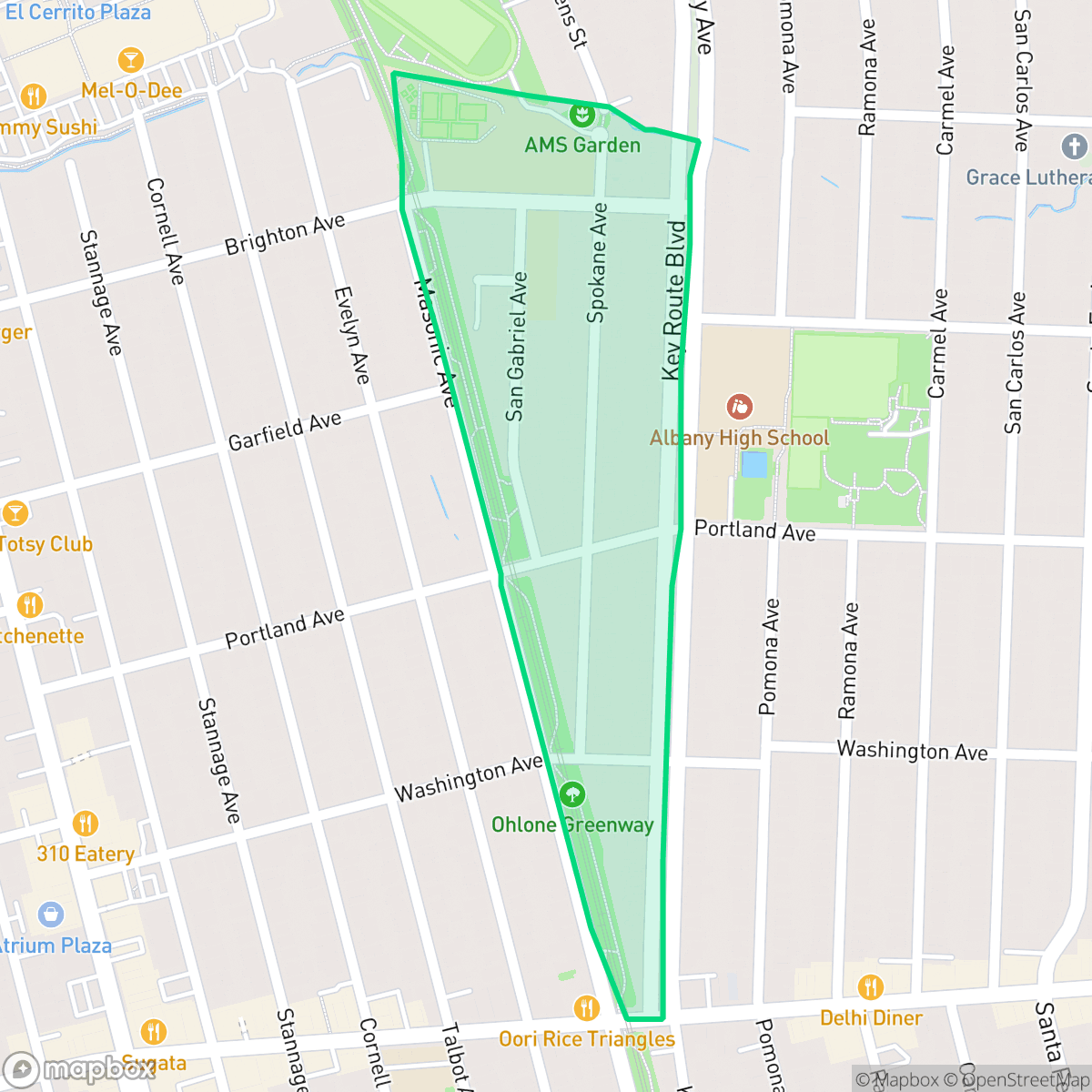
About San Gabriel Triangle
The San Gabriel Triangle is a highly walkable residential enclave in Albany, California, characterized by its distinct pre-World War II housing stock. The neighborhood is particularly defined by its classic "MacGregor" homes, built primarily during the late 1930s and early 1940s by the prominent local developer Charles Manning MacGregor. These split-level, Spanish Mediterranean-style stucco houses feature signature entryways, original hardwood floors, and tiled fireplaces, giving the area a cohesive and historic architectural character. Situated just blocks from the bustling Solano Avenue commercial corridor, Memorial Park, and the Ohlone Greenway, this quiet neighborhood has retained its original mid-century suburban charm while evolving into one of the city's most accessible and bike-friendly districts.
The neighborhood functions as a dense, transit-oriented hub within Albany. It features a mix of single-family homes and apartment complexes, fostering a lively atmosphere that balances quiet residential streets with nearby dining and retail options like Kyoto Ramen and Harding Park. The area maintains a high level of connectivity, supported by a consistent sidewalk network that makes daily errands and commuting simple for pedestrians and cyclists alike.
Prospective residents should note that the neighborhood presents specific trade-offs regarding privacy and acoustic comfort. Because homes are situated in a compact layout with narrow side yards, privacy is limited compared to more spacious suburban settings. Furthermore, road traffic contributes to a moderate noise level throughout the area. Despite these factors, the neighborhood remains a strong choice for those seeking a highly accessible, school-focused environment within the top-tier Albany City Unified School District.
Neighborhood Scores Across 15 Qualities
Homes are often closely packed with narrow side yards and minimal spacing between neighbors. This level of density is roughly in line with the average for Albany.
Pedestrian-friendly infrastructure is a defining feature here, characterized by a dense grid of continuous sidewalks and clear crossings. According to iHuus data, the sidewalk network is more comprehensive and integrated than the average found throughout Albany.
Standard tract housing dominates the area, characterized by small yards and uniform rooflines. This landscape is slightly less varied than the Albany city average according to iHuus data.
Access to large public parks and continuous green verges provides ample space for pets. According to iHuus data, these connected outdoor areas and wide paths offer a higher level of dog friendliness than the Albany average.
Residential layouts feature a blend of single-family homes and larger institutional structures. This level of density is consistent with the broader Albany area.
Diverse dining options and local cultural spots provide a level of activity that is notably higher than the Albany average. According to iHuus data, the area features a dense concentration of cafes, eateries, and community spaces that contribute to a steady social energy.
Persistent noise from nearby busy streets is a common feature here. According to iHuus data, the acoustic environment is slightly more active than the Albany average.
Air quality remains consistently high with minimal health concerns, matching the broader city average according to iHuus data.
No warehouses, heavy industrial facilities, or hazardous sites are present within this area. This lack of industrial presence makes the neighborhood notably cleaner of heavy-duty commerce than the Albany average, according to iHuus data.
Health insurance coverage levels in this area are lower than the average for the city of Albany, according to iHuus data.
Voting patterns and census indicators show a predominantly liberal political leaning, which is consistent with the broader Albany area according to iHuus data.
Residents live alongside a balanced distribution of young adults, families, and older individuals. This demographic spread is consistent with the average seen across Albany.
Flood risk in this area remains undetermined because official FEMA studies for this specific zone are incomplete. According to iHuus data, this level of risk is higher than the average seen across Albany.
Address-Level Insights for San Gabriel Triangle


iHuus Neighborhood Intelligence Insights
Get address-level neighborhood insights for San Gabriel Triangle
- Street-level scores — see how individual blocks compare, not just neighborhood averages
- Micro-zone boundaries — identify quiet pockets, flood boundaries, and walkable clusters before you visit
- 15 dimensions in full — walkability, noise, air quality, school quality, insurance coverage, population age profile, urban/rural index, and more
- Boundary risk alerts — know if your address sits near a block boundary where scores drop, the kind of detail no listing will ever mention
- School insights — individual school ratings and insights, not just district-level data
- Compare before you commit — side-by-side data across neighborhoods, down to block precision
No credit card required
Compare with Any Neighborhood
| Dimension | San Gabriel Triangle | Albany Terrace |
|---|---|---|
| 🚶 Walkabilityavg 9.53 | ||
| 🔊 Acoustic Comfortavg 3.69 | ||
| 🤫 Privacy Indexavg 4.06 | ||
| 🎨 Visual Appealavg 6.31 | ||
| 🐕 Dog Friendlinessavg 7.13 | ||
| 🗺️ Urban-Rural Indexavg 6.55 | ||
| ✨ Neighborhood Vibeavg 6.15 | ||
| 🏥 Health Insurance Coverageavg 8.83 | ||
| 🌿 Air Qualityavg 10 | ||
| 🏭 Industrial Proximityavg 8.16 | ||
| 🌊 Flood Safetyavg 3.37 | ||
| 🗳️ Ideological Leanavg 9.97 | ||
| 👥 Population Age Profileavg 4.96 | ||
| 🔥 Fire Safety | ||
| 🏫 School Quality |
San Gabriel Triangle Rankings
School Districts Serving San Gabriel Triangle
School Insights for San Gabriel Triangle
Below average outcomes; significant attendance and academic challenges.
School Insights
See what's really behind every school rating near San Gabriel Triangle
- Individual school ratings — each school's own score with outcome context, not just a district average
- Enrollment & class size data — student-to-teacher ratio and how it compares to the state average
- Full demographics breakdown — ethnicity and gender composition for every school in the enrollment zone
- Every school in the district — all schools within the enrollment boundary ranked by rating, not just the closest one
- Grade levels & benchmarks — elementary through high school, with below/above state-average flags
No credit card required