South Shore, Alameda
Updated · 4,908 residents
South Shore is a highly walkable coastal enclave defined by its immediate access to Robert W. Crown Memorial State Beach and convenient retail hubs. The area features a dense mix of suburban homes and apartment complexes, offering a quiet residential atmosphere with excellent proximity to local amenities.
Key Highlights
About South Shore
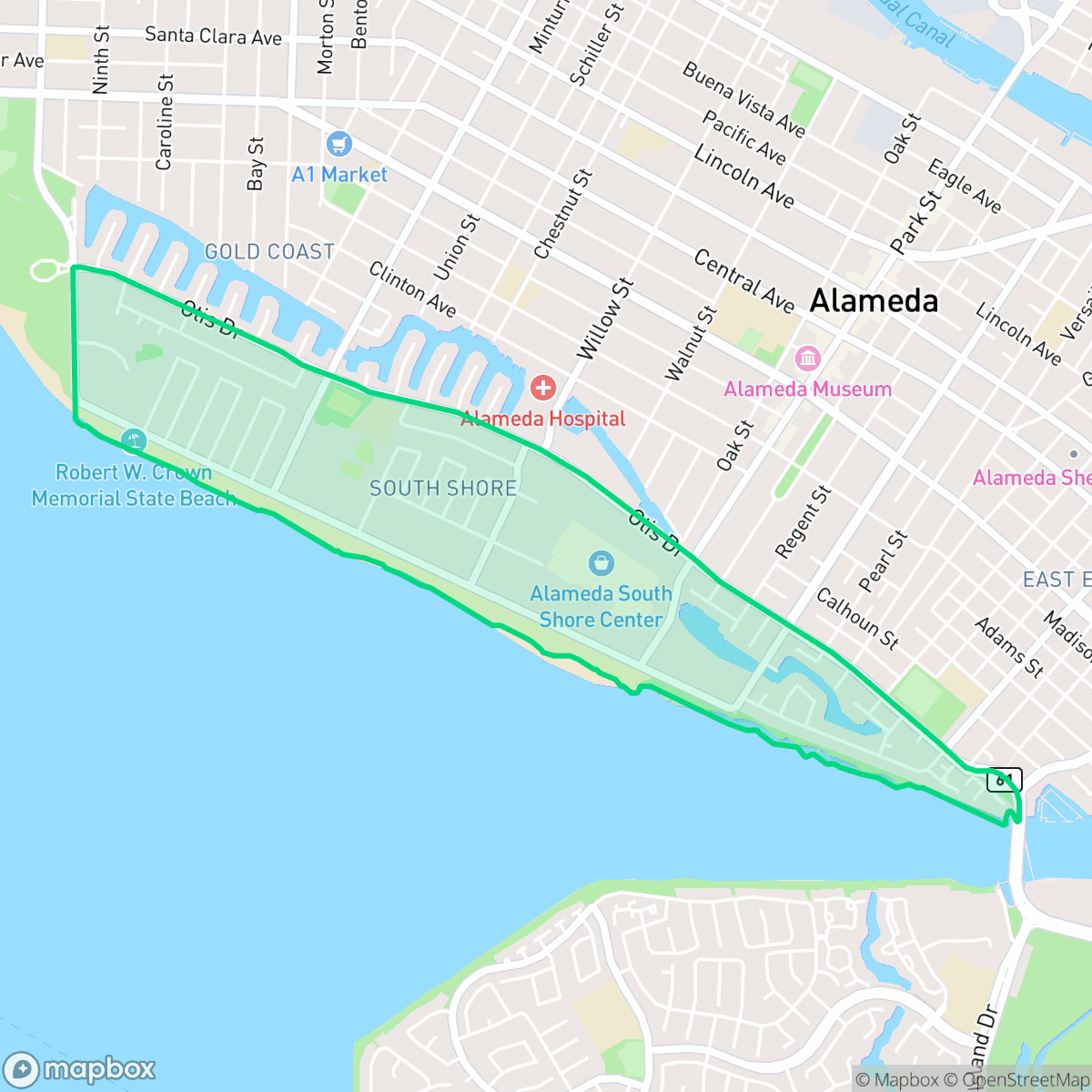
The South Shore neighborhood of Alameda, California, was transformed in the 1950s from a stretch of tidelands, mudflats, and bluffs into a modern suburban enclave. In 1955, the Utah Construction Company initiated a massive and highly controversial land reclamation project, pumping millions of cubic yards of sand from the San Francisco Bay to create roughly 400 acres of new land. This development blocked the bay views of Alameda's historic "Gold Coast" properties, replacing them with a series of artificial lagoons, mid-century tract housing, and apartment complexes. Key neighborhood landmarks established during this postwar expansion include the South Shore Center—Alameda's primary shopping mall, opened in 1958—and the scenic, two-mile-long Robert W. Crown Memorial State Beach, which borders the neighborhood's southern edge.
This neighborhood functions as a self-contained coastal community, characterized by a dense grid of residential streets that prioritize pedestrian access. Residents benefit from seamless connectivity to the shoreline and the South Shore Center, which serves as the primary commercial anchor for daily needs. According to iHuus data, the area maintains a strong sense of community through its recreational spaces and consistent access to high-quality education within the Alameda City Unified School District. The landscape is dominated by a blend of mid-century residential architecture and modern multi-family housing, creating a distinct suburban aesthetic that remains free from industrial activity. Prospective residents should note that the high density of housing leads to limited privacy in certain pockets, as many structures are situated in close proximity to one another. While the area offers a peaceful environment, road traffic contributes to a moderate level of ambient noise. The neighborhood is particularly well-suited for those who value an active, outdoor-oriented lifestyle, as the expansive beach and park trails provide significant opportunities for recreation. With high health insurance coverage and a lack of industrial hazards, the area remains a stable and secure choice for families and professionals alike.
Neighborhood Scores Across 15 Qualities
Housing density varies across the area, ranging from closely packed multi-unit buildings to waterfront properties with larger buffers. This level of density is slightly higher than the average for Alameda.
Continuous sidewalks, clear pedestrian crossings, and a dense street grid make navigating the area on foot easy. This level of accessibility is even higher than the average found throughout Alameda.
Upscale waterfront properties and private lagoons create a highly aesthetic landscape that is more visually polished than the typical Alameda neighborhood. According to iHuus data, the presence of large homes and premium amenities like private docks contributes to a more premium streetscape.
Expansive shoreline parks, beach access, and wide trails provide significantly more green space for pets than the Alameda average. According to iHuus data, the area features numerous large fields and connected park paths that are well-separated from heavy traffic.
Residential layouts consist of a dense suburban coastal mix of single-family homes, apartments, and waterfront developments. This environment is slightly more developed than the Alameda average, featuring a blend of multi-unit buildings and integrated retail centers.
Quiet, coastal streets offer a balance of green space and accessible dining, providing a slightly more active atmosphere than the city average. While some social spots are reachable via walkable paths, many businesses are oriented toward car-based convenience.
Steady traffic noise from a nearby busy street is common in this area. According to iHuus data, acoustic comfort in South Shore is notably higher than the Alameda city average.
Air quality in this area remains consistently clean with rare instances of elevated readings. This level of air quality is consistent with the average found throughout Alameda.
No warehouses, heavy industrial facilities, or hazardous sites are present within this area. According to iHuus data, this neighborhood is notably more free of industrial activity than the Alameda average.
Health insurance access is exceptionally high among residents, trending well above the Alameda city average according to iHuus data.
Voting patterns and census indicators reflect a highly liberal political landscape that is consistent with the rest of Alameda. Residents will find a community with political views that align with the citywide average.
A balanced mix of young adults, families, and older residents characterizes the area, representing a slightly more even age distribution than the Alameda average according to iHuus data.
Flood risk levels in this area are comparable to the rest of the city, though a lack of detailed FEMA studies means the precise vulnerability remains undetermined. According to iHuus data, residents should account for this lack of definitive mapping when evaluating long term property safety.
Address-Level Insights for South Shore


iHuus Neighborhood Intelligence Insights
Get address-level neighborhood insights for South Shore
- Street-level scores — see how individual blocks compare, not just neighborhood averages
- Micro-zone boundaries — identify quiet pockets, flood boundaries, and walkable clusters before you visit
- 15 dimensions in full — walkability, noise, air quality, school quality, insurance coverage, population age profile, urban/rural index, and more
- Boundary risk alerts — know if your address sits near a block boundary where scores drop, the kind of detail no listing will ever mention
- School insights — individual school ratings and insights, not just district-level data
- Compare before you commit — side-by-side data across neighborhoods, down to block precision
No credit card required
Compare with Any Neighborhood
| Dimension | South Shore | Alameda Point |
|---|---|---|
| 🚶 Walkabilityavg 9.54 | ||
| 🔊 Acoustic Comfortavg 3.74 | ||
| 🤫 Privacy Indexavg 4.01 | ||
| 🎨 Visual Appealavg 6.39 | ||
| 🐕 Dog Friendlinessavg 7.11 | ||
| 🗺️ Urban-Rural Indexavg 6.41 | ||
| ✨ Neighborhood Vibeavg 5.24 | ||
| 🏥 Health Insurance Coverageavg 9.02 | ||
| 🌿 Air Qualityavg 8 | ||
| 🏭 Industrial Proximityavg 8.45 | ||
| 🌊 Flood Safetyavg 4.99 | ||
| 🗳️ Ideological Leanavg 9.88 | ||
| 👥 Population Age Profileavg 5.15 | ||
| 🔥 Fire Safety | ||
| 🏫 School Quality |
South Shore Rankings
School Districts Serving South Shore
School Insights for South Shore
Below average outcomes; significant attendance and academic challenges.
School Insights
See what's really behind every school rating near South Shore
- Individual school ratings — each school's own score with outcome context, not just a district average
- Enrollment & class size data — student-to-teacher ratio and how it compares to the state average
- Full demographics breakdown — ethnicity and gender composition for every school in the enrollment zone
- Every school in the district — all schools within the enrollment boundary ranked by rating, not just the closest one
- Grade levels & benchmarks — elementary through high school, with below/above state-average flags
No credit card required