Marina Village, Alameda
Updated · 1,593 residents
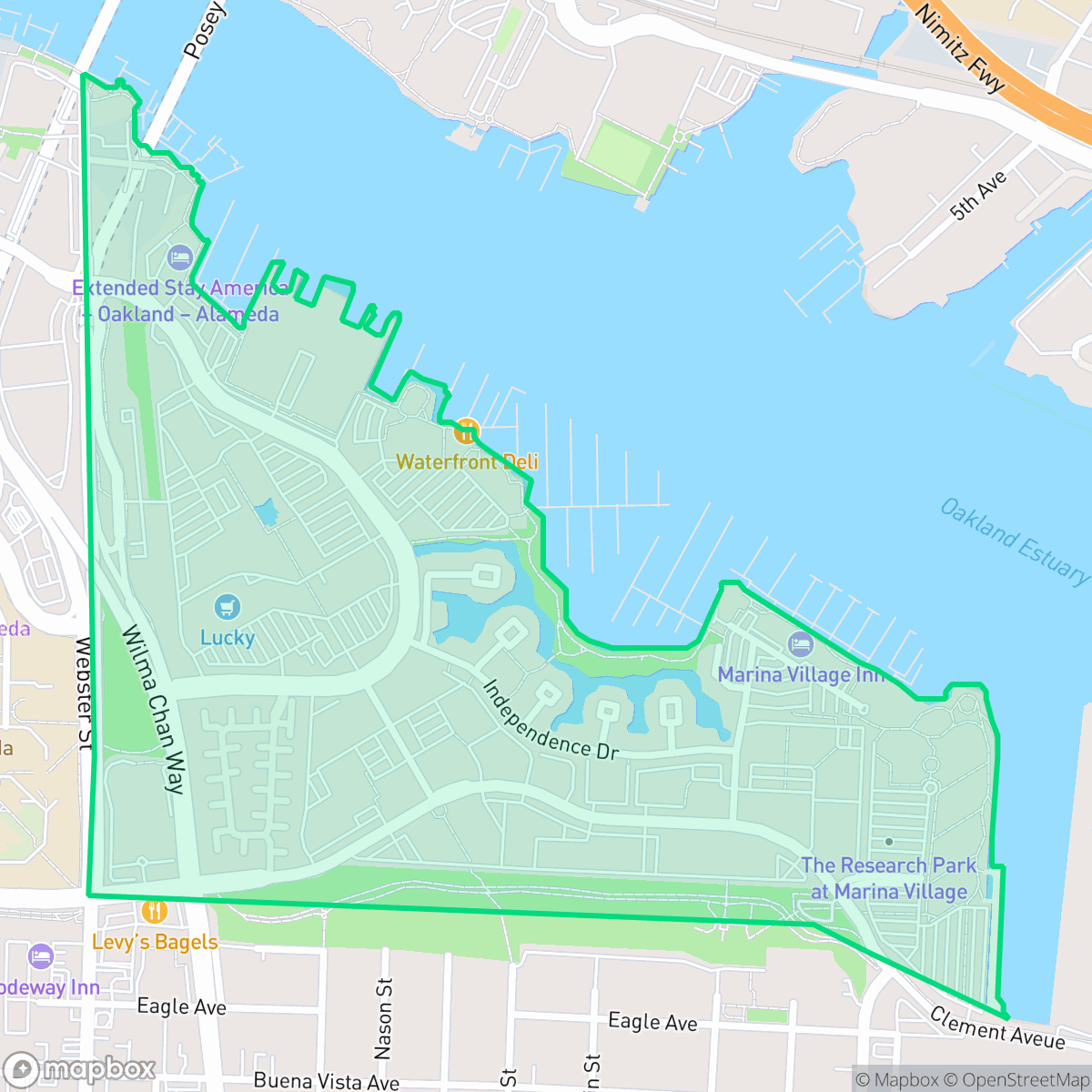
Marina Village is a master-planned, mixed-use community on the Alameda waterfront, defined by its extensive marina and blend of office and residential spaces. While it offers high visual appeal and proximity to the water, residents should expect significant road noise and a quieter, less active social atmosphere.
Key Highlights
About Marina Village
Marina Village in Alameda, California, was built on the historic grounds of the former Bethlehem-Alameda Shipyard (originally the Union Iron Works' Alameda Works). During World War II, this site was a vital industrial hub that repaired over 1,000 vessels. In the 1980s, developers Joseph Seiger and Michael Humphreys transformed the defunct shipyard into Marina Village, a master-planned, mixed-use community featuring office parks, residential townhouses, and the largest privately owned marina on San Francisco Bay. While the redevelopment led to the controversial 1985 demolition of the historic 1918 "Red Brick Building" (the turbine machine shop), the 1917 Union Iron Works Powerhouse survived. Designed by Frederick H. Meyer and listed on the National Register of Historic Places, the powerhouse stands as the neighborhood's premier architectural landmark.
This neighborhood functions as a hybrid space, balancing residential townhouses with professional office parks. The area maintains a distinct visual identity, enhanced by its coastal setting and preserved industrial architecture. It serves as a hub for those who value waterfront access and a structured, suburban-style environment within the East Bay. The community benefits from the high-performing Alameda City Unified School District, which provides consistent academic quality and strong parent engagement for local families.
The area is best suited for professionals or residents who prioritize aesthetic surroundings and access to regional amenities over urban nightlife or silence. While it is moderately walkable, the neighborhood experiences significant road noise, which may impact those sensitive to sound. It offers a stable population base with excellent access to local dining and green spaces along the coastline.
Neighborhood Scores Across 15 Qualities
Residential spacing is consistent with the city average, featuring a mix of detached homes and shared-wall complexes. Some areas contain high-density townhomes where houses are positioned very close to one another.
Extensive sidewalk networks and clear crossings connect residential streets to the waterfront, making the area as easy to navigate on foot as the rest of Alameda. According to iHuus data, the neighborhood features consistent pedestrian paths through parks and campus areas.
Uniform rooflines and small, tidy yards characterize this area. The visual landscape is slightly below the Alameda average, consisting primarily of conventional tract housing and multi-unit apartment complexes.
Spacious shoreline trails, large parks, and wide sidewalk buffers provide ample room for pets. According to iHuus data, these interconnected green spaces make the area more dog friendly than the Alameda average.
Residential areas feature a mix of single-family homes and low-rise apartments alongside commercial hubs. This landscape is comparable to the broader Alameda area in its balance of built density and open spaces.
Primarily composed of suburban streets and light industrial zones, this area offers a low-energy atmosphere that is notably more subdued than the Alameda average. While certain pockets near the coastline feature accessible dining and social hubs, much of the neighborhood is characterized by quiet, car-oriented layouts.
Frequent disturbances from nearby railroad tracks and flight paths contribute to an acoustic environment that is noisier than the Alameda average, according to iHuus data.
Air quality in this area remains consistently good with rare instances of elevated readings. This level of air cleanliness is consistent with the average found throughout Alameda.
Heavy industrial presence is largely absent here, though some maritime piers and warehouses may introduce occasional heavy vehicle activity. While the area is more industrial than the Alameda average, it remains primarily residential with no significant manufacturing hazards.
Nearly all residents in this area are covered by health insurance, which represents a higher rate of coverage than the Alameda city average according to iHuus data.
Voting patterns and census indicators show a deeply liberal political leaning that is consistent with the rest of Alameda. According to iHuus data, residents can expect a political landscape that aligns closely with the citywide average.
A balanced distribution of young adults, families, and seniors characterizes the area. According to iHuus data, this demographic spread is largely consistent with the average seen across Alameda.
Flood risk in this area is higher than the Alameda average, though official assessments from FEMA remain incomplete for this specific location. According to iHuus data, the area is subject to undetermined risk levels due to the lack of a detailed flood study.
Address-Level Insights for Marina Village


iHuus Neighborhood Intelligence Insights
Get address-level neighborhood insights for Marina Village
- Street-level scores — see how individual blocks compare, not just neighborhood averages
- Micro-zone boundaries — identify quiet pockets, flood boundaries, and walkable clusters before you visit
- 15 dimensions in full — walkability, noise, air quality, school quality, insurance coverage, population age profile, urban/rural index, and more
- Boundary risk alerts — know if your address sits near a block boundary where scores drop, the kind of detail no listing will ever mention
- School insights — individual school ratings and insights, not just district-level data
- Compare before you commit — side-by-side data across neighborhoods, down to block precision
No credit card required
Compare with Any Neighborhood
| Dimension | Marina Village | Alameda Point |
|---|---|---|
| 🚶 Walkabilityavg 9.54 | ||
| 🔊 Acoustic Comfortavg 3.74 | ||
| 🤫 Privacy Indexavg 4.01 | ||
| 🎨 Visual Appealavg 6.39 | ||
| 🐕 Dog Friendlinessavg 7.11 | ||
| 🗺️ Urban-Rural Indexavg 6.41 | ||
| ✨ Neighborhood Vibeavg 5.24 | ||
| 🏥 Health Insurance Coverageavg 9.02 | ||
| 🌿 Air Qualityavg 8 | ||
| 🏭 Industrial Proximityavg 8.45 | ||
| 🌊 Flood Safetyavg 4.99 | ||
| 🗳️ Ideological Leanavg 9.88 | ||
| 👥 Population Age Profileavg 5.15 | ||
| 🔥 Fire Safety | ||
| 🏫 School Quality |
Marina Village Rankings
School Districts Serving Marina Village
School Insights for Marina Village
Below average outcomes; significant attendance and academic challenges.
School Insights
See what's really behind every school rating near Marina Village
- Individual school ratings — each school's own score with outcome context, not just a district average
- Enrollment & class size data — student-to-teacher ratio and how it compares to the state average
- Full demographics breakdown — ethnicity and gender composition for every school in the enrollment zone
- Every school in the district — all schools within the enrollment boundary ranked by rating, not just the closest one
- Grade levels & benchmarks — elementary through high school, with below/above state-average flags
No credit card required