Harbor Bay Isle, Alameda
Updated · 5,771 residents
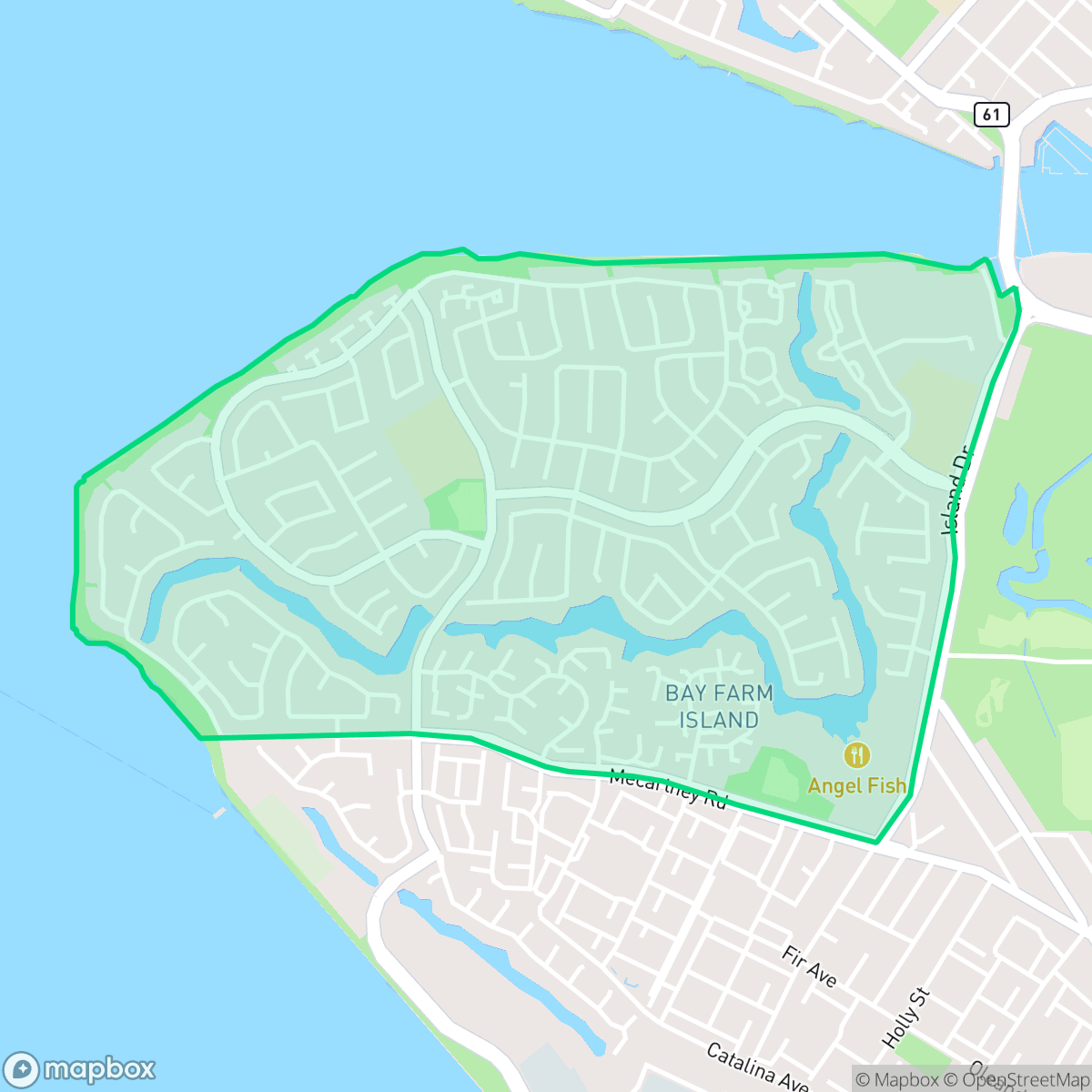
Harbor Bay Isle is a master-planned community on Bay Farm Island characterized by its scenic saltwater lagoons, expansive green spaces, and access to top-rated schools. The neighborhood offers a highly walkable environment with a continuous network of pedestrian paths and bridges, though residents experience limited privacy due to dense housing and compact lot sizes.
Key Highlights
About Harbor Bay Isle
Harbor Bay Isle is a 917-acre master-planned community on Alameda’s Bay Farm Island, built on filled San Francisco Bay wetlands. In 1972, developer Ron Cowan of Doric Development partnered with Utah International to propose a massive 10,000-home development. However, the passage of Alameda’s Measure A in 1973 limited residential density, scaling the project down to approximately 3,000 homes. Developed throughout the late 1970s and 1980s, the neighborhood was designed around a series of scenic saltwater lagoons, parks, and the Harbor Bay Club. To resolve the community's relative isolation, Cowan pioneered a private high-speed ferry service to San Francisco in the mid-1980s, a precursor to the region’s modern water transit system. Today, the neighborhood's distinct character is commemorated by its signature thoroughfare, the Ron Cowan Parkway.
This residential enclave offers a quiet, suburban atmosphere centered on recreational amenities and well-maintained public parks like Leydecker and Tillman. The community is served by the highly regarded Alameda City Unified School District, including local institutions like Bay Farm and Amelia Earhart Elementary. With its focus on residential and recreational zoning, the area remains free from industrial activity, providing a calm environment for those who prioritize a low-traffic, pedestrian-friendly lifestyle. While the area excels in walkability and aesthetic appeal, potential residents should consider the trade-offs of a dense, master-planned layout. The proximity of homes results in limited personal privacy, and the neighborhood features few commercial businesses, requiring travel for most shopping and dining needs. Additionally, the area faces specific environmental considerations, including lower flood safety scores compared to the city average. It is an ideal setting for families and individuals who value academic excellence and outdoor access over urban nightlife or commercial convenience.
Neighborhood Scores Across 15 Qualities
Housing density varies across the area, with some waterfront lots providing seclusion while other shared-wall townhomes feature very small setbacks. This level of privacy is consistent with the average found throughout Alameda.
Extensive sidewalk networks, marked crosswalks, and pedestrian bridges over the water make navigating this area on foot very easy. This neighborhood offers a pedestrian-friendly environment that is slightly more navigable than the rest of Alameda.
Manicured landscapes, private pools, and large modern homes provide a more aesthetically pleasing environment than the Alameda average. According to iHuus data, the proximity to golf course amenities and waterfront settings enhances the area's visual character.
Continuous green pathways along the lagoons and shoreline parks provide expansive, traffic-free areas for pet exercise. According to iHuus data, these connected park spaces and waterfront trails offer higher levels of dog friendliness than the Alameda average.
Planned residential grids and man-made lagoons create a suburban atmosphere that is slightly more developed than the typical Alameda landscape. According to iHuus data, the area features a mix of single-family homes and multi-unit complexes integrated with recreational green space.
Residential streets and green spaces provide a peaceful atmosphere with limited commercial activity, making the area slightly calmer than the typical Alameda neighborhood. Access to local dining and parks like Leydecker Park is available, though most essential services require a car.
A steady hum from nearby busy streets is present; however, acoustic comfort remains slightly higher than the Alameda city average according to iHuus data.
Air quality remains consistently good with infrequent periods of poor air. This level of cleanliness is consistent with the average found throughout Alameda.
Industrial activity and warehouses are entirely absent from this area, offering a more secluded environment than much of Alameda. According to iHuus data, the neighborhood consists solely of residential and recreational zones with no detectable industrial hazards.
Nearly all residents possess health insurance, representing a rate slightly higher than the Alameda average according to iHuus data.
Voting patterns and census indicators reflect a deeply liberal political leaning that is consistent with the rest of Alameda.
Residents live alongside a balanced mix of young adults, families, and seniors. This demographic spread is slightly more varied than the typical profile found across Alameda.
Located within a 100-year floodplain, this area faces significant flooding threats that are considerably higher than the Alameda average. Residents should expect that flood insurance will likely be a requirement for properties here, according to iHuus data.
Address-Level Insights for Harbor Bay Isle


iHuus Neighborhood Intelligence Insights
Get address-level neighborhood insights for Harbor Bay Isle
- Street-level scores — see how individual blocks compare, not just neighborhood averages
- Micro-zone boundaries — identify quiet pockets, flood boundaries, and walkable clusters before you visit
- 15 dimensions in full — walkability, noise, air quality, school quality, insurance coverage, population age profile, urban/rural index, and more
- Boundary risk alerts — know if your address sits near a block boundary where scores drop, the kind of detail no listing will ever mention
- School insights — individual school ratings and insights, not just district-level data
- Compare before you commit — side-by-side data across neighborhoods, down to block precision
No credit card required
Compare with Any Neighborhood
| Dimension | Harbor Bay Isle | Alameda Point |
|---|---|---|
| 🚶 Walkabilityavg 9.54 | ||
| 🔊 Acoustic Comfortavg 3.74 | ||
| 🤫 Privacy Indexavg 4.01 | ||
| 🎨 Visual Appealavg 6.39 | ||
| 🐕 Dog Friendlinessavg 7.11 | ||
| 🗺️ Urban-Rural Indexavg 6.41 | ||
| ✨ Neighborhood Vibeavg 5.24 | ||
| 🏥 Health Insurance Coverageavg 9.02 | ||
| 🌿 Air Qualityavg 8 | ||
| 🏭 Industrial Proximityavg 8.45 | ||
| 🌊 Flood Safetyavg 4.99 | ||
| 🗳️ Ideological Leanavg 9.88 | ||
| 👥 Population Age Profileavg 5.15 | ||
| 🔥 Fire Safety | ||
| 🏫 School Quality |
Harbor Bay Isle Rankings
School Districts Serving Harbor Bay Isle
School Insights for Harbor Bay Isle
Below average outcomes; significant attendance and academic challenges.
School Insights
See what's really behind every school rating near Harbor Bay Isle
- Individual school ratings — each school's own score with outcome context, not just a district average
- Enrollment & class size data — student-to-teacher ratio and how it compares to the state average
- Full demographics breakdown — ethnicity and gender composition for every school in the enrollment zone
- Every school in the district — all schools within the enrollment boundary ranked by rating, not just the closest one
- Grade levels & benchmarks — elementary through high school, with below/above state-average flags
No credit card required