Fernside, Alameda
Updated · 3,827 residents
Fernside is a highly walkable residential enclave in Alameda known for its diverse architectural styles and the famous holiday light displays on Thompson Avenue. Residents benefit from top-tier school district access and a lively suburban atmosphere, though the area features closely spaced homes with limited private outdoor space.
Key Highlights
About Fernside
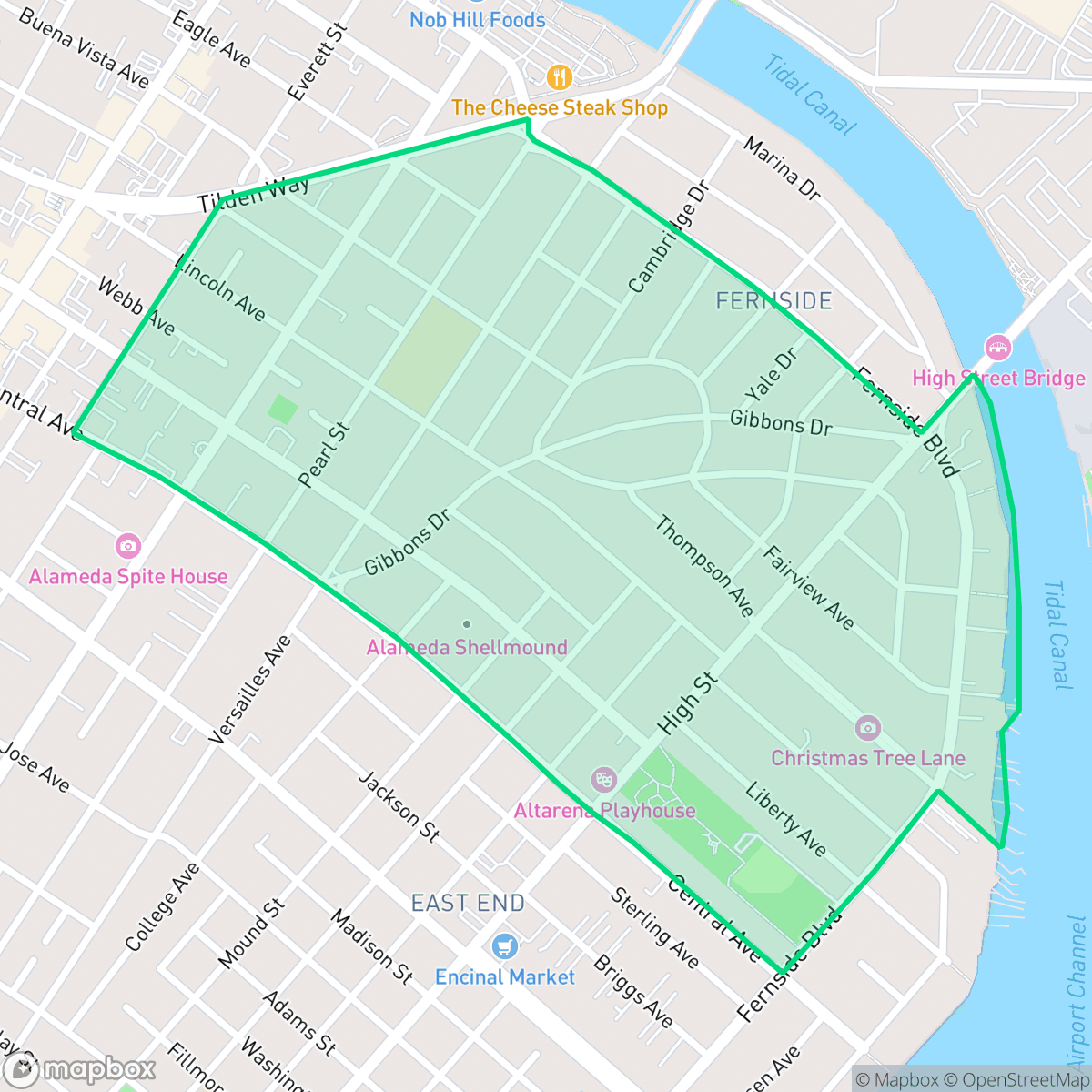
Located on Alameda’s East End, the Fernside neighborhood originated as the 19th-century estate of Alfred A. Cohen, a prominent railroad financier who built a grand Italianate mansion on the property in 1864. After serving for decades as a private estate, orchard, and horse pasture, the land was subdivided in 1925, marking the last major tract of land on the main island to be developed. The Fernside Home Owners Association was incorporated shortly after in 1927. Today, the neighborhood is highly regarded for its tree-lined streets and diverse architectural stock, which includes Tudor Revival, Spanish Colonial, Craftsman, and Storybook-style homes. A key cultural landmark is Thompson Avenue, locally famous as 'Christmas Tree Lane,' which draws visitors from across the San Francisco Bay Area for its elaborate annual holiday light displays.
The neighborhood is defined by its dense suburban layout, characterized by single-family homes and a complete absence of industrial facilities. It maintains a high level of livability with excellent air quality and near-universal health insurance coverage among residents. The area offers a vibrant social atmosphere, striking a balance between residential quiet and local services that makes it a central hub for community engagement in Alameda.
Neighborhood Scores Across 15 Qualities
Structures are positioned with mixed spacing, featuring some tightly packed homes and narrow side yards alongside larger industrial plots and a canal. According to iHuus data, privacy levels are roughly comparable to the rest of Alameda.
Continuous sidewalks and a dense grid layout make most trips easy to complete on foot. This neighborhood offers a sidewalk network that is slightly more comprehensive than the rest of Alameda.
Uniform tract housing and industrial zones define the local landscape. The area features consistent rooflines and small yards, presenting a visual profile that is slightly below the Alameda city average.
Public access to parks and wide grassy verges is below the Alameda average. While some areas feature tree-lined streets, much of the neighborhood's greenery is contained within private backyards.
Open land and scattered homes provide a semi-rural atmosphere that is slightly more expansive than the typical Alameda urban landscape. Residents will find a mix of residential pockets and open spaces that offer a sense of openness compared to the city average.
Local dining and small cafes offer a variety of social spots, making the area more active than much of Alameda. While some blocks remain quiet and suburban, others feature a diverse mix of restaurants and essential services.
Steady hum from nearby busy streets characterizes the area, though acoustic levels remain slightly more peaceful than the Alameda average according to iHuus data.
Air quality remains consistently high with rare instances of elevated readings. According to iHuus data, these levels are typical of the broader Alameda area.
Minimal industrial activity defines this area, as it consists almost entirely of residential and light commercial zones. According to iHuus data, the lack of heavy manufacturing or large warehouses is consistent with the rest of the city.
Health insurance access is nearly universal among residents, sitting slightly above the Alameda city average according to iHuus data.
Voting patterns and census indicators show a very strong liberal leaning, which is consistent with the broader Alameda area according to iHuus data.
Residents live alongside a diverse range of age groups, including young professionals, families, and seniors. This demographic spread is largely consistent with the broader Alameda area, according to iHuus data.
Flood risk levels in Fernside are higher than the Alameda average, though the area lacks a detailed federal study to confirm specific vulnerability. According to iHuus data, the neighborhood falls into a category where precise flood mapping is currently undetermined.
Address-Level Insights for Fernside


iHuus Neighborhood Intelligence Insights
Get address-level neighborhood insights for Fernside
- Street-level scores — see how individual blocks compare, not just neighborhood averages
- Micro-zone boundaries — identify quiet pockets, flood boundaries, and walkable clusters before you visit
- 15 dimensions in full — walkability, noise, air quality, school quality, insurance coverage, population age profile, urban/rural index, and more
- Boundary risk alerts — know if your address sits near a block boundary where scores drop, the kind of detail no listing will ever mention
- School insights — individual school ratings and insights, not just district-level data
- Compare before you commit — side-by-side data across neighborhoods, down to block precision
No credit card required
Compare with Any Neighborhood
| Dimension | Fernside | Alameda Point |
|---|---|---|
| 🚶 Walkabilityavg 9.54 | ||
| 🔊 Acoustic Comfortavg 3.74 | ||
| 🤫 Privacy Indexavg 4.01 | ||
| 🎨 Visual Appealavg 6.39 | ||
| 🐕 Dog Friendlinessavg 7.11 | ||
| 🗺️ Urban-Rural Indexavg 6.41 | ||
| ✨ Neighborhood Vibeavg 5.24 | ||
| 🏥 Health Insurance Coverageavg 9.02 | ||
| 🌿 Air Qualityavg 8 | ||
| 🏭 Industrial Proximityavg 8.45 | ||
| 🌊 Flood Safetyavg 4.99 | ||
| 🗳️ Ideological Leanavg 9.88 | ||
| 👥 Population Age Profileavg 5.15 | ||
| 🔥 Fire Safety | ||
| 🏫 School Quality |
Fernside Rankings
School Districts Serving Fernside
School Insights for Fernside
Below average outcomes; significant attendance and academic challenges.
School Insights
See what's really behind every school rating near Fernside
- Individual school ratings — each school's own score with outcome context, not just a district average
- Enrollment & class size data — student-to-teacher ratio and how it compares to the state average
- Full demographics breakdown — ethnicity and gender composition for every school in the enrollment zone
- Every school in the district — all schools within the enrollment boundary ranked by rating, not just the closest one
- Grade levels & benchmarks — elementary through high school, with below/above state-average flags
No credit card required