East End, Alameda
Updated · 6,131 residents
The East End is a highly walkable Alameda neighborhood defined by its dense grid of historic homes and a vibrant, local culinary scene. Residents benefit from top-tier schools and a peaceful, residential atmosphere that remains connected to the broader East Bay community.
Key Highlights
About East End
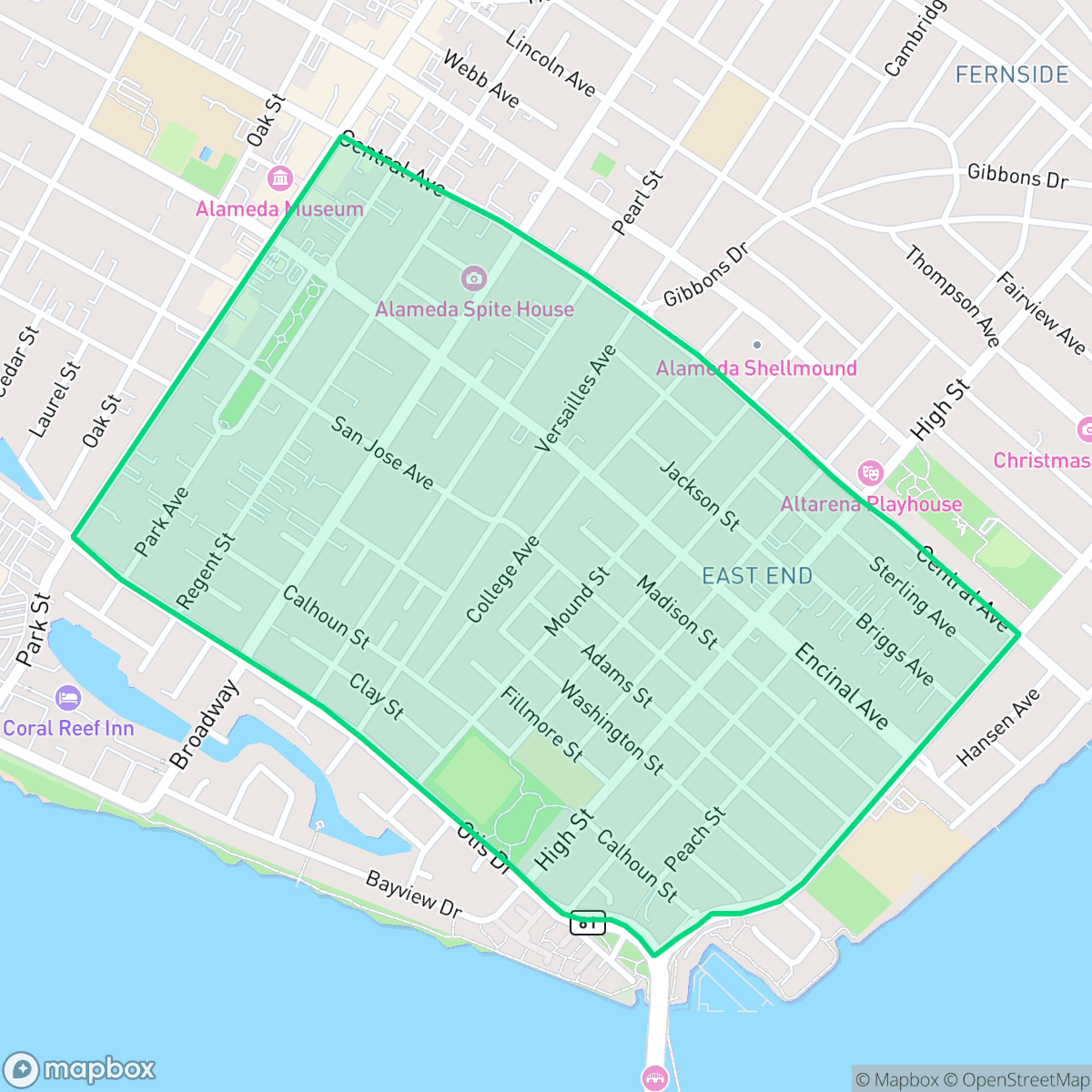
Originally home to the Ohlone people, the East End of Alameda, California, began its modern development in 1851 when William Worthington Chipman and Gideon Aughinbaugh purchased 160 acres of land from Antonio Peralta. Laid out in 1853 with High Street as its axis, the area was initially bypassed by early railroads, leaving it a quiet enclave known as “Old Alameda”. The introduction of Southern Pacific’s electric interurban system in 1908 sparked a major building boom, transforming the East End into a residential haven. Today, the neighborhood is celebrated for its vintage late-19th and early-20th-century homes, including Queen Anne and Craftsman styles. Key local landmarks include Chochenyo Park, which opened in 1895 as the city's first public park, and the 1897 Colonial Revival Meyers House and Garden, designed by renowned East Bay architect Henry H. Meyers.
The neighborhood offers a quintessential urban-suburban experience, characterized by its tightly packed, historic architecture and a grid-based layout that prioritizes pedestrian access. With a perfect walkability score, the area encourages frequent travel on foot to local favorites like Julie's Coffee & Tea Garden and diverse dining options along its commercial corridors. The environment is primarily residential, free from heavy industrial activity, and maintains a consistent, calm pace of life that appeals to those seeking a stable, community-oriented setting. According to recent data, the area maintains excellent air quality and benefits from the high-performing Alameda City Unified School District, making it a reliable choice for families and professionals alike.
Living in this area involves certain trade-offs, particularly regarding privacy and acoustic comfort. Because homes are situated close together with minimal space between structures, residents should expect a high-density living arrangement with limited private outdoor areas. While the neighborhood is generally quiet, road traffic contributes to a moderate noise level that is typical for a central, well-connected urban grid. It is best suited for individuals who value proximity to amenities and a strong sense of community over expansive private yards or total isolation.
Neighborhood Scores Across 15 Qualities
Residential structures are situated in close proximity with minimal separation between properties. According to iHuus data, this level of density is slightly higher than the average for Alameda.
Pedestrian movement is seamless due to a dense grid of continuous sidewalks and clear crossings that even exceeds the Alameda average. Most local errands can be completed on foot via well-connected paths and dedicated coastal walkways.
Streetscapes range from standard middle-class tract housing to premium waterfront properties with private docks. According to iHuus data, the visual landscape is consistent with the overall city average.
Access to public trails and shoreline parks provides good walking opportunities, though overall dog friendliness is slightly below the Alameda average. While some residential pockets feature narrow sidewalks, other areas offer direct access to large green spaces and park paths.
Residential layouts feature a blend of single-family homes and low-rise apartments interspersed with maritime and industrial zones. This character is largely consistent with the broader Alameda area.
Social hubs and local dining options are more concentrated here than in the rest of the city. Residents can find a diverse mix of cafes, sushi, and casual eateries distributed throughout the suburban streets.
A steady hum from local traffic on nearby busy streets is common here. According to iHuus data, acoustic comfort in this area is slightly higher than the city average.
Air quality remains consistently good with rare instances of elevated readings, matching the broader Alameda average according to iHuus data.
Industrial activity and heavy warehouses are absent from this area, making it significantly more free of industrial proximity than the Alameda average. According to iHuus data, the neighborhood consists entirely of residential, retail, and recreational spaces with no detectable heavy industry or hazard sites.
Health insurance access is very high among residents, slightly exceeding the Alameda city average according to iHuus data.
Voting patterns and census indicators reflect a predominantly liberal political leaning, matching the broader Alameda average according to iHuus data.
A balanced mix of young adults, families, and older residents characterizes this area. According to iHuus data, the age distribution is slightly more varied than the average seen across Alameda.
Flood risk in this area is slightly above the city average, though current FEMA records lack a detailed study for this specific location.
Address-Level Insights for East End


iHuus Neighborhood Intelligence Insights
Get address-level neighborhood insights for East End
- Street-level scores — see how individual blocks compare, not just neighborhood averages
- Micro-zone boundaries — identify quiet pockets, flood boundaries, and walkable clusters before you visit
- 15 dimensions in full — walkability, noise, air quality, school quality, insurance coverage, population age profile, urban/rural index, and more
- Boundary risk alerts — know if your address sits near a block boundary where scores drop, the kind of detail no listing will ever mention
- School insights — individual school ratings and insights, not just district-level data
- Compare before you commit — side-by-side data across neighborhoods, down to block precision
No credit card required
Compare with Any Neighborhood
| Dimension | East End | Alameda Point |
|---|---|---|
| 🚶 Walkabilityavg 9.54 | ||
| 🔊 Acoustic Comfortavg 3.74 | ||
| 🤫 Privacy Indexavg 4.01 | ||
| 🎨 Visual Appealavg 6.39 | ||
| 🐕 Dog Friendlinessavg 7.11 | ||
| 🗺️ Urban-Rural Indexavg 6.41 | ||
| ✨ Neighborhood Vibeavg 5.24 | ||
| 🏥 Health Insurance Coverageavg 9.02 | ||
| 🌿 Air Qualityavg 8 | ||
| 🏭 Industrial Proximityavg 8.45 | ||
| 🌊 Flood Safetyavg 4.99 | ||
| 🗳️ Ideological Leanavg 9.88 | ||
| 👥 Population Age Profileavg 5.15 | ||
| 🔥 Fire Safety | ||
| 🏫 School Quality |
East End Rankings
School Districts Serving East End
School Insights for East End
Below average outcomes; significant attendance and academic challenges.
School Insights
See what's really behind every school rating near East End
- Individual school ratings — each school's own score with outcome context, not just a district average
- Enrollment & class size data — student-to-teacher ratio and how it compares to the state average
- Full demographics breakdown — ethnicity and gender composition for every school in the enrollment zone
- Every school in the district — all schools within the enrollment boundary ranked by rating, not just the closest one
- Grade levels & benchmarks — elementary through high school, with below/above state-average flags
No credit card required