Central, Alameda
Updated · 9,854 residents
Central serves as the primary commercial and historic hub of Alameda, defined by its exceptional walkability and dense, tree-lined residential streets. Residents benefit from immediate access to the Park Street corridor, though the area experiences moderate noise levels from road traffic and features a high density of homes with limited private outdoor space.
Key Highlights
About Central
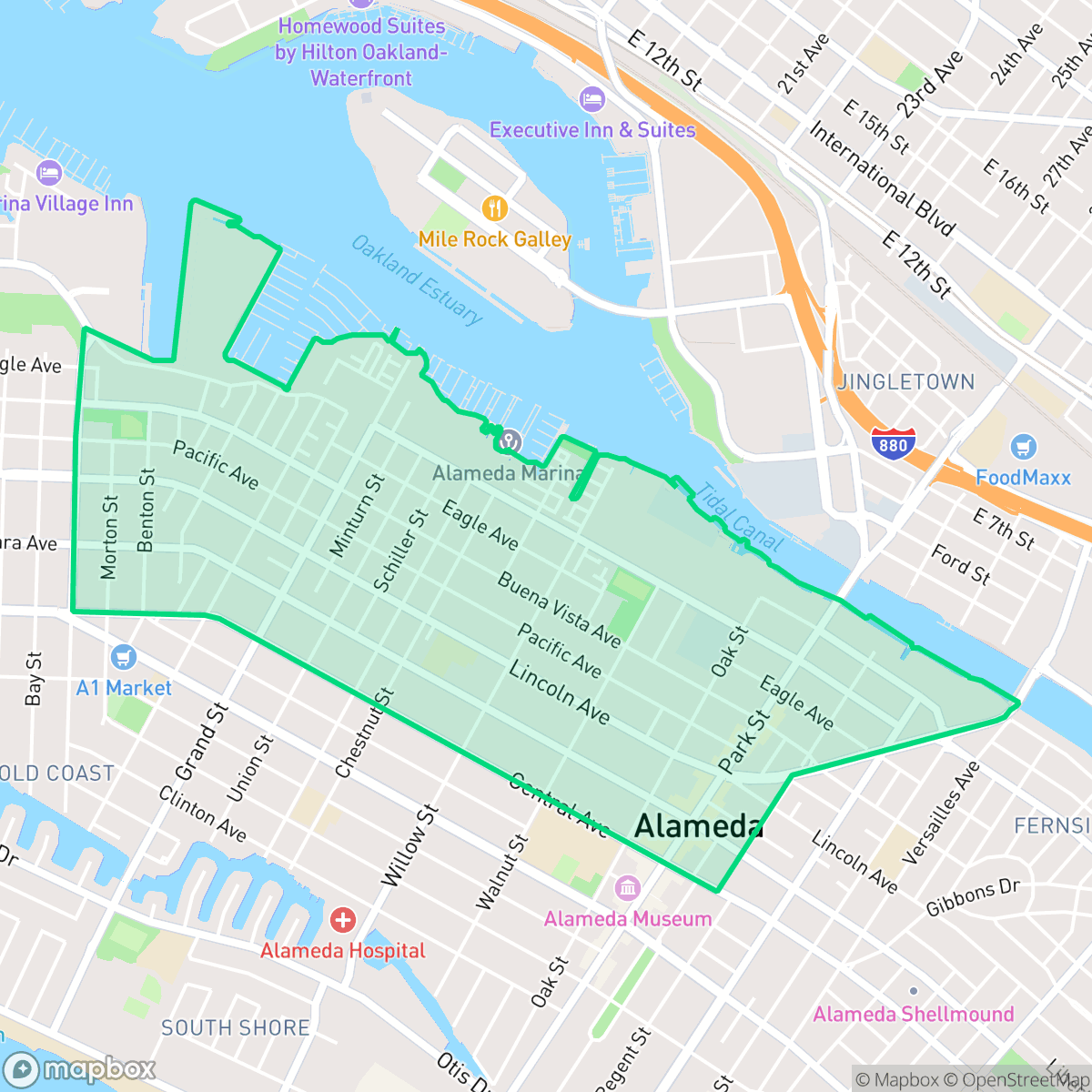
Central Alameda, the historic heart of the island city, is anchored by the vibrant Park Street commercial corridor and extends west toward Grand Avenue. Developed heavily after the completion of the Oakland Estuary tidal canal in 1902, the neighborhood transitioned from early transit roots into a dense, walkable hub. It boasts a remarkable concentration of pre-WWII architecture, with over half its housing stock consisting of historic Queen Anne cottages, Craftsman bungalows, and grand Victorians. Notable neighborhood landmarks include the 1906 Classical Revival Alameda High School, famous for its massive Corinthian columns, and the 1932 Art Deco-Moderne Alameda Theatre designed by Timothy L. Pflueger. Longtime local institutions like Ole’s Waffle Shop on Park Street continue to define the neighborhood’s enduring, community-oriented character.
The area functions as a highly accessible urban core where residents can reach daily amenities and transit options on foot. The neighborhood maintains a consistent, grid-based layout that supports a vibrant street life, blending local dining, service-oriented businesses, and community institutions. While the housing stock is characterized by a mix of historic residential styles and modern apartment blocks, the overall environment is dense, with structures often spaced closely together.
Prospective residents should anticipate a lively atmosphere with moderate ambient noise primarily generated by road traffic. The neighborhood is well-suited for those who prioritize proximity to schools and commerce over expansive private yards or total seclusion. With strong public health coverage and a high-performing school district, the area offers a stable environment for families and professionals seeking a walkable, urban-suburban lifestyle.
Neighborhood Scores Across 15 Qualities
Residential structures are often closely packed with minimal setbacks or shared walls. This density is roughly in line with the rest of Alameda.
Extensive sidewalk networks and clear pedestrian crossings define the area, making it just as easy to navigate on foot as the rest of Alameda. Residents benefit from a dense grid layout that connects residential streets directly to waterfront amenities and parks.
Uniform tract housing and multi-unit complexes define the landscape, which features mostly boxy rooflines and small yards. This visual character is slightly below the city average for Alameda.
Access to public parks and continuous green verges is more limited here than in the rest of Alameda. While some areas feature large parks and shoreline trails, other parts of the neighborhood rely primarily on private backyards for green space.
A blend of low-rise residential blocks and industrial warehouses creates a landscape that is slightly more semi-rural than the Alameda average. According to iHuus data, the area features a mix of single-family homes and dense street grids alongside larger commercial infrastructure.
Lively pockets of dining and local services provide more activity than the typical Alameda neighborhood. While some areas remain quiet and suburban, many blocks feature a concentrated mix of eateries, cafes, and community spaces.
Steady traffic noise from nearby busy streets is present, though levels are slightly more tranquil than the city average according to iHuus data.
Air quality remains consistently good with rare instances of elevated readings. This level of air purity is consistent with the average for Alameda.
No heavy industry, warehouses, or hazardous facilities are present within the neighborhood. This area offers a more residential environment than the city average, featuring only light commercial use and maritime recreation.
Health insurance access is widespread among residents, matching the broader Alameda city average. According to iHuus data, nearly all inhabitants are covered by a health plan.
Voting patterns and census indicators show a deeply liberal political leaning that is consistent with the rest of Alameda. According to iHuus data, this neighborhood shares the same high level of liberal-leaning characteristics as the city average.
A balanced mix of young professionals, families, and seniors characterizes the area. This demographic spread is consistent with the broader Alameda population according to iHuus data.
Residual flood risk exists within this area due to its location in a 500-year floodplain. According to iHuus data, flood safety levels in Central are notably higher than the average for the rest of the city.
Address-Level Insights for Central


iHuus Neighborhood Intelligence Insights
Get address-level neighborhood insights for Central
- Street-level scores — see how individual blocks compare, not just neighborhood averages
- Micro-zone boundaries — identify quiet pockets, flood boundaries, and walkable clusters before you visit
- 15 dimensions in full — walkability, noise, air quality, school quality, insurance coverage, population age profile, urban/rural index, and more
- Boundary risk alerts — know if your address sits near a block boundary where scores drop, the kind of detail no listing will ever mention
- School insights — individual school ratings and insights, not just district-level data
- Compare before you commit — side-by-side data across neighborhoods, down to block precision
No credit card required
Compare with Any Neighborhood
| Dimension | Central | Alameda Point |
|---|---|---|
| 🚶 Walkabilityavg 9.54 | ||
| 🔊 Acoustic Comfortavg 3.74 | ||
| 🤫 Privacy Indexavg 4.01 | ||
| 🎨 Visual Appealavg 6.39 | ||
| 🐕 Dog Friendlinessavg 7.11 | ||
| 🗺️ Urban-Rural Indexavg 6.41 | ||
| ✨ Neighborhood Vibeavg 5.24 | ||
| 🏥 Health Insurance Coverageavg 9.02 | ||
| 🌿 Air Qualityavg 8 | ||
| 🏭 Industrial Proximityavg 8.45 | ||
| 🌊 Flood Safetyavg 4.99 | ||
| 🗳️ Ideological Leanavg 9.88 | ||
| 👥 Population Age Profileavg 5.15 | ||
| 🔥 Fire Safety | ||
| 🏫 School Quality |
Central Rankings
School Districts Serving Central
School Insights for Central
Below average outcomes; significant attendance and academic challenges.
School Insights
See what's really behind every school rating near Central
- Individual school ratings — each school's own score with outcome context, not just a district average
- Enrollment & class size data — student-to-teacher ratio and how it compares to the state average
- Full demographics breakdown — ethnicity and gender composition for every school in the enrollment zone
- Every school in the district — all schools within the enrollment boundary ranked by rating, not just the closest one
- Grade levels & benchmarks — elementary through high school, with below/above state-average flags
No credit card required