Bronze Coast, Alameda
Updated · 6,660 residents
The Bronze Coast is a highly walkable, dense suburban enclave in Alameda characterized by its historic architectural charm and proximity to recreational waterfront areas. Residents enjoy a quiet, residential atmosphere with excellent access to top-rated schools and green spaces like Franklin Park.
Key Highlights
About Bronze Coast
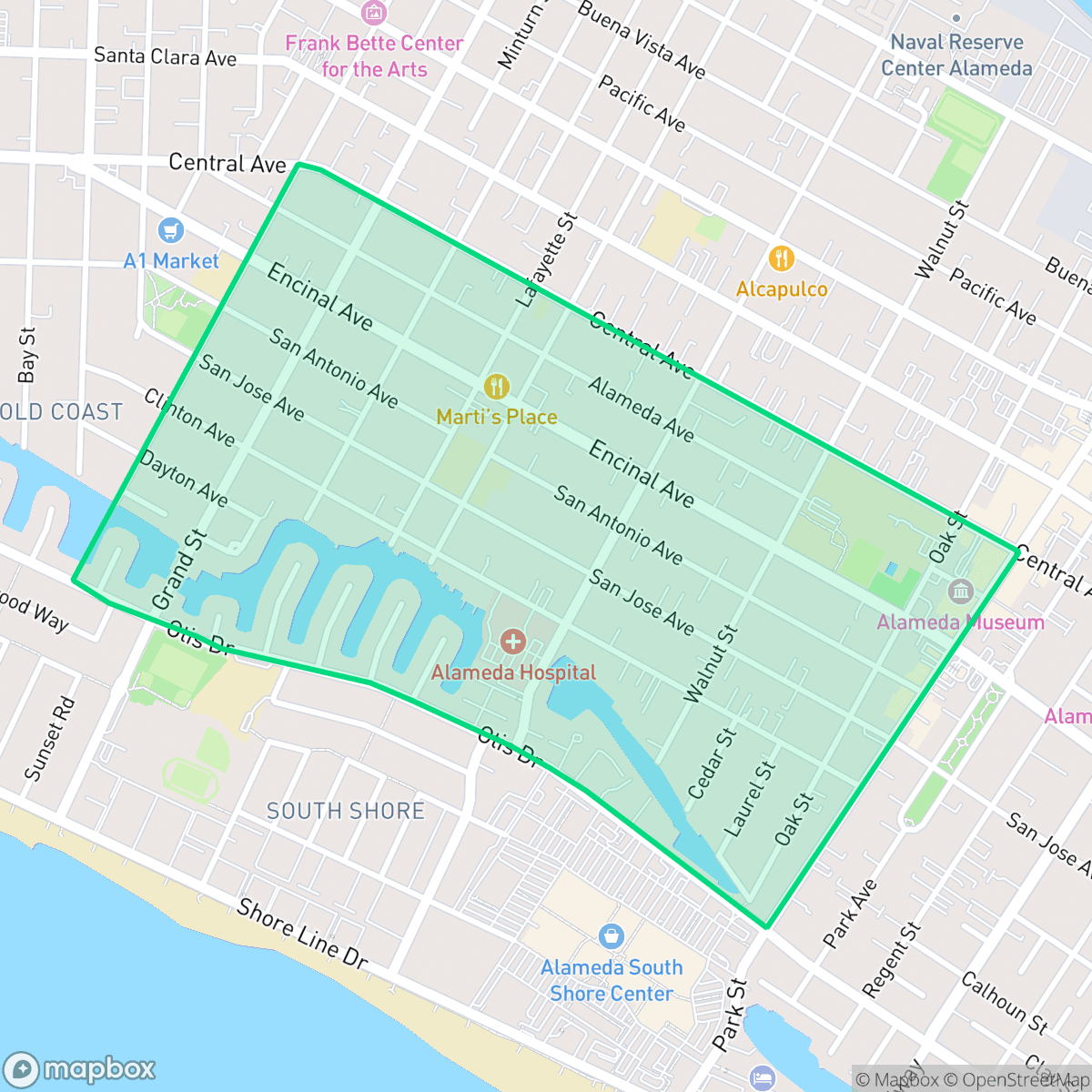
Coined in the late 20th century as a playful counterpart to the neighboring Gold Coast, Alameda's Bronze Coast is bounded by Grand Street, Park Street, Central Avenue, and the lagoon. The neighborhood encompasses "Leonardville," a historic heritage area boasting Queen Anne Victorian homes built in the 1890s by noted developer Joseph A. Leonard, alongside designs by legendary architect Julia Morgan. When the Naval Air Base opened in 1940, many of the area's grand estates were divided into multi-family units or replaced with apartments, creating a uniquely diverse and dense housing stock. Today, this walkable enclave centers around Franklin Park and is famous for its vibrant community spirit, particularly during the city’s historic 4th of July Parade and elaborate neighborhood Halloween displays.
The area offers a peaceful living environment defined by its commitment to residential and recreational use. With a perfect walkability score, the neighborhood grid allows for easy navigation to local parks and nearby community hubs. The visual landscape is marked by well-maintained homes and private lagoons, contributing to a high standard of aesthetic appeal. While the neighborhood lacks significant commercial activity, its residential density and proximity to the water create a distinct, quiet suburban character that avoids industrial noise and hazards.
Prospective residents will find a community that prioritizes safety and education, supported by the highly-rated Alameda City Unified School District. The area is well-suited for families and individuals seeking a stable, quiet environment with strong social cohesion. While housing is tightly spaced with limited privacy between neighbors, the trade-off is a deeply integrated community feel. The neighborhood maintains a consistent, quiet acoustic profile, making it an ideal choice for those who value tranquility over proximity to high-traffic commercial centers.
Neighborhood Scores Across 15 Qualities
Homes and apartment buildings are situated in close proximity with minimal separation between structures. This density is slightly higher than the average for Alameda, meaning property lines and building walls are often very near to one another.
Extremely easy to navigate on foot due to a continuous sidewalk network and clear pedestrian crossings. This area offers superior pedestrian infrastructure compared to the rest of Alameda.
Residential vistas consist primarily of uniform tract housing and boxy rooflines, making the visual landscape slightly below the Alameda average. While some waterfront areas feature private lagoons and pools, much of the neighborhood maintains a dense, functional aesthetic.
Limited street-side verges and fewer public parks compared to the rest of Alameda mean fewer spontaneous walking opportunities. While some areas offer direct access to waterfront paths and sandy beaches, overall greenery for pets is below the city average.
Residential layouts feature a blend of single-family homes, apartment complexes, and nearby marina facilities. This landscape is largely consistent with the broader Alameda area, offering a mix of low-density housing and small-scale commercial blocks.
Local dining and social spots provide a more active atmosphere than the Alameda average. While some residential streets remain quiet and suburban, several pockets feature a noticeable concentration of cafes and diverse eateries according to iHuus data.
Steady hum from nearby busy streets defines the local soundscape, though levels remain more tranquil than the Alameda average according to iHuus data.
Air quality in this area is consistently good with rare instances of elevated readings. This level of air cleanliness is typical for the rest of Alameda.
Industrial activity and warehouses are entirely absent from this area, offering a cleaner environment than the Alameda average. According to iHuus data, the neighborhood consists strictly of residential, retail, and recreational zones with no detectable heavy industry or hazardous sites.
Health insurance access is nearly universal among residents, representing a rate slightly higher than the Alameda average according to iHuus data.
Voting patterns and census indicators show a predominantly liberal political leaning, which is consistent with the broader Alameda area according to iHuus data.
Residents live alongside a diverse range of age groups, from young professionals to seniors. This demographic distribution is consistent with the broader Alameda area.
Residual flood risks exist as some areas fall within the 500-year floodplain, though safety levels remain notably higher than the Alameda city average according to iHuus data.
Address-Level Insights for Bronze Coast


iHuus Neighborhood Intelligence Insights
Get address-level neighborhood insights for Bronze Coast
- Street-level scores — see how individual blocks compare, not just neighborhood averages
- Micro-zone boundaries — identify quiet pockets, flood boundaries, and walkable clusters before you visit
- 15 dimensions in full — walkability, noise, air quality, school quality, insurance coverage, population age profile, urban/rural index, and more
- Boundary risk alerts — know if your address sits near a block boundary where scores drop, the kind of detail no listing will ever mention
- School insights — individual school ratings and insights, not just district-level data
- Compare before you commit — side-by-side data across neighborhoods, down to block precision
No credit card required
Compare with Any Neighborhood
| Dimension | Bronze Coast | Alameda Point |
|---|---|---|
| 🚶 Walkabilityavg 9.54 | ||
| 🔊 Acoustic Comfortavg 3.74 | ||
| 🤫 Privacy Indexavg 4.01 | ||
| 🎨 Visual Appealavg 6.39 | ||
| 🐕 Dog Friendlinessavg 7.11 | ||
| 🗺️ Urban-Rural Indexavg 6.41 | ||
| ✨ Neighborhood Vibeavg 5.24 | ||
| 🏥 Health Insurance Coverageavg 9.02 | ||
| 🌿 Air Qualityavg 8 | ||
| 🏭 Industrial Proximityavg 8.45 | ||
| 🌊 Flood Safetyavg 4.99 | ||
| 🗳️ Ideological Leanavg 9.88 | ||
| 👥 Population Age Profileavg 5.15 | ||
| 🔥 Fire Safety | ||
| 🏫 School Quality |
Bronze Coast Rankings
School Districts Serving Bronze Coast
School Insights for Bronze Coast
Below average outcomes; significant attendance and academic challenges.
School Insights
See what's really behind every school rating near Bronze Coast
- Individual school ratings — each school's own score with outcome context, not just a district average
- Enrollment & class size data — student-to-teacher ratio and how it compares to the state average
- Full demographics breakdown — ethnicity and gender composition for every school in the enrollment zone
- Every school in the district — all schools within the enrollment boundary ranked by rating, not just the closest one
- Grade levels & benchmarks — elementary through high school, with below/above state-average flags
No credit card required