Charnwood District, Tyler
Updated · 313 residents
The Charnwood District is a visually striking neighborhood known for its high walkability and diverse collection of historic homes. While the area offers a lively atmosphere and easy access to local dining, residents should be aware of elevated noise levels from nearby road traffic and railway activity.
Key Highlights
About Charnwood District
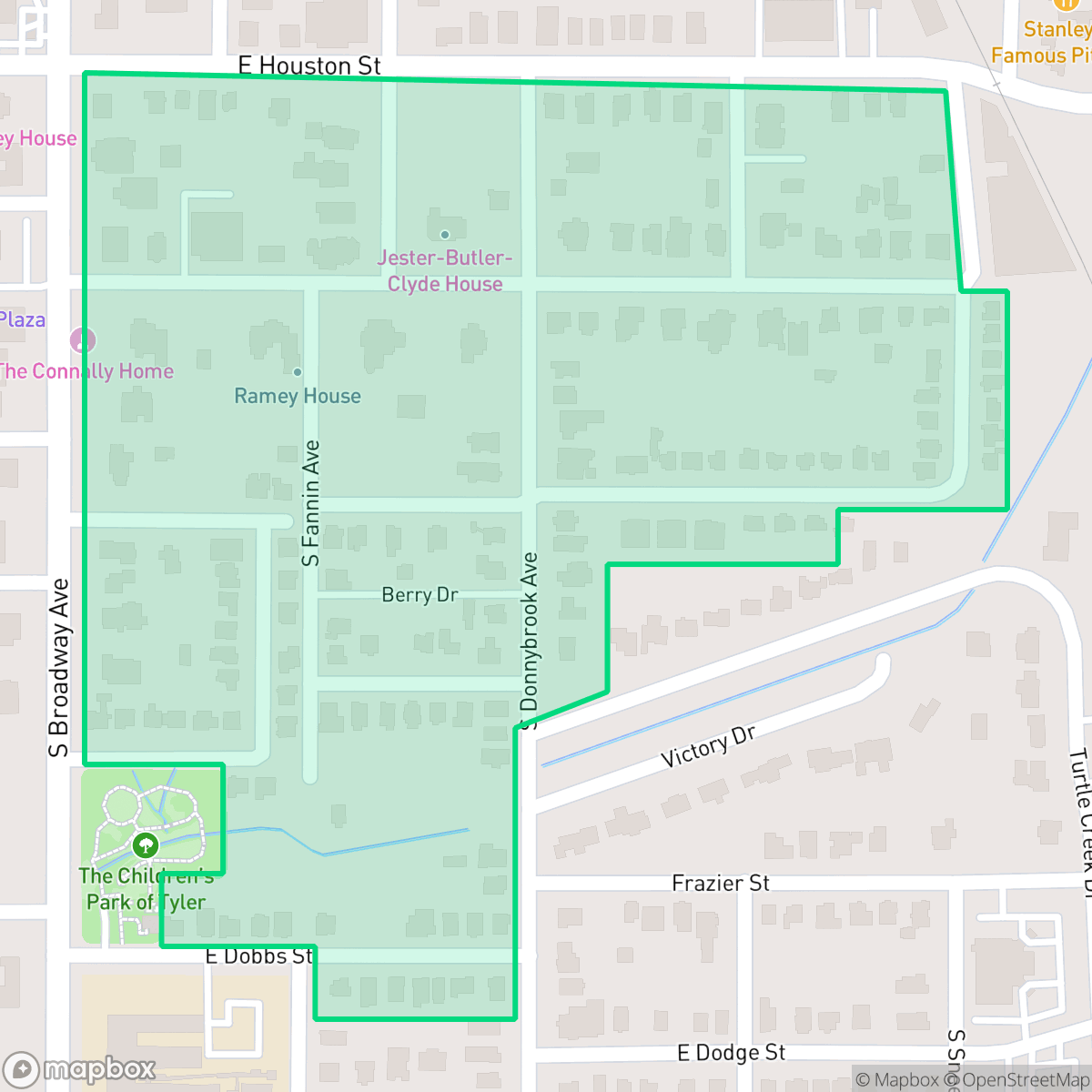
Listed on the National Register of Historic Places in 1999, the Charnwood Residential Historic District is Tyler, Texas's first historic district. Known in the 19th century as "South Tyler," the 59.5-acre neighborhood originally attracted working-class families before becoming a premier enclave for the city's business elite. Spanning roughly 15 blocks, Charnwood features a diverse array of mid-19th to mid-20th-century architectural styles, including Tudor Revival, Colonial Revival, and Queen Anne. Prominent landmarks include the 1861 Hand-Mayfield-Hunt House—which once served the 1853 Eastern Texas Female College and later the Charnwood Institute—and the 1908 Connally-Musselman House, an eclectic blend of Prairie, Craftsman, and Italianate styles. The district remains celebrated for its preserved craftsmanship and deep-rooted community heritage.
This area stands out for its strong visual appeal and active street life, which significantly exceeds the city average for vibrancy. Residents benefit from a highly walkable environment that makes navigating the local streets and nearby dining options convenient. The neighborhood maintains a balanced suburban feel, characterized by well-kept green spaces and a predominantly residential layout that keeps industrial proximity minimal. According to iHuus data, the community also benefits from higher-than-average health insurance coverage rates compared to the broader city.
Prospective residents should weigh the benefits of this central location against specific environmental factors. The area experiences consistent noise from road traffic and rail lines, resulting in a lower acoustic comfort rating. Additionally, the district faces significant challenges regarding flood safety, and those considering a move should review local hazard maps. It is best suited for individuals who prioritize architectural heritage and walkability over absolute quiet or flood-prone terrain.
Neighborhood Scores Across 15 Qualities
Residential spacing is mixed, providing some buffer between neighbors but remaining comparable to the Tyler average. According to iHuus data, homes in Charnwood District feature moderate density without significant isolation.
Sidewalks and safe crossings are widely available, making pedestrian travel significantly more accessible than the typical Tyler neighborhood. Most short trips within the area can be completed on foot according to iHuus data.
Large homes and frequent upscale amenities provide a premium aesthetic that is noticeably more polished than the Tyler average, according to iHuus data.
Access to public parks and green spaces is roughly in line with the Tyler average. According to iHuus data, the area provides adequate space for pet owners, though it lacks exceptional amounts of continuous green verges.
Open land and scattered homes among woodlands characterize this area. According to iHuus data, the landscape is notably less developed than the typical Tyler urban environment.
Frequent access to diverse dining options and local amenities provides a much higher level of activity than the Tyler average. Residents can enjoy a lively suburban atmosphere characterized by balanced streetscapes and nearby greenery.
A steady hum of local traffic from a nearby busy street is common here. This level of ambient noise is roughly consistent with the average for Tyler.
Air quality in this area is generally good with infrequent periods of elevated readings. According to iHuus data, the air quality is slightly better than the Tyler average.
No warehouses, industrial facilities, or hazard sites are present within the neighborhood. This area is notably more free of industrial proximity than the Tyler average, consisting instead of quiet streets and open green spaces.
Health insurance enrollment among residents is notably higher than the Tyler city average, according to iHuus data.
Political leanings in this area are evenly distributed, reflecting a balance of conservative and liberal views that is largely in line with the broader Tyler area.
Residents experience a diverse demographic spread of young adults, families, and older individuals. This age distribution is largely comparable to the broader Tyler area, according to iHuus data.
Address-Level Insights for Charnwood District


iHuus Neighborhood Intelligence Insights
Get address-level neighborhood insights for Charnwood District
- Street-level scores — see how individual blocks compare, not just neighborhood averages
- Micro-zone boundaries — identify quiet pockets, flood boundaries, and walkable clusters before you visit
- 15 dimensions in full — walkability, noise, air quality, school quality, insurance coverage, population age profile, urban/rural index, and more
- Boundary risk alerts — know if your address sits near a block boundary where scores drop, the kind of detail no listing will ever mention
- School insights — individual school ratings and insights, not just district-level data
- Compare before you commit — side-by-side data across neighborhoods, down to block precision
No credit card required
Charnwood District Rankings
School Districts Serving Charnwood District
School Insights for Charnwood District
Below average outcomes; significant attendance and academic challenges.
School Insights
See what's really behind every school rating near Charnwood District
- Individual school ratings — each school's own score with outcome context, not just a district average
- Enrollment & class size data — student-to-teacher ratio and how it compares to the state average
- Full demographics breakdown — ethnicity and gender composition for every school in the enrollment zone
- Every school in the district — all schools within the enrollment boundary ranked by rating, not just the closest one
- Grade levels & benchmarks — elementary through high school, with below/above state-average flags
No credit card required