Downtown Midland Management District, Midland
Updated · 403 residents
The Downtown Midland Management District serves as the commercial and cultural hub of the city, defined by its historic oil-era architecture and modern public spaces like Centennial Park. While the area offers a lively atmosphere with diverse dining options, it remains a car-dependent environment with notable road traffic noise. According to iHuus data, the district provides a unique blend of urban activity and industrial heritage, though residents should anticipate limited walkability and challenges regarding air quality.
Key Highlights
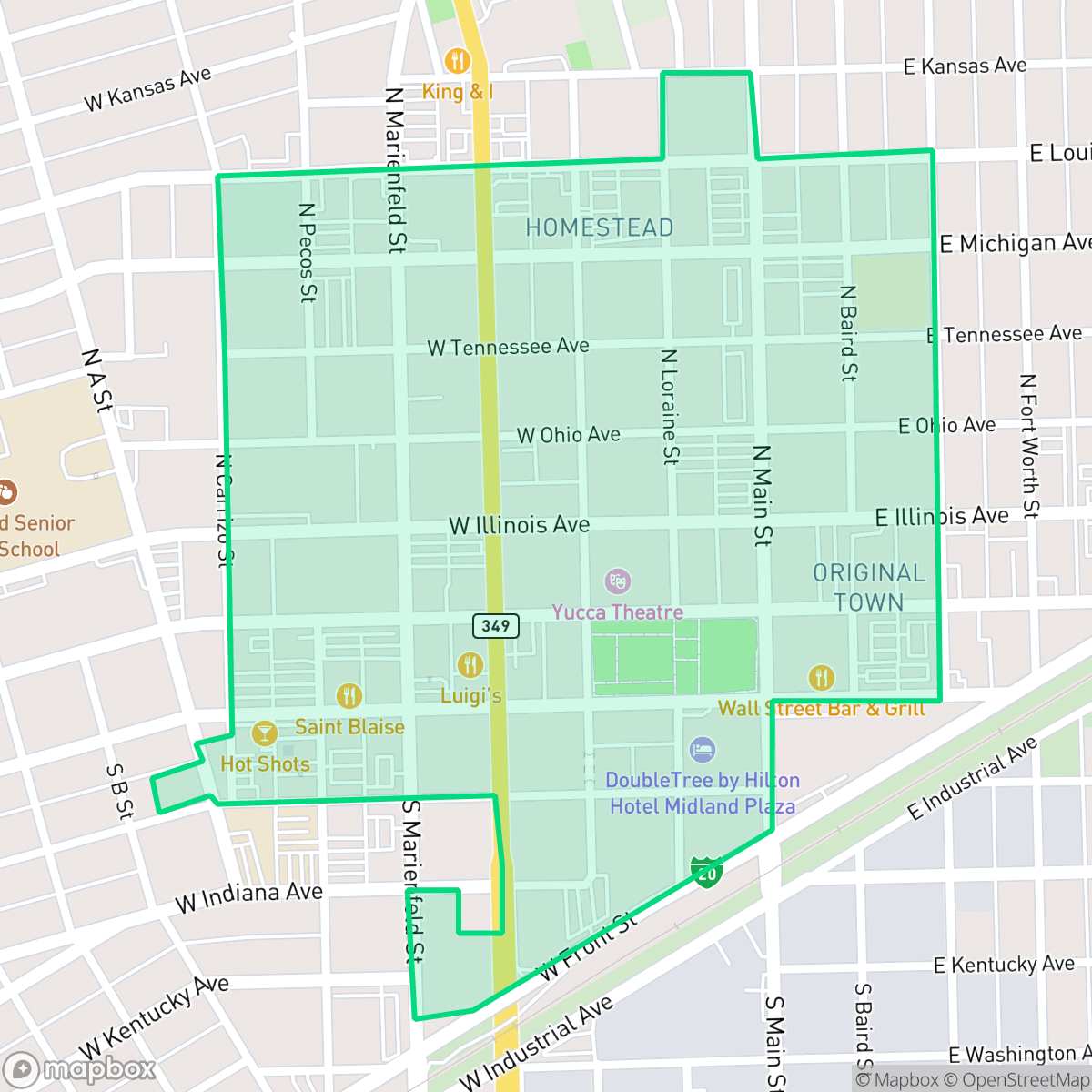
About Downtown Midland Management District
The Downtown Midland Management District, established in 2003 by the Texas Legislature, encompasses the historic and architectural heart of Midland's oil-driven boom era. The district features notable architectural landmarks, including the 1928 T.S. Hogan Petroleum Building, a 12-story Neo-Gothic high-rise designed by Wyatt C. Hedrick that symbolizes the region's early petroleum industry. Directly adjacent is the historic Yucca Theatre, which opened in 1929 and hosts the "Summer Mummers," the longest-running continuous melodrama in the United States. The neighborhood's skyline is anchored by the 24-story Bank of America Building, designed by famed Texas architect George Dahl. At the center of this revitalizing district is Centennial Park, a premier public space that serves as a community gathering hub alongside the modern Bush Convention Center.
The area functions as the primary center for commerce and community engagement in Midland. It balances its legacy as the heart of the petroleum industry with ongoing efforts to revitalize the urban core through projects like the Bush Convention Center. The streetscape is characterized by a mix of historic high-rises and active commercial zones, creating a distinct daytime energy that contrasts with the quieter residential pockets found nearby. Visitors and residents alike will find a neighborhood that prioritizes professional and cultural access over suburban tranquility.
Prospective residents should note that the neighborhood is primarily car-dependent, with limited pedestrian infrastructure despite the concentration of amenities. While the area benefits from high flood safety ratings, iHuus analysis indicates that factors such as air quality and health insurance coverage are significant considerations for those evaluating long-term livability. The district is best suited for individuals who prioritize proximity to the city's professional and cultural core over extensive outdoor recreation or high-density residential amenities.
Neighborhood Scores Across 15 Qualities
Building density is consistent with the city average, providing a balance of mixed spacing and some buffer between neighbors. Residents can expect a typical urban layout where some proximity to adjacent structures is present.
Quiet streets allow for some movement on foot, but a lack of sidewalks makes navigating the area more difficult than in other parts of Midland. According to iHuus data, pedestrian accessibility is below the city average.
Standard building structures and minimal greenery characterize this area. The visual environment is less lush than the Midland average, featuring simple architectural lines and small, tidy lots.
Limited access to green verges and public parks makes this area less ideal for dog owners. According to iHuus data, pet-friendly amenities are below the Midland city average.
Frequent open land and scattered development create a more rural atmosphere, though this is slightly less pronounced than the typical Midland landscape according to iHuus data.
Frequent activity is driven by a notable concentration of local dining and social hubs, making this area significantly more lively than the Midland average. While diverse eateries and parks provide steady engagement, most blocks remain car-dependent.
Continuous traffic sounds from nearby busy streets define the acoustic environment. This level of noise is more noticeable here than in many other parts of the city.
Residential life here remains largely undisturbed by heavy industry, featuring mostly light commercial activity and quiet streets. This lack of industrial proximity is slightly better than the Midland average according to iHuus data.
Health insurance access among residents is notably lower than the Midland city average, according to iHuus data.
Political leanings in this area are predominantly conservative, representing a more conservative presence than the broader Midland area according to iHuus data.
Residents live alongside a balanced mix of young professionals, families, and older adults. This age distribution is consistent with the broader Midland area.
Properties within the 100-year floodplain are subject to elevated flood risks, which may necessitate flood insurance according to iHuus data. This area presents a higher risk of flooding than the Midland average.
Address-Level Insights for Downtown Midland Management District


iHuus Neighborhood Intelligence Insights
Get address-level neighborhood insights for Downtown Midland Management District
- Street-level scores — see how individual blocks compare, not just neighborhood averages
- Micro-zone boundaries — identify quiet pockets, flood boundaries, and walkable clusters before you visit
- 15 dimensions in full — walkability, noise, air quality, school quality, insurance coverage, population age profile, urban/rural index, and more
- Boundary risk alerts — know if your address sits near a block boundary where scores drop, the kind of detail no listing will ever mention
- School insights — individual school ratings and insights, not just district-level data
- Compare before you commit — side-by-side data across neighborhoods, down to block precision
No credit card required
Downtown Midland Management District Rankings
School Districts Serving Downtown Midland Management District
School Insights for Downtown Midland Management District
Below average outcomes; significant attendance and academic challenges.
School Insights
See what's really behind every school rating near Downtown Midland Management District
- Individual school ratings — each school's own score with outcome context, not just a district average
- Enrollment & class size data — student-to-teacher ratio and how it compares to the state average
- Full demographics breakdown — ethnicity and gender composition for every school in the enrollment zone
- Every school in the district — all schools within the enrollment boundary ranked by rating, not just the closest one
- Grade levels & benchmarks — elementary through high school, with below/above state-average flags
No credit card required