Hamlet, Everman
Updated · 1,763 residents
Hamlet is a quiet, semi-rural neighborhood in Everman, Texas, defined by its uniform tract housing and peaceful atmosphere. Residents benefit from notable acoustic comfort, though the area remains car-dependent and requires awareness of local flood risks.
Key Highlights
About Hamlet
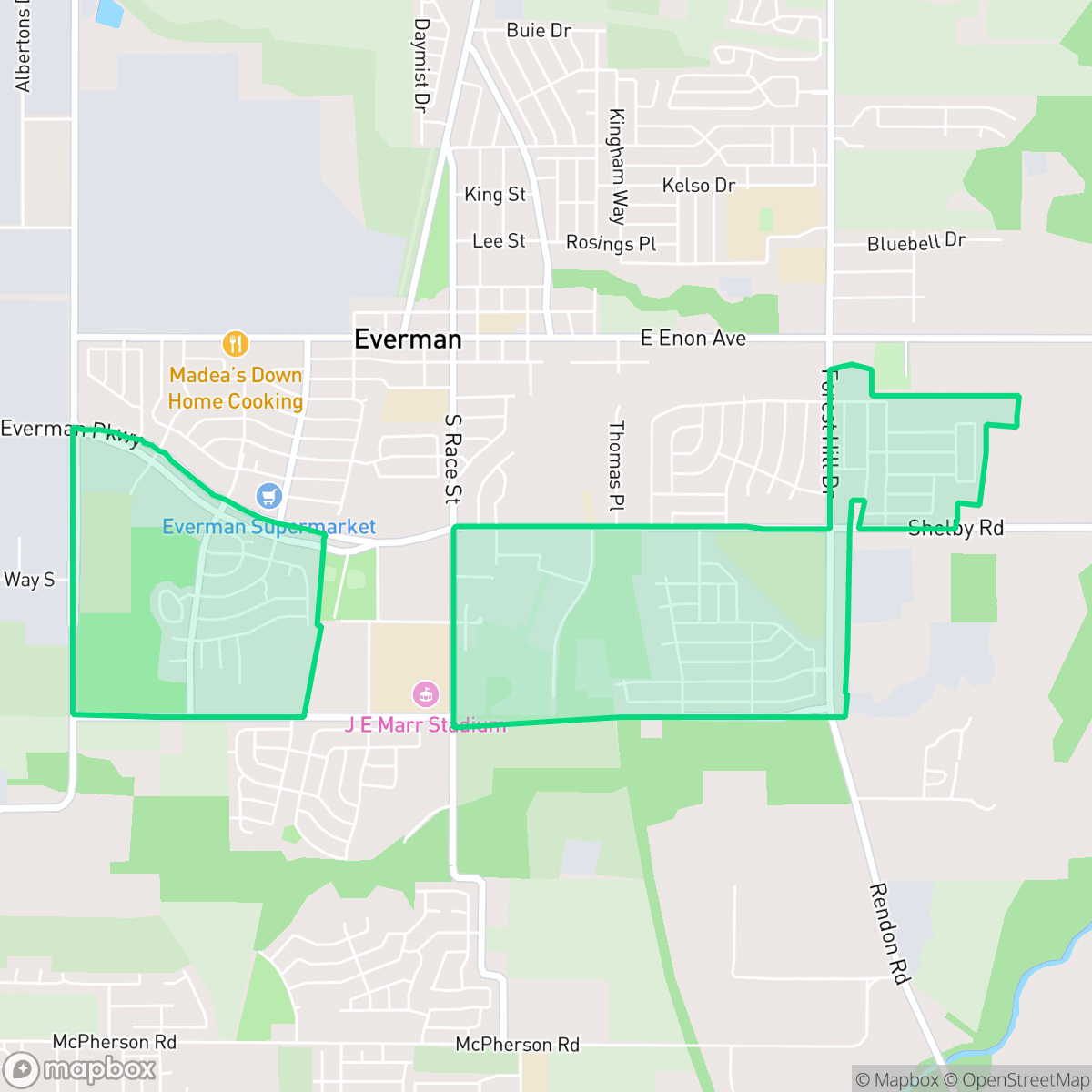
Hamlet presents a semi-rural character, defined by large open fields interspersed with standard suburban tract housing. The neighborhood maintains a peaceful environment with minimal noise pollution, offering a quiet retreat from more congested regions. Its layout consists of closely positioned homes with modest yards, reflecting a suburban density that balances residential space with the surrounding open landscape.
Living in this area requires navigating specific trade-offs, particularly regarding environmental and infrastructure factors. The neighborhood is situated within a 100-year floodplain, making flood insurance a critical consideration for homeowners. Furthermore, residents rely on personal vehicles for daily errands, as the area lacks significant commercial density. Families should also consider that the local school district is currently undergoing external management due to academic challenges, and public amenities for pets are limited.
Neighborhood Scores Across 15 Qualities
Residential spacing is typical of dense suburban developments, with houses positioned closely together and small side yards. This level of separation between neighbors is roughly in line with the average for Everman.
Pedestrian access is supported by sidewalks on certain streets and safe crossings, though many residents may rely on low-traffic roads. This level of walkability is slightly above the Everman average according to iHuus data.
Standard tract housing with small lots and uniform rooflines defines the area. This landscape is slightly more visually varied than the average for Everman.
Private backyards are the primary area for pets, as the neighborhood lacks large public parks and features narrow sidewalk verges. This level of accessibility is slightly below the Everman average according to iHuus data.
Large open fields and scattered homes define the landscape, mirroring the broader city average for the region. This edge-of-town environment provides a balance between low-density development and nearby industrial logistics areas.
Low density and vast open spaces create a serene, rural atmosphere, though the area lacks significant commercial character. Residents will find the landscape primarily functional and car-oriented, a trend that is slightly more pronounced here than in the rest of Everman.
Acoustic levels are notably lower than the Everman average, characterized primarily by infrequent distant trains and sporadic vehicle noise. According to iHuus data, the area maintains a high level of acoustic comfort for residents.
Air quality levels fluctuate between acceptable and unhealthy, presenting occasional concerns for sensitive groups. This condition is consistent with the average seen across Everman.
Industrial and commercial facilities, including warehouses and logistics hubs with heavy truck traffic, exist alongside residential areas. According to iHuus data, the level of industrial proximity is slightly lower than the Everman city average.
Health insurance accessibility is low in this area and falls below the Everman average. According to iHuus data, a small portion of the population possesses medical coverage.
Voting patterns and census indicators in Hamlet align closely with the broader liberal leaning observed across Everman.
Residents live alongside a balanced mix of young adults, families, and older individuals. This age distribution is consistent with the average seen across Everman.
Located within a 100-year floodplain, this area carries a significant risk of flooding that matches the city average. Residents should be aware that flood insurance is typically required for properties here according to iHuus data.
Address-Level Insights for Hamlet


iHuus Neighborhood Intelligence Insights
Get address-level neighborhood insights for Hamlet
- Street-level scores — see how individual blocks compare, not just neighborhood averages
- Micro-zone boundaries — identify quiet pockets, flood boundaries, and walkable clusters before you visit
- 15 dimensions in full — walkability, noise, air quality, school quality, insurance coverage, population age profile, urban/rural index, and more
- Boundary risk alerts — know if your address sits near a block boundary where scores drop, the kind of detail no listing will ever mention
- School insights — individual school ratings and insights, not just district-level data
- Compare before you commit — side-by-side data across neighborhoods, down to block precision
No credit card required
Hamlet Rankings
School Districts Serving Hamlet
School Insights for Hamlet
Below average outcomes; significant attendance and academic challenges.
School Insights
See what's really behind every school rating near Hamlet
- Individual school ratings — each school's own score with outcome context, not just a district average
- Enrollment & class size data — student-to-teacher ratio and how it compares to the state average
- Full demographics breakdown — ethnicity and gender composition for every school in the enrollment zone
- Every school in the district — all schools within the enrollment boundary ranked by rating, not just the closest one
- Grade levels & benchmarks — elementary through high school, with below/above state-average flags
No credit card required