Winnetka Heights, Cockrell Hill
Updated · 56,310 residents
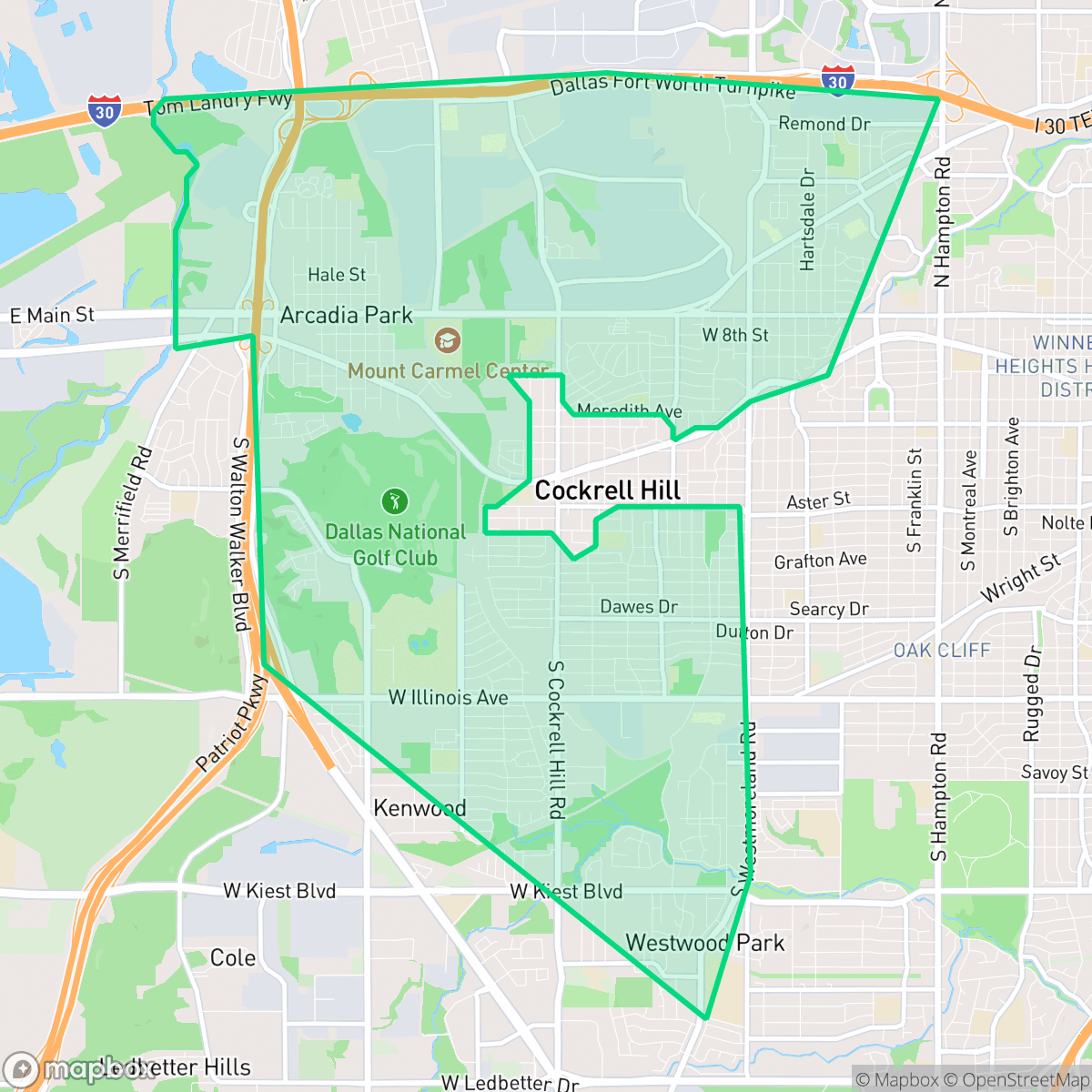
Winnetka Heights is a historic Oak Cliff neighborhood defined by its early 20th-century architecture and a grid-based street layout that supports moderate walkability. Residents benefit from accessible green spaces and local parks, though the area is characterized by dense housing and proximity to industrial logistics zones.
Key Highlights
About Winnetka Heights
Platted in 1908 and developed starting in 1910 by J.P. Blake, Leslie Stemmons, R.S. Waldron, and T.S. Miller Jr., Winnetka Heights is a prominent historic district in the Oak Cliff area of Dallas, Texas, adjacent to Cockrell Hill. Originally promoted as "Dallas’ Ideal Suburb," the 50-block neighborhood is celebrated for its exceptional collection of early 20th-century Craftsman bungalows and Prairie-style Four-square homes. Notable landmarks include the Turner House (originally the J.P. Blake home), which serves as the headquarters for the Oak Cliff Society of Fine Arts. Additionally, the neighborhood is the birthplace of the global convenience store chain 7-Eleven, which originated in 1927 when the local Southland Ice Company on West 12th Street began selling everyday staples like milk, bread, and eggs.
The neighborhood maintains a dense suburban atmosphere, blending residential clusters with nearby logistics and warehouse infrastructure. While the streets follow a consistent grid pattern that facilitates pedestrian movement, the area remains largely car-dependent for broader regional access. Local amenities are primarily focused on convenience, with various small-scale dining options and neighborhood-level services scattered throughout the vicinity.
Prospective residents should note that the area experiences moderate noise levels primarily driven by road traffic. While the neighborhood offers good access to public parks and green spaces, it faces challenges regarding flood safety and limited health insurance coverage for the local population. Educational options are varied, as the neighborhood is served by several independent school districts that offer a range of specialized magnet programs alongside neighborhood schools with differing performance levels. It is best suited for those seeking a historic residential setting with proximity to urban logistics hubs and a range of public educational choices.
Neighborhood Scores Across 15 Qualities
Residential spacing provides a moderate level of separation between neighbors, sitting slightly higher than the Cockrell Hill average. Residents will find a mix of closely placed suburban homes and larger lots with small green buffers.
Pedestrian movement is facilitated by a consistent sidewalk network and safe crossings, which is slightly better than the city average. While many residential streets are easy to navigate, some sidewalks are obscured by mature tree canopy or interrupted by high-traffic arterials.
Housing consists primarily of standard tract homes and apartment complexes with uniform rooflines and small yards. This level of visual variety is roughly in line with the city average.
Access to large public parks and wooded greenbelts provides more opportunities for pet exercise than the city average. Many areas feature wide sidewalk verges and connected trails that are well-suited for walking dogs.
Open land and wooded areas provide a sense of space that is slightly more rural than the city average. According to iHuus data, the landscape features a mix of scattered homes and significant undeveloped tracts.
Low-density industrial zones and warehouses define much of the landscape, resulting in a quieter atmosphere than the city average. While some pockets offer diverse dining options, much of the area is car-dependent and lacks a high concentration of walkable social hubs.
Steady hum from nearby busy streets creates more ambient noise than is typical for the city. According to iHuus data, acoustic comfort in this area is lower than the average across Dallas.
Air quality in this area fluctuates between acceptable and unhealthy levels, presenting occasional concerns for sensitive groups. This level of air quality is consistent with the average found across Cockrell Hill.
Residents can enjoy a landscape primarily composed of residential and light commercial spaces with very little heavy industry. While the area is slightly more exposed to logistics and warehouse activity than the city average, there are no significant industrial hazards or large-scale factories located within the neighborhood.
Health insurance access is limited among residents in this area, falling below the average for Cockrell Hill. Data from iHuus indicates that a small portion of the population maintains coverage.
Voting patterns and census indicators show a predominantly liberal leaning, which is more pronounced than the average seen across Cockrell Hill. According to iHuus data, this area exhibits a more consistent liberal political orientation compared to the rest of the city.
Residents live alongside a balanced mix of young adults, families, and older individuals. This demographic distribution is consistent with the broader Cockrell Hill area according to iHuus data.
Extreme flood hazards and potential wave action make this area significantly more vulnerable than the rest of the city. Residents should prepare for elevated or potentially prohibitive insurance costs according to iHuus data.
Address-Level Insights for Winnetka Heights


iHuus Neighborhood Intelligence Insights
Get address-level neighborhood insights for Winnetka Heights
- Street-level scores — see how individual blocks compare, not just neighborhood averages
- Micro-zone boundaries — identify quiet pockets, flood boundaries, and walkable clusters before you visit
- 15 dimensions in full — walkability, noise, air quality, school quality, insurance coverage, population age profile, urban/rural index, and more
- Boundary risk alerts — know if your address sits near a block boundary where scores drop, the kind of detail no listing will ever mention
- School insights — individual school ratings and insights, not just district-level data
- Compare before you commit — side-by-side data across neighborhoods, down to block precision
No credit card required
Winnetka Heights Rankings
School Districts Serving Winnetka Heights
School Insights for Winnetka Heights
Below average outcomes; significant attendance and academic challenges.
School Insights
See what's really behind every school rating near Winnetka Heights
- Individual school ratings — each school's own score with outcome context, not just a district average
- Enrollment & class size data — student-to-teacher ratio and how it compares to the state average
- Full demographics breakdown — ethnicity and gender composition for every school in the enrollment zone
- Every school in the district — all schools within the enrollment boundary ranked by rating, not just the closest one
- Grade levels & benchmarks — elementary through high school, with below/above state-average flags
No credit card required