Angel City, Merritt Island
Updated · 3,287 residents
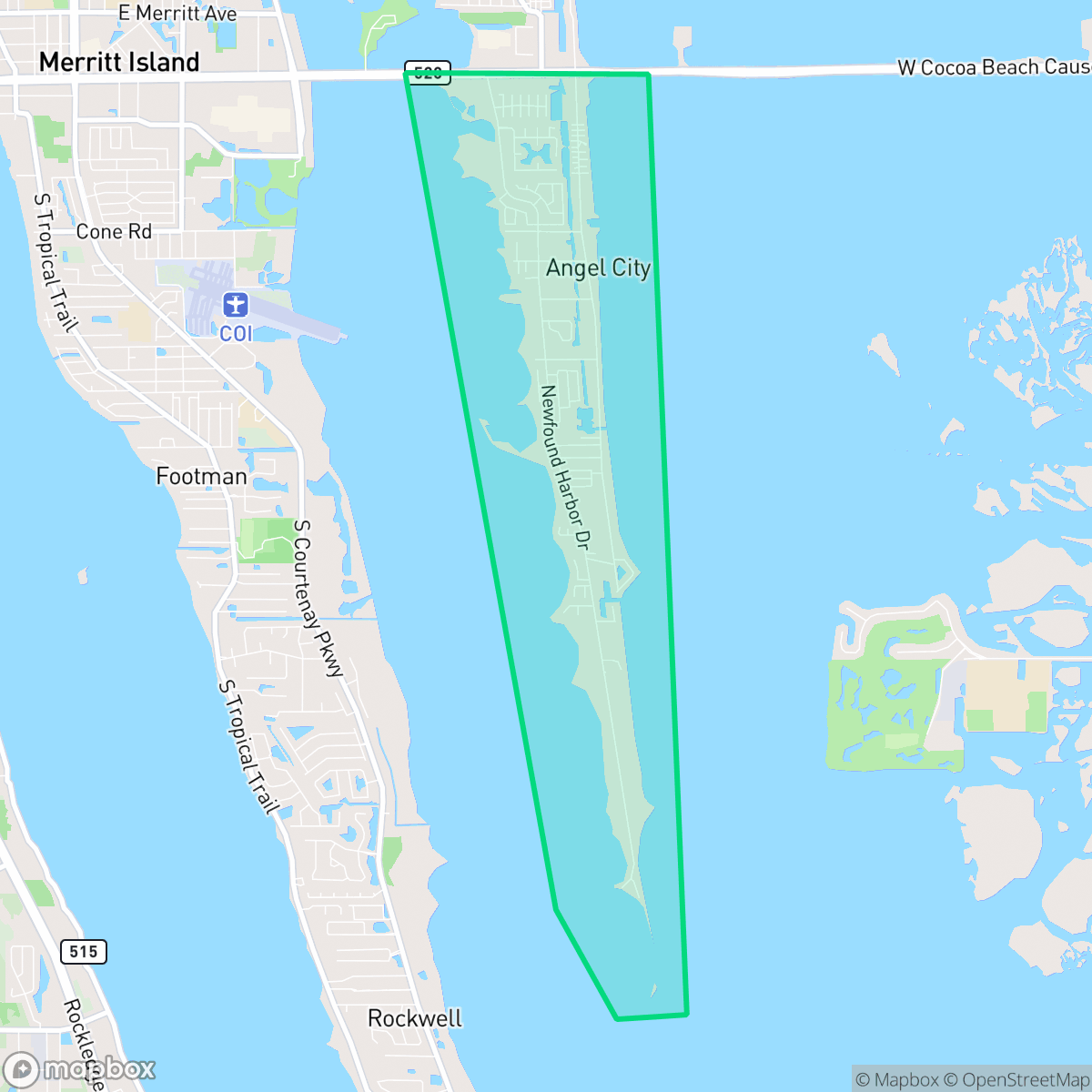
Angel City is a quiet, semi-rural community on the Horti Point peninsula defined by its upscale residential character and spacious properties. While the neighborhood offers a peaceful environment with clean air and a diverse age demographic, residents should be prepared for frequent aircraft noise.
Key Highlights
About Angel City
Angel City, located on the Horti Point peninsula of Merritt Island, is a historic community believed to be named after early settler Captain Angel. The area gained prominence in the 1920s as the site of a wooden toll bridge—the Merritt Island Causeway—which opened in 1923 to connect the island to Cocoa Beach. The bridge served as a critical transit link until it was dismantled in 1941 following the completion of State Road 520. Today, only concrete abutments and pilings remain as landmarks of this era. The community also hosted a post office from 1927 to 1931. Historically, the area was associated with figures like bridge tender Oscar Worley, who later operated a local fish business in the neighborhood until the mid-1950s.
The neighborhood is defined by its semi-rural atmosphere, characterized by open land, woodland areas, and a mix of large, well-maintained homes. According to iHuus data, the area provides a more polished visual landscape than much of the surrounding region, with many southern properties featuring private pools and generous driveways. While the community lacks significant commercial activity, it maintains a tranquil, residential focus that appeals to those seeking privacy and a slower pace of life.
Prospective residents should weigh the benefits of high health insurance coverage and clean air against specific local trade-offs. The neighborhood experiences consistent acoustic disruption due to its proximity to a nearby runway, and sidewalk access is primarily restricted to main thoroughfares. Families should also note that while the local school district maintains a high graduation rate, it has recently navigated periods of administrative instability and political debate. Additionally, the flood risk remains undetermined due to a lack of comprehensive FEMA studies, making it important for homeowners to conduct individual property assessments.
Neighborhood Scores Across 15 Qualities
Residential spacing varies across the area, featuring more separation in the southern houses compared to denser apartment and mobile home clusters in the north. This level of privacy is higher than the Merritt Island average according to iHuus data.
Low traffic volumes and quiet residential streets make walking safe, though sidewalks are primarily limited to main roads. This level of walkability sits slightly above the Merritt Island average according to iHuus data.
Large homes and frequent upscale amenities contribute to a visual landscape that is more polished than the Merritt Island average. Some southern residential clusters also feature private pools and spacious driveways, according to iHuus data.
Residential streets feature consistent green verges and nearby access to natural wetlands and water. This level of accessibility for pet owners is in line with the Merritt Island average, according to iHuus data.
Open land and woodland areas are common throughout this neighborhood, providing a more semi-rural feel than the Merritt Island average. Residents will find a mix of scattered homes and dense suburban pockets near waterfronts according to iHuus data.
This area offers a calm, low-key atmosphere with very little commercial activity or street life. While the landscape is moderately walkable, residents will find fewer local dining or entertainment options compared to the broader Merritt Island area.
Frequent aircraft noise from the nearby runway is a constant presence; this level of acoustic disruption is significantly higher than the average for Merritt Island.
Air quality remains consistently high with very few health concerns. This level of air purity is notably better than the Merritt Island average, according to iHuus data.
Industrial presence is notably lower here than the city average, as the area consists primarily of residential streets and local services without heavy manufacturing or toxic facilities. According to iHuus data, there are no warehouses or hazard sites detected within the neighborhood.
Health insurance access is notably higher in this area than the Merritt Island average, according to iHuus data. Most residents have access to medical coverage, providing a level of security that exceeds the city standard.
Conservative voting patterns and census indicators are prominent in this area, aligning closely with the broader Merritt Island community.
Residents experience a more varied age demographic than the Merritt Island average, featuring a balanced distribution of young adults, families, and seniors according to iHuus data.
Flood safety levels in this area are roughly comparable to the Merritt Island average. According to iHuus data, a detailed FEMA study has not yet been completed for this specific location, resulting in an undetermined risk level.
Address-Level Insights for Angel City


iHuus Neighborhood Intelligence Insights
Get address-level neighborhood insights for Angel City
- Street-level scores — see how individual blocks compare, not just neighborhood averages
- Micro-zone boundaries — identify quiet pockets, flood boundaries, and walkable clusters before you visit
- 15 dimensions in full — walkability, noise, air quality, school quality, insurance coverage, population age profile, urban/rural index, and more
- Boundary risk alerts — know if your address sits near a block boundary where scores drop, the kind of detail no listing will ever mention
- School insights — individual school ratings and insights, not just district-level data
- Compare before you commit — side-by-side data across neighborhoods, down to block precision
No credit card required
Angel City Rankings
School Districts Serving Angel City
School Insights for Angel City
Below average outcomes; significant attendance and academic challenges.
School Insights
See what's really behind every school rating near Angel City
- Individual school ratings — each school's own score with outcome context, not just a district average
- Enrollment & class size data — student-to-teacher ratio and how it compares to the state average
- Full demographics breakdown — ethnicity and gender composition for every school in the enrollment zone
- Every school in the district — all schools within the enrollment boundary ranked by rating, not just the closest one
- Grade levels & benchmarks — elementary through high school, with below/above state-average flags
No credit card required