Downtown, Tehachapi
Updated · 784 residents
Downtown Tehachapi serves as a vibrant, highly walkable hub where residents can access diverse dining options and local social spots on foot. The area maintains a quiet, semi-rural atmosphere with clean air and a balanced, multi-generational demographic.
Key Highlights
About Downtown
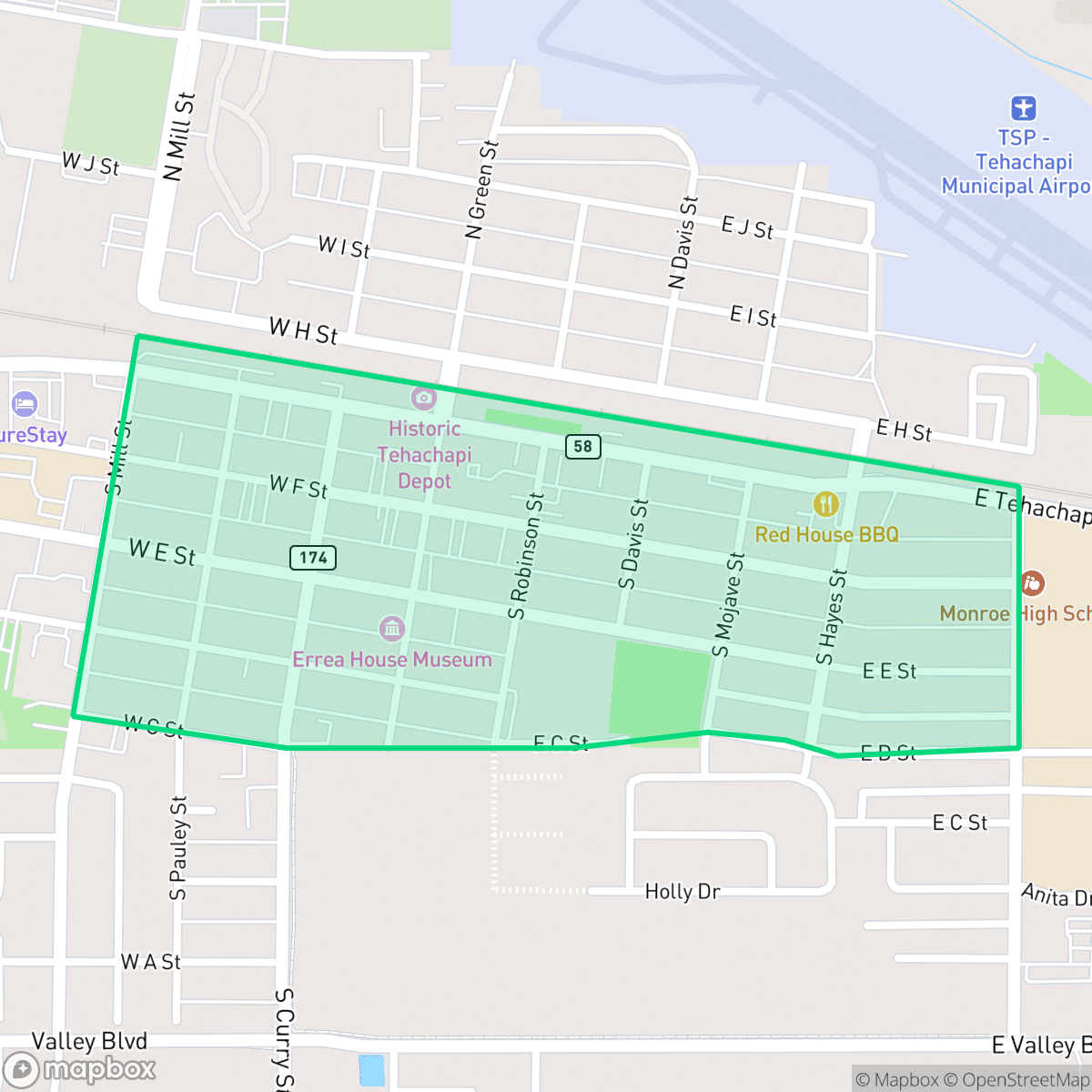
Downtown Tehachapi originated in 1876 as 'Tehachapi Summit' following the arrival of the Southern Pacific Railroad. As the railroad became the town's economic anchor, residents relocated from the nearby 'Old Town' settlement, bringing homes and businesses to the new rail-side hub. The neighborhood is defined by its late 19th and early 20th-century architectural character, featuring classic facades and historic structures like the Errea House, a museum moved to the site in 1900. The iconic Tehachapi Depot, originally built in 1876, remains a central landmark; although the historic structure was lost to a 2008 fire, it was meticulously reconstructed in 2010 to serve as a railroad museum. Today, the area preserves its small-town heritage through active historical preservation, murals, and the adaptive reuse of vintage buildings, maintaining a distinct identity as a historic mountain railroad town.
The neighborhood functions as the primary social and commercial center of the town, characterized by its high walkability and concentration of restaurants. Unlike more isolated parts of the region, this area offers a consistent sense of peace, with minimal noise from traffic or industrial activity. Residents benefit from excellent air quality and a community-focused environment where daily errands are easily managed without a vehicle. Prospective residents should weigh the neighborhood's lifestyle advantages against specific regional challenges. The area faces a significant risk of flooding during heavy rain, and the local school district is currently experiencing fiscal instability and academic performance issues. While the community offers a stable, conservative-leaning environment with high rates of health insurance coverage, those considering a move should be aware of these infrastructure and institutional constraints.
Neighborhood Scores Across 15 Qualities
Residential spacing provides some buffer between neighbors, though privacy levels are slightly lower than the Tehachapi average. Building density is moderate, resulting in mixed separation between adjacent properties.
Pedestrian access is much better than the city average, featuring safe crossings and sidewalks along one side of the streets. According to iHuus data, most local errands can be completed on foot within this area.
Residential views consist of standard tract housing with simple rooflines and small, maintained yards. This area presents a more varied landscape than the city average according to iHuus data.
Access to public parks and green spaces for pets is slightly better than the Tehachapi average. Residents can find various opportunities for walking dogs within the downtown area according to iHuus data.
Open land and scattered dwellings characterize this area, though it feels more developed than the more rural outskirts of Tehachapi. According to iHuus data, the landscape features more concentrated surroundings than the city average.
A diverse mix of restaurants, cafes, and local social hubs creates a much more vibrant atmosphere than the typical Tehachapi neighborhood. Residents can enjoy a variety of dining options ranging from Mediterranean to Italian, interspersed with quieter, low-density pockets and green spaces.
Occasional distant traffic or passing trains provide the only notable sounds, making the area significantly quieter than the rest of Tehachapi. According to iHuus data, acoustic levels remain low throughout the day.
Air quality remains consistently good with rare instances of elevated readings. This level of cleanliness is typical for the Tehachapi area according to iHuus data.
Residential life is largely uninterrupted by heavy industry, as the area consists of quiet streets and occasional light commercial activity. This lack of industrial density is slightly better than the average seen across Tehachapi, according to iHuus data.
Health insurance access is notably higher in this area than the Tehachapi average, according to iHuus data. Most residents in the neighborhood are covered by a health insurance plan.
Political leanings in this area are notably more conservative than the Tehachapi average. According to iHuus data, the community maintains a strong conservative majority with a small presence of opposing views.
A diverse range of age groups resides here, representing a more balanced demographic spread than the Tehachapi average. According to iHuus data, the area contains a relatively even distribution of young adults, families, and older residents.
Flood vulnerability is significant in this area, representing a much higher risk than the rest of Tehachapi. According to iHuus data, the neighborhood is prone to inundation during heavy rain events.
Address-Level Insights for Downtown


iHuus Neighborhood Intelligence Insights
Get address-level neighborhood insights for Downtown
- Street-level scores — see how individual blocks compare, not just neighborhood averages
- Micro-zone boundaries — identify quiet pockets, flood boundaries, and walkable clusters before you visit
- 15 dimensions in full — walkability, noise, air quality, school quality, insurance coverage, population age profile, urban/rural index, and more
- Boundary risk alerts — know if your address sits near a block boundary where scores drop, the kind of detail no listing will ever mention
- School insights — individual school ratings and insights, not just district-level data
- Compare before you commit — side-by-side data across neighborhoods, down to block precision
No credit card required
Downtown Rankings
School Districts Serving Downtown
School Insights for Downtown
Below average outcomes; significant attendance and academic challenges.
School Insights
See what's really behind every school rating near Downtown
- Individual school ratings — each school's own score with outcome context, not just a district average
- Enrollment & class size data — student-to-teacher ratio and how it compares to the state average
- Full demographics breakdown — ethnicity and gender composition for every school in the enrollment zone
- Every school in the district — all schools within the enrollment boundary ranked by rating, not just the closest one
- Grade levels & benchmarks — elementary through high school, with below/above state-average flags
No credit card required