Escondido Village, Stanford
Updated · 2,775 residents
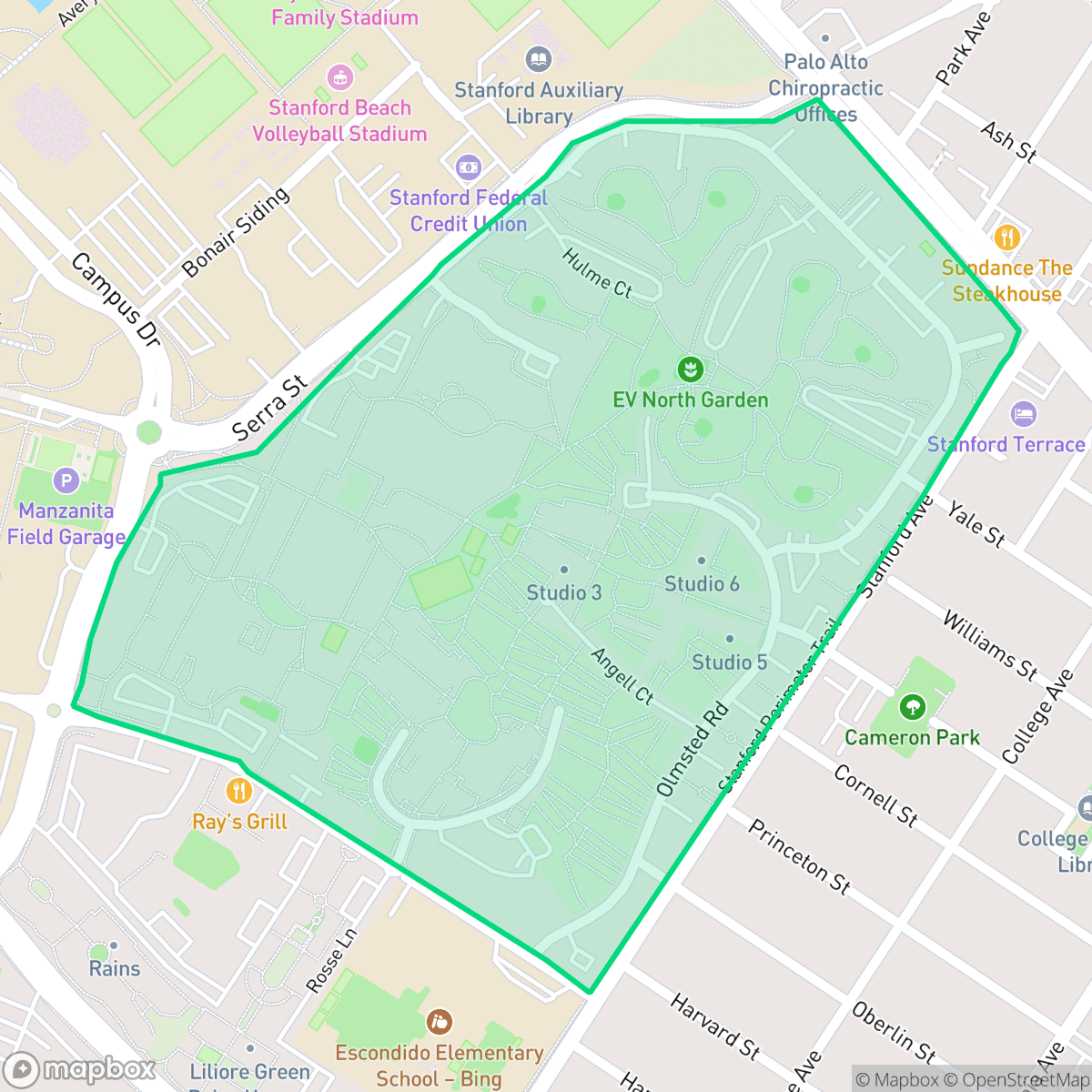
Escondido Village is a dense, pedestrian-oriented graduate housing community located on the Stanford University campus. It features exceptional walkability and access to extensive green corridors, serving as a convenient hub for students navigating daily university life.
Key Highlights
About Escondido Village
Escondido Village, situated on the east side of the Stanford University campus, originated in the late 1950s to address the growing need for graduate student housing. Its historical landscape is anchored by the Escondité Cottage, an 1875 Victorian Gothic and Italianate board-and-batten home built by French exile Jean-Baptiste Paulin Caperon (under the alias Peter Coutts). Today, the cottage serves as the village's administrative office. Architecturally, the neighborhood evolved from mid-century low-rise townhouses and 1960s reinforced concrete mid-rises named after early Stanford professors to the massive Escondido Village Graduate Residences (EVGR) completed in 2020. EVGR features four prominent 10-story towers built from prefabricated precast concrete, designed to blend modern density with Stanford’s traditional Mission-style aesthetics.
The neighborhood functions as a self-contained residential enclave that balances high-density living with significant open space. Residents benefit from a network of dedicated footpaths and pedestrian-only zones that facilitate easy transit across the university grounds. The area maintains a lively atmosphere, supported by localized amenities like Ray's Grill and various communal green spaces that serve as social anchors for the graduate student population.
Living here is defined by its proximity to academic facilities and an absence of industrial activity, fostering a quiet environment despite the moderate density of the housing blocks. While the area is exceptionally dog-friendly and enjoys high health insurance coverage, prospective residents should note the limited flood and fire safety infrastructure in the immediate vicinity. It is primarily suited for graduate students and faculty who prioritize walkability and direct access to university resources over the traditional suburban housing model found in surrounding Palo Alto.
Neighborhood Scores Across 15 Qualities
Large dormitory blocks and apartment buildings are separated by wide gardens and plazas, offering a level of privacy that is roughly in line with the city average. According to iHuus data, the area maintains a balance of shared walls and open spacing between structures.
Pedestrian-priority zones and a complete sidewalk network make navigating the area on foot very easy. This level of accessibility is even higher than the Palo Alto city average, according to iHuus data.
Well-maintained landscaping and high-quality institutional architecture define the local landscape. While the area is visually pleasing, the level of aesthetic appeal is slightly lower than the Palo Alto city average.
Extensive campus lawns and wide green corridors provide ample space for exercise. Numerous public parks and trails make this area slightly more dog friendly than the surrounding city average, according to iHuus data.
A dense blend of academic buildings and student housing characterizes this area, creating a landscape that is slightly more developed than the surrounding semi-rural regional average. According to iHuus data, the environment transitions between structured campus complexes and more open, scattered landscapes.
Diverse local dining, cafes, and green spaces create a much more active atmosphere than the typical city average. According to iHuus data, the area features a dense mix of functional businesses and social destinations integrated with walkable suburban streets.
A steady hum of local traffic from nearby busy streets is present. According to iHuus data, acoustic levels are slightly higher than the average for the surrounding city.
Air quality in this area fluctuates between acceptable and unhealthy levels. According to iHuus data, conditions are consistent with the city average, though sensitive groups may experience occasional concern.
The area is composed entirely of residential and educational structures with no detectable warehouses or hazardous industrial sites. This lack of industrial proximity is consistent with the surrounding city average.
Nearly all residents are covered by health insurance, a rate that is essentially in line with the city average according to iHuus data.
Voting patterns and census indicators show a deeply liberal political leaning that is consistent with the broader Palo Alto area. According to iHuus data, the community's ideological landscape aligns closely with the city average.
A balanced distribution of young adults, families, and older residents characterizes the area. This demographic spread is roughly in line with the average found across the wider city.
Address-Level Insights for Escondido Village


iHuus Neighborhood Intelligence Insights
Get address-level neighborhood insights for Escondido Village
- Street-level scores — see how individual blocks compare, not just neighborhood averages
- Micro-zone boundaries — identify quiet pockets, flood boundaries, and walkable clusters before you visit
- 15 dimensions in full — walkability, noise, air quality, school quality, insurance coverage, population age profile, urban/rural index, and more
- Boundary risk alerts — know if your address sits near a block boundary where scores drop, the kind of detail no listing will ever mention
- School insights — individual school ratings and insights, not just district-level data
- Compare before you commit — side-by-side data across neighborhoods, down to block precision
No credit card required
Escondido Village Rankings
School Districts Serving Escondido Village
School Insights for Escondido Village
Below average outcomes; significant attendance and academic challenges.
School Insights
See what's really behind every school rating near Escondido Village
- Individual school ratings — each school's own score with outcome context, not just a district average
- Enrollment & class size data — student-to-teacher ratio and how it compares to the state average
- Full demographics breakdown — ethnicity and gender composition for every school in the enrollment zone
- Every school in the district — all schools within the enrollment boundary ranked by rating, not just the closest one
- Grade levels & benchmarks — elementary through high school, with below/above state-average flags
No credit card required