Chinatown, Salinas
Updated · 727 residents
Chinatown is a historically significant district in Salinas defined by its deep cultural heritage and proximity to industrial hubs. While it offers a unique connection to the city's immigrant past, residents face challenges including significant ambient noise from transit infrastructure and limited pedestrian connectivity.
Key Highlights
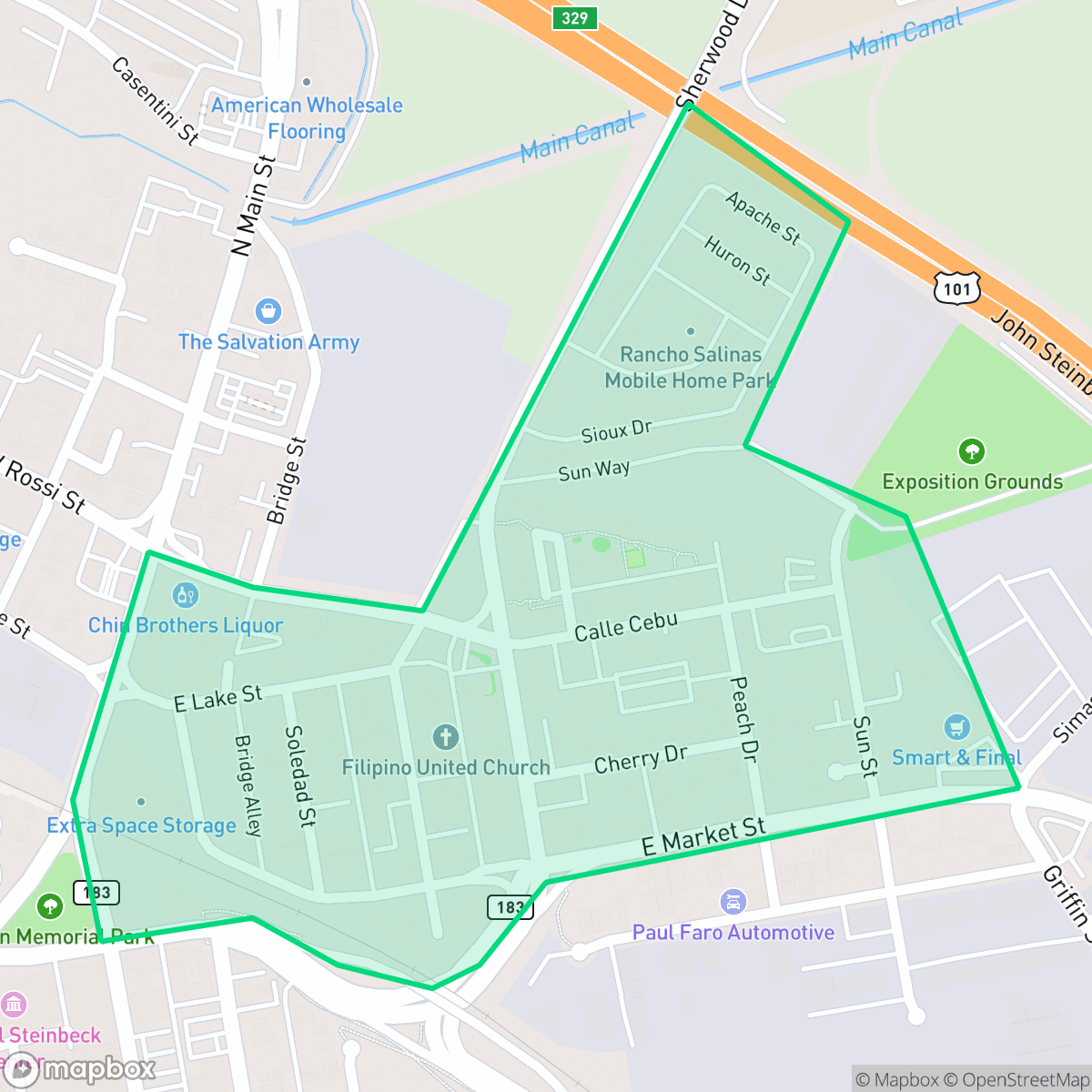
About Chinatown
Salinas’ Chinatown, located along Soledad Street, was established in 1893 following the destruction of the city’s original 1872 settlement. As the largest extant Chinatown between San Francisco and Los Angeles, it served as a vital cultural and economic hub for successive waves of immigrant laborers, including Chinese, Japanese, and Filipino communities who were instrumental in the region’s agricultural development. The neighborhood’s historic character is anchored by landmarks like the Republic Café, a 1942 structure listed on the National Register of Historic Places, which once served as a central gathering space for diverse immigrant groups. Despite suffering from significant deterioration following urban renewal programs in the mid-20th century, the district remains a focal point for preservation efforts, including the development of the Asian Cultural Experience museum to honor its complex immigrant history and resilience.
The neighborhood functions as a semi-rural edge where residential life meets industrial activity. It is characterized by standard tract housing and a diverse demographic profile that spans young adults to older individuals. Residents here experience a strong liberal political environment while living in close proximity to warehouses, electrical substations, and logistics facilities. The area maintains a steady level of activity with various dining options, though the overall layout remains largely car-dependent due to the surrounding industrial landscape.
Living in this area requires navigating specific trade-offs, particularly regarding environmental and infrastructure factors. The neighborhood experiences frequent noise from nearby rail and airport activity, and the lack of dedicated sidewalks makes walking difficult. Prospective residents should also be aware of the elevated flood risk and limited access to local health insurance coverage. It is a location best suited for those who prioritize proximity to industrial employment centers and a connection to the area's deep cultural history over the quiet or high-end walkability found in other parts of the city.
Neighborhood Scores Across 15 Qualities
Residential spacing provides some buffer between neighbors, though density is slightly higher than the Salinas average according to iHuus data.
Quiet streets allow for occasional walking, but the lack of sidewalks makes it significantly less walkable than the Salinas average. According to iHuus data, navigating the area on foot requires extra caution due to the absence of dedicated pedestrian paths.
Standard tract housing dominates the landscape, characterized by boxy rooflines and small yards. This area offers less visual variety than the Salinas average.
Sparse greenery and narrow sidewalks make for few comfortable walking options for pets. According to iHuus data, the availability of open, unfenced areas is significantly below the Salinas average.
Open land and scattered homes characterize this area, which sits slightly below the Salinas average for urban density. Residents will find a mix of industrial zones and mobile home parks alongside pockets of field and woodland.
A varied mix of dining and amenities provides a steady activity level, though the overall energy is slightly below the Salinas average. Many popular restaurants and green spaces are accessible, but the area remains largely car-dependent due to its proximity to highways and industrial zones.
Constant noise from nearby heavy rail or airport activity makes this area significantly noisier than the Salinas average. Residents should expect frequent loud interruptions throughout the day.
Air quality remains consistently good with rare instances of elevated readings. This level of air cleanliness is in line with the Salinas city average, according to iHuus data.
Residential areas coexist with warehouse rows, electrical substations, and logistics hubs. According to iHuus data, the presence of light industrial activity and truck traffic is notably higher here than the Salinas average.
Access to health insurance is notably lower here than the average for Salinas. Residents may face greater challenges in securing medical coverage compared to most other parts of the city, according to iHuus data.
Voting patterns and census indicators reflect a strong liberal leaning that is slightly more pronounced than the Salinas average.
Residents will find a balanced mix of young adults, families, and older individuals, representing a demographic profile slightly more varied than the Salinas average.
Flood risk is notably higher than the Salinas average because portions of this area fall within a designated floodplain. Residents should be aware that flood insurance is typically required for properties in this zone, according to iHuus data.
Address-Level Insights for Chinatown


iHuus Neighborhood Intelligence Insights
Get address-level neighborhood insights for Chinatown
- Street-level scores — see how individual blocks compare, not just neighborhood averages
- Micro-zone boundaries — identify quiet pockets, flood boundaries, and walkable clusters before you visit
- 15 dimensions in full — walkability, noise, air quality, school quality, insurance coverage, population age profile, urban/rural index, and more
- Boundary risk alerts — know if your address sits near a block boundary where scores drop, the kind of detail no listing will ever mention
- School insights — individual school ratings and insights, not just district-level data
- Compare before you commit — side-by-side data across neighborhoods, down to block precision
No credit card required
Chinatown Rankings
School Districts Serving Chinatown
School Insights for Chinatown
Below average outcomes; significant attendance and academic challenges.
School Insights
See what's really behind every school rating near Chinatown
- Individual school ratings — each school's own score with outcome context, not just a district average
- Enrollment & class size data — student-to-teacher ratio and how it compares to the state average
- Full demographics breakdown — ethnicity and gender composition for every school in the enrollment zone
- Every school in the district — all schools within the enrollment boundary ranked by rating, not just the closest one
- Grade levels & benchmarks — elementary through high school, with below/above state-average flags
No credit card required