Ontario Ranch, Ontario
Updated · 16,478 residents
Ontario Ranch is a large-scale master-planned community in Southern California known for its modern, high-speed fiber-optic infrastructure and consistent suburban design. While the neighborhood offers excellent sidewalk connectivity and access to top-rated schools, residents navigate a landscape defined by the proximity of large-scale logistics warehouses and industrial activity.
Key Highlights
About Ontario Ranch
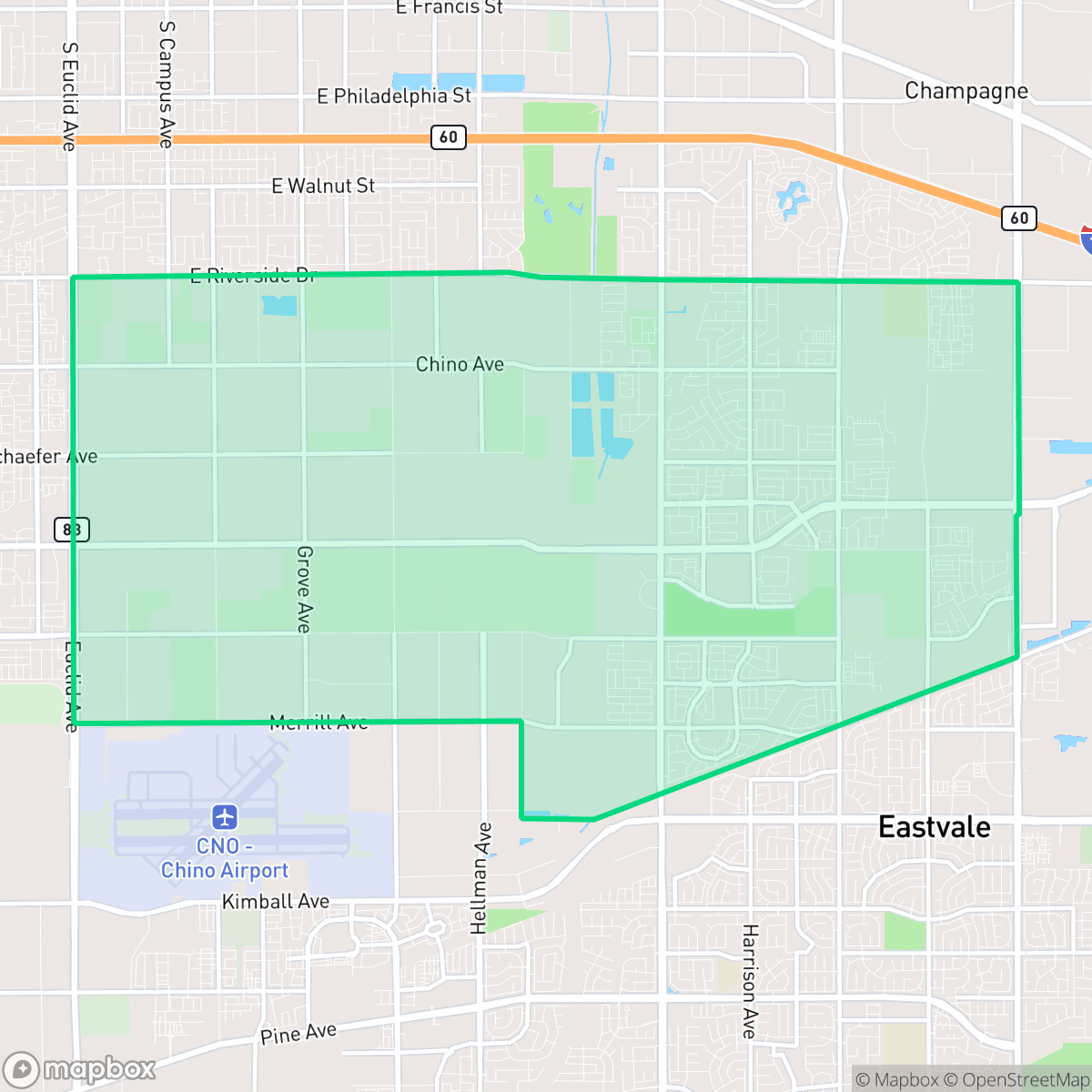
Spanning 13 square miles in southern Ontario, California, the Ontario Ranch neighborhood was historically part of San Bernardino County’s "Ag Preserve," a vast agricultural and dairy farming region. In 1993, local leaders voted to dissolve the agricultural preserve status, paving the way for residential and commercial conversion. Formally annexed by the city on November 30, 1999, the area was initially dubbed the "New Model Colony"—a nod to the 1881 founding of Ontario as a master-planned "model colony" by Canadian engineers George and William Chaffey. Rebranded as Ontario Ranch, the area has transitioned into the largest master-planned community in Southern California. It is recognized as the region's first "gigabit community" due to its fully integrated, high-speed fiber-optic infrastructure.
The neighborhood serves as a modern suburban hub characterized by uniform tract housing, manicured landscapes, and a well-integrated network of sidewalks that promote pedestrian activity. Families are frequently drawn to the area by its access to high-performing educational institutions, including several schools within the Corona-Norco and Chaffey Joint Union districts. The community maintains a distinct, orderly aesthetic with private backyard amenities and a structured layout that reflects its origins as a master-planned development.
Prospective residents should weigh these benefits against the realities of living in a transitional industrial-suburban environment. The landscape is frequently interspersed with massive logistics centers and freight corridors, which can lead to increased truck traffic and industrial noise in certain sections. While the area provides a quiet residential atmosphere, it remains car-dependent with limited local commercial services, making it best suited for those who prioritize modern housing and school access over immediate proximity to entertainment or retail centers.
Neighborhood Scores Across 15 Qualities
Housing density is typical for the area, featuring a mix of detached homes with small side yards and some townhome structures. According to iHuus data, neighbors are often positioned closely together with limited buffers between properties.
Extensive sidewalk networks and clearly marked crosswalks make navigating the neighborhood on foot very easy. This area offers superior connectivity for pedestrians compared to the city average.
Well-manicured landscapes and large homes with private pools characterize much of this area, making the visual appeal higher than the Ontario average. According to iHuus data, some sections of the neighborhood feature more dense, standard tract housing with shared amenities.
Access to public parks and wide, landscaped green verges varies by block, though walking opportunities are slightly better than the city average. While some residential areas feature continuous sidewalks and large parklands, other sections rely primarily on private backyards for greenery.
A blend of large-scale logistics warehouses and remaining agricultural fields creates a semi-rural landscape that is slightly more open than the city average. Residents will find a transitional environment where dense suburban housing clusters meet expansive industrial and farming plots.
Most areas feature a tranquil, suburban atmosphere with limited commercial character and few local destinations. Frequent reliance on a vehicle is necessary for errands, as social hubs and dining options are sparse and generally not within walking distance.
Steady traffic sounds from nearby busy streets are present, though acoustic conditions are notably calmer than the city average. According to iHuus data, the environment lacks significant tranquility but remains quieter than many other parts of Ontario.
Air quality remains mostly clean with only rare instances of elevated readings. This level of air purity is notably higher than the average for Ontario.
Residential and light commercial uses predominate here, offering a cleaner environment than the city average. While occasional logistics warehouses and airfield activity exist, the area lacks significant heavy industrial hazards.
Health insurance enrollment among residents is notably higher than the average for the city of Ontario, according to iHuus data.
Political leanings in this area are largely liberal, though the community is less progressive than the city average according to iHuus data.
A diverse mix of young adults, families, and older residents characterizes the area. According to iHuus data, the age distribution in Ontario Ranch is consistent with the broader Ontario community.
Significant flood risk exists in this area due to its location within a mapped floodplain. According to iHuus data, this risk level is slightly higher than the average for the city of Ontario.
Address-Level Insights for Ontario Ranch


iHuus Neighborhood Intelligence Insights
Get address-level neighborhood insights for Ontario Ranch
- Street-level scores — see how individual blocks compare, not just neighborhood averages
- Micro-zone boundaries — identify quiet pockets, flood boundaries, and walkable clusters before you visit
- 15 dimensions in full — walkability, noise, air quality, school quality, insurance coverage, population age profile, urban/rural index, and more
- Boundary risk alerts — know if your address sits near a block boundary where scores drop, the kind of detail no listing will ever mention
- School insights — individual school ratings and insights, not just district-level data
- Compare before you commit — side-by-side data across neighborhoods, down to block precision
No credit card required
Ontario Ranch Rankings
School Districts Serving Ontario Ranch
School Insights for Ontario Ranch
Below average outcomes; significant attendance and academic challenges.
School Insights
See what's really behind every school rating near Ontario Ranch
- Individual school ratings — each school's own score with outcome context, not just a district average
- Enrollment & class size data — student-to-teacher ratio and how it compares to the state average
- Full demographics breakdown — ethnicity and gender composition for every school in the enrollment zone
- Every school in the district — all schools within the enrollment boundary ranked by rating, not just the closest one
- Grade levels & benchmarks — elementary through high school, with below/above state-average flags
No credit card required