Don Edwards National Wildlife Refuge, Newark

Updated June 22, 2026 · 429 residents

Don Edwards National Wildlife Refuge in Newark is a vast expanse of tidal marshes and salt evaporation ponds defined by its rural, undeveloped character. The area offers high privacy and excellent dog-friendly access to nature, though it lacks urban amenities and features significant industrial infrastructure.

Key Highlights
Moderate PrivacyHighly WalkablePleasant SceneryIdeal for Dog OwnersVast Open WetlandsQuiet and RemoteModerate Traffic NoiseModerate Air QualityMinimal Industrial PresenceHigh Insurance CoverageModerately LiberalBalanced Age MixHigh Flood Risk
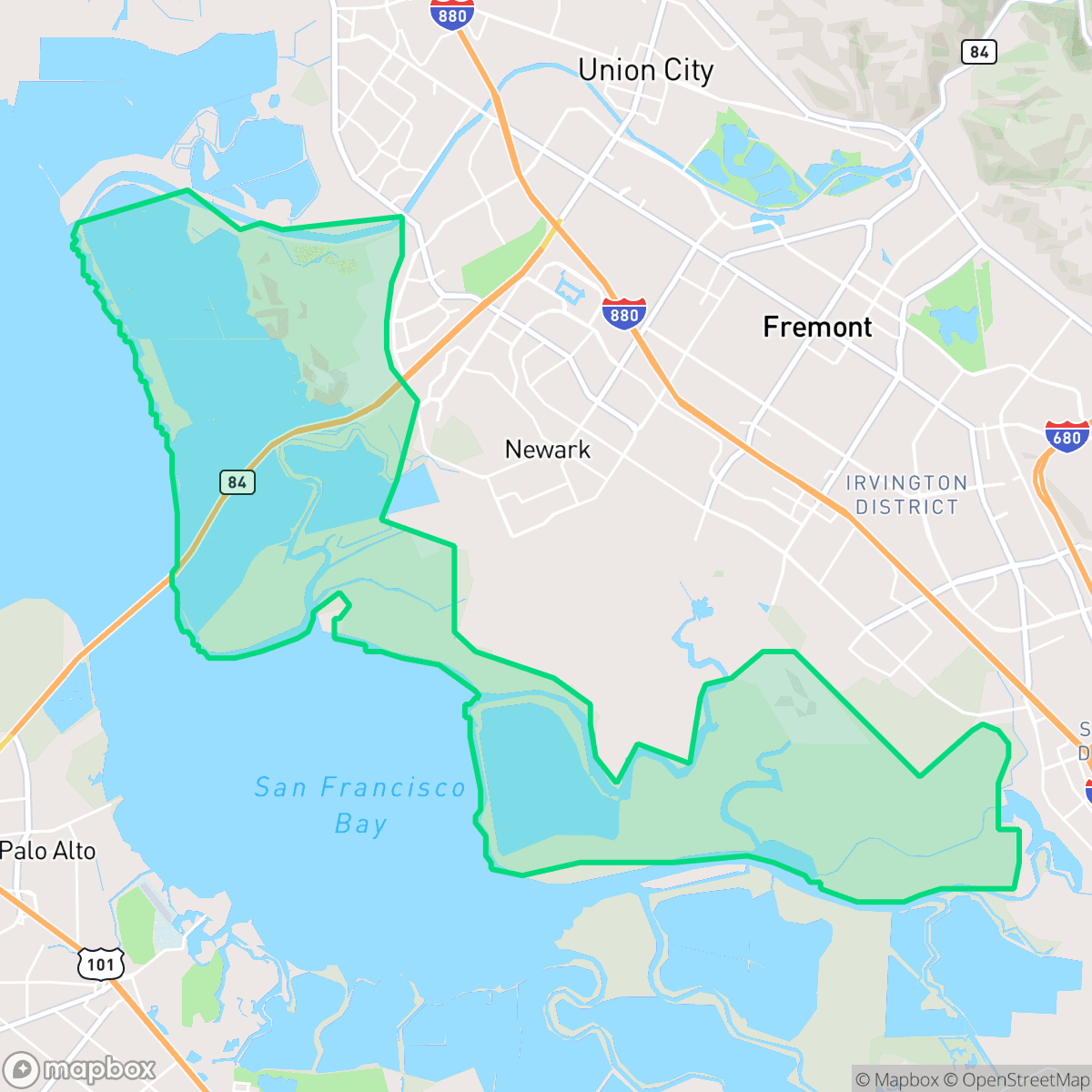
Map showing the location of Don Edwards National Wildlife Refuge, Newark, CA

About Don Edwards National Wildlife Refuge

The Don Edwards National Wildlife Refuge serves as a significant natural buffer in Newark, characterized by its expansive salt evaporation ponds, tidal wetlands, and marshlands. The landscape is almost entirely undeveloped, lacking residential or commercial structures, which contributes to an exceptionally high privacy index and a quiet, rural atmosphere. While the area provides a unique opportunity for outdoor recreation, the environment is dominated by industrial salt harvesting infrastructure, including berms and utility lines, which impacts its overall visual appeal.

Visitors to the area should note the significant trade-offs associated with its remote nature, including low air quality and a lack of local services. The neighborhood is best suited for those seeking proximity to protected wildlife habitats and dog-friendly walking trails rather than those looking for urban convenience or social density. With virtually no residential population and high vulnerability to environmental risks like flooding, the region functions primarily as an ecological preserve and industrial utility zone.

Neighborhood Scores Across 15 Qualities

🤫 Privacy Index

Residential spacing offers some separation between neighbors, though levels of privacy are slightly lower than the Newark average according to iHuus data.

🚶 Walkability

Extensive sidewalks and pedestrian-priority infrastructure make navigating the area on foot very easy. This level of accessibility is slightly above the Newark average according to iHuus data.

🎨 Visual Appeal

Spacious properties and upscale amenities contribute to a more visually pleasing environment than the Newark average, according to iHuus data.

🐕 Dog Friendliness

Extensive trails and vast open spaces provide significant opportunities for pet exercise. According to iHuus data, this area offers much higher accessibility to large parks and natural landscapes than the Newark average.

🗺️ Urban-Rural Index

Dominated by expansive salt ponds and tidal marshes, this area is significantly more rural than the Newark average. Residents will find almost no residential or commercial buildings within the refuge, as the landscape consists primarily of undeveloped natural space and industrial evaporation ponds.

Neighborhood Vibe

Remote landscapes and vast open spaces define this area, which lacks the commercial density or social activity found in most of Newark. According to iHuus data, the lack of local businesses and low-density development results in a much lower level of liveliness than the city average.

🔊 Acoustic Comfort

Steady noise from nearby local traffic is present, though levels remain noticeably quieter than the average for Newark. According to iHuus data, the area experiences a consistent hum from adjacent busy streets.

🌿 Air Quality

Air quality fluctuates between acceptable and unhealthy levels, which is slightly lower than the Newark average. Sensitive groups may experience occasional concerns during certain periods, according to iHuus data.

🏭 Industrial Proximity

Industrial activity is notably absent here, providing a much cleaner environment than the Newark average. While some nearby salt evaporation ponds and utility infrastructure exist, there are no heavy warehouses or hazardous industrial facilities within the immediate area.

🏥 Health Insurance Coverage

Health insurance enrollment is exceptionally high among residents, sitting well above the Newark average according to iHuus data.

🗳️ Ideological Lean

Political leanings in this area are largely liberal, though the community shows a slightly less progressive tilt than the Newark average according to iHuus data.

👥 Population Age Profile

A diverse range of age groups including young adults, families, and seniors resides here. This demographic spread is slightly lower than the Newark city average according to iHuus data.

🌊 Flood Safety

Located within a designated floodplain, this area faces a significantly higher risk of flooding than the Newark average. According to iHuus data, residents may find that flood insurance is typically required for properties in this zone.

Block-Level Insights for Don Edwards National Wildlife Refuge

iHuus Neighborhood Intelligence Insights

Get block-level neighborhood insights for Don Edwards National Wildlife Refuge

  • Street-level scores — see how individual blocks compare, not just neighborhood averages
  • Micro-zone boundaries — identify quiet pockets, flood boundaries, and walkable clusters before you visit
  • 15 dimensions in full — walkability, noise, air quality, school quality, insurance coverage, population age profile, urban/rural index, and more
  • Boundary risk alerts — know if your address sits near a block boundary where scores drop, the kind of detail no listing will ever mention
  • School insights — individual school ratings and insights, not just district-level data
  • Compare before you commit — side-by-side data across neighborhoods, down to block precision

No credit card required

School Districts Serving Don Edwards National Wildlife Refuge

Fremont Unified School District school district map
Fremont Unified School District
Grades K–127/10
44 schools Rating range: 210 / 10

Fremont Unified School District is a high-performing academic powerhouse characterized by exceptional state testing scores, low chronic absenteeism, and a portfolio dominated by 10/10 rated schools. While the district maintains elite status in college readiness and teacher quality, it is currently navigating a significant $24.7 million budget reduction for the 2026-2027 cycle to ensure long-term solvency. Community sentiment reflects a high-pressure environment supported by strong parental involvement, and while facilities at some older campuses are maturing, the district remains a premier choice for families due to its consistent delivery of top-tier educational outcomes and stable institutional leadership.

Schools

American HighHigh
10/10
Joshua Chadbourne ElementaryElementary
10/10
John Gomes ElementaryElementary
10/10
William Hopkins MiddleMiddle
10/10
Mission San Jose ElementaryElementary
10/10
Mission San Jose HighHigh
10/10
Warm Springs ElementaryElementary
10/10
Washington HighHigh
10/10
Ardenwood ElementaryElementary
10/10
Fred E. Weibel ElementaryElementary
10/10
John M. Horner MiddleMiddle
10/10
Irvington HighHigh
10/10
James Leitch ElementaryElementary
10/10
Mission Valley ElementaryElementary
10/10
Thornton MiddleMiddle
10/10
Lila Bringhurst ElementaryElementary
10/10
Forest Park ElementaryElementary
9/10
J. Haley Durham ElementaryElementary
9/10
Harvey Green ElementaryElementary
9/10
Steven Millard ElementaryElementary
9/10
O. N. Hirsch ElementaryElementary
9/10
Niles ElementaryElementary
9/10
Parkmont ElementaryElementary
9/10
Warwick ElementaryElementary
9/10
Centerville MiddleMiddle
8/10
Glenmoor ElementaryElementary
8/10
Tom Maloney ElementaryElementary
8/10
Oliveira ElementaryElementary
8/10
Patterson ElementaryElementary
8/10
G. M. Walters MiddleMiddle
8/10
Vista AlternativeHigh
8/10
Young Adult ProgramHigh
8/10
Brookvale ElementaryElementary
8/10
John G. Mattos ElementaryElementary
8/10
Joseph Azevada ElementaryElementary
7/10
E. M. Grimmer ElementaryElementary
7/10
John F. Kennedy HighHigh
7/10
Vallejo Mill ElementaryElementary
7/10
Circle Of Independent LearningOther
7/10
John Blacow ElementaryElementary
6/10
Brier ElementaryElementary
4/10
Cabrillo ElementaryElementary
4/10
Robertson High (Continuation)High
2/10
Glankler Early Learning Center
Not rated
Newark Unified School District school district map
Newark Unified School District
Grades K–125/10
10 schools Rating range: 29 / 10

Newark Unified School District is currently in a transitional state characterized by strong community identity and pockets of academic excellence, yet it is increasingly burdened by fiscal and structural instability. While primary feeders like Birch Grove are high-performing, the district faces a $4.5 million deficit, declining enrollment, and middle-to-high school ratings that hover around the state average. The district's 'B' grade from Niche and positive anecdotal feedback regarding safety and diversity are offset by significant turnover among young educators and persistent concerns regarding math and ELA proficiency. NUSD remains a stable community option but requires significant financial correction and facility modernization to move into a higher performance tier.

Schools

Birch Grove PrimaryElementary
9/10
Birch Grove IntermediateElementary
7/10
Crossroads High (Alternative)High
6/10
Lincoln ElementaryElementary
6/10
Newark Memorial HighHigh
6/10
Newark MiddleMiddle
6/10
John F. Kennedy ElementaryElementary
5/10
Bridgepoint HighHigh
2/10
Coyote Hills ElementaryElementary
2/10
August Schilling ElementaryElementary
2/10
New Haven Unified School District school district map
New Haven Unified School District
Grades K–125/10
13 schools Rating range: 110 / 10

New Haven Unified School District presents a tale of two districts, characterized by elite-level academic performance in its elementary schools and national-caliber extracurricular programs at James Logan High, contrasted against significant financial and operational instability. While state testing data consistently exceeds averages, the district is currently grappling with the 'Distressed' symptoms of declining enrollment, budget deficits, and polarizing campus safety concerns at the secondary level. The operational health is categorized as 'Mixed'—it maintains a 'Blue Chip' reputation for its high-achieving student body and specialized STEAM programs, yet it faces the immediate reality of potential school closures and administrative consolidation to remain solvent.

Schools

Delaine Eastin ElementaryElementary
10/10
Tom Kitayama ElementaryElementary
9/10
James Logan HighHigh
8/10
Pioneer ElementaryElementary
7/10
Hillview Crest ElementaryElementary
7/10
Guy Jr. Emanuele ElementaryElementary
7/10
Decoto School For Independent StudyOther
7/10
Alvarado ElementaryElementary
6/10
Searles ElementaryElementary
6/10
Itliong-Vera CruzMiddle
5/10
Cesar Chavez MiddleMiddle
3/10
Core Learning Academy At Conley-Caraballo HighHigh
2/10
Alternative Learning Academy At Conley-Caraballo HighHigh
1/10

School Insights for Don Edwards National Wildlife Refuge

School Insights

See what's really behind every school rating near Don Edwards National Wildlife Refuge

  • Individual school ratings — each school's own score with outcome context, not just a district average
  • Enrollment & class size data — student-to-teacher ratio and how it compares to the state average
  • Full demographics breakdown — ethnicity and gender composition for every school in the enrollment zone
  • Every school in the district — all schools within the enrollment boundary ranked by rating, not just the closest one
  • Grade levels & benchmarks — elementary through high school, with below/above state-average flags

No credit card required

Frequently Asked Questions

Is the Don Edwards National Wildlife Refuge a residential neighborhood?
No, the area is almost entirely composed of undeveloped salt evaporation ponds and tidal wetlands. There are no residential or commercial structures within the core refuge area.
Are dogs allowed in the refuge?
Yes, the refuge is considered highly dog-friendly, making it a popular destination for outdoor enthusiasts and pet owners looking for open, natural spaces.
What are the primary environmental considerations for this area?
The region faces significant challenges, including low air quality and a lack of flood and fire safety infrastructure. It is primarily an industrial utility zone used for salt harvesting rather than a residential development.