Sunny Hills, Milpitas
Updated · 7,943 residents
Sunny Hills is a highly walkable, dense suburban neighborhood in Milpitas known for its proximity to top-rated schools and diverse local dining options. While the area offers convenient pedestrian paths and green spaces, residents should be aware of significant road traffic noise and limited privacy due to the close spacing of homes.
Key Highlights
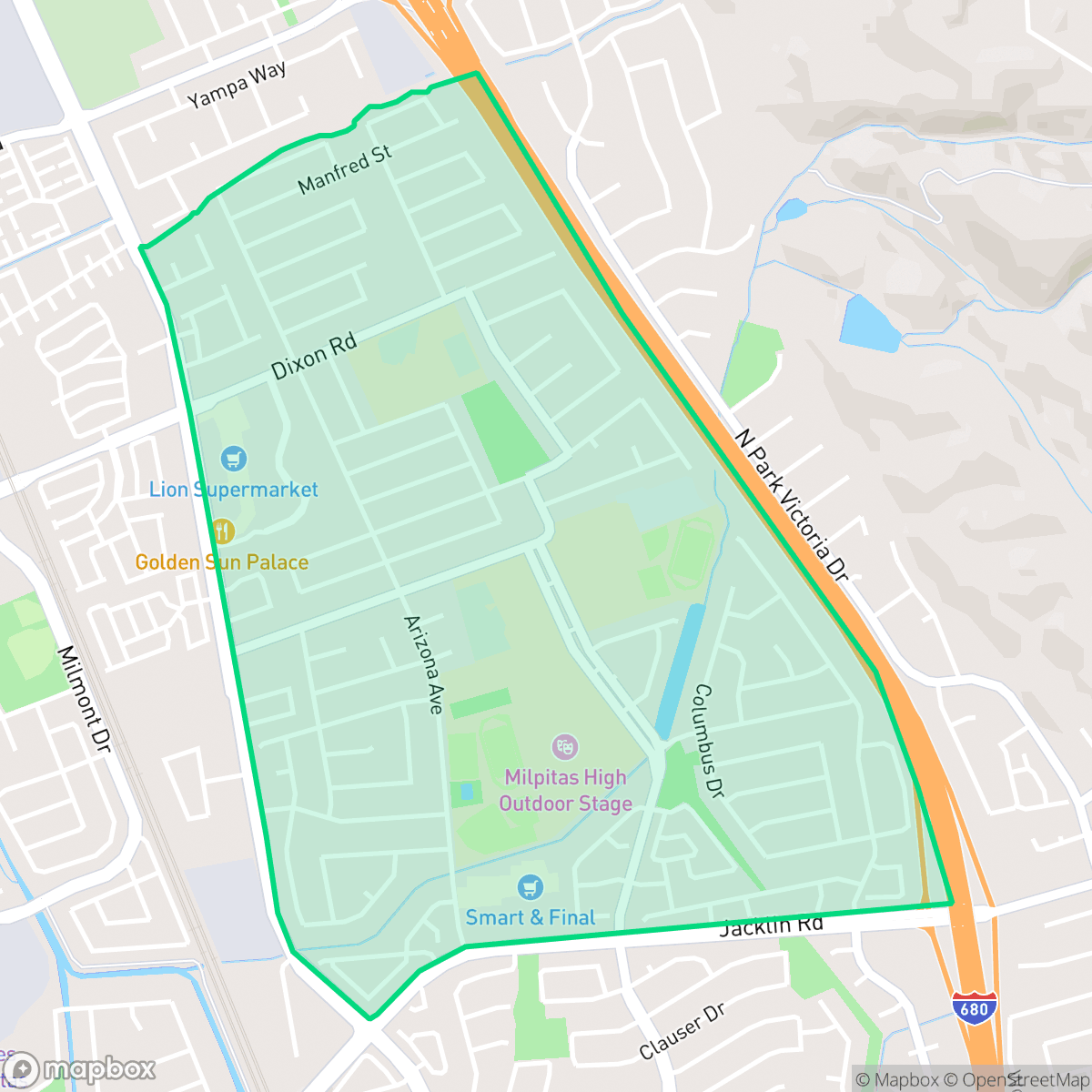
About Sunny Hills
Established in 1956, the Sunnyhills neighborhood in Milpitas is recognized as one of the first planned, intentionally racially-integrated communities in the United States. The development was organized through a collaboration between the United Auto Workers (UAW) union and the American Friends Service Committee to provide equal housing for Black and white workers relocating to the nearby Ford Assembly Plant. Civil rights leader Ben Gross, who later became California's first Black mayor, played a pivotal role in the neighborhood's creation and integration. Sunnyhills' groundbreaking social model drew international attention; in 1959, Soviet Premier Nikita Khrushchev visited the neighborhood, stopping at Gross’s home to witness the integrated community firsthand.
The neighborhood features a dense suburban landscape characterized by a mix of single-family homes, townhouses, and light commercial areas. It benefits from a comprehensive network of sidewalks and pedestrian trails that connect residential blocks to local parks like Albert Augustine Park. Families are often drawn to the area for its access to the Milpitas Unified School District, which maintains a high academic reputation. According to iHuus data, the area provides a lively atmosphere with various dining establishments, including local favorites such as Taqueria Las Vegas and Golden Sun Palace, situated near the railway and light industrial zones.
Living in this part of Milpitas involves specific trade-offs regarding the acoustic environment and property layout. The proximity to major highways results in elevated noise levels, and the high-density design means homes are situated close together, which impacts private outdoor space. Prospective residents should also consider environmental factors, as the area faces notable fire and flood safety challenges. Despite these considerations, the combination of high walkability and strong school performance makes the community a practical choice for those prioritizing educational access and pedestrian-friendly infrastructure.
Neighborhood Scores Across 15 Qualities
Closely spaced housing and shared walls in certain clusters result in less personal separation than the Milpitas average. Residents in townhome and mobile home sections may experience minimal distance between neighboring properties.
Extensive sidewalk networks and dedicated pedestrian paths provide easy connectivity between residential areas and commercial zones. According to iHuus data, the area offers superior pedestrian infrastructure compared to the Milpitas average, featuring clear crosswalks and even a pedestrian bridge over the highway.
Streetscapes feature a mix of standard tract housing and larger suburban estates with well-kept landscaping. This level of visual variety is typical for the Milpitas area.
Continuous sidewalks, wide grass verges, and various central parks provide ample space for pet exercise. According to iHuus data, these connected green spaces and walking trails offer more opportunities for pet owners than the Milpitas average.
Residential tracts feature a mix of single-family homes and apartment complexes situated near major highways. This landscape is largely consistent with the broader Milpitas area, characterized by dense suburban development rather than open rural land.
Suburban streets offer a mix of quiet residential blocks and lively pockets featuring diverse dining and parks. According to iHuus data, the area possesses a higher level of activity and amenity access than the average Milpitas neighborhood.
Frequent sounds from nearby rail lines and major freeways characterize this area. According to iHuus data, acoustic comfort is lower than the average for Milpitas.
Air quality in this area fluctuates between acceptable and unhealthy levels, which may present occasional concerns for sensitive groups. According to iHuus data, these conditions are slightly lower than the average seen throughout Milpitas.
Industrial presence is minimal, as the area consists mostly of residential and light commercial zones. While some larger warehouses and loading docks are located near the western edges, the neighborhood maintains a level of tranquility similar to the rest of Milpitas.
Health insurance enrollment is nearly universal among residents, remaining slightly above the Milpitas average according to iHuus data.
Voting patterns and census indicators show a predominantly liberal political leaning, consistent with the broader Milpitas area according to iHuus data.
A balanced mix of young adults, families, and older residents characterizes the area, reflecting a slightly more varied age distribution than the Milpitas average according to iHuus data.
Flood risk in this area is elevated due to its location within a designated floodplain. According to iHuus data, this risk level is higher than the average for Milpitas.
Fire hazards in this area are severe and significantly higher than the Milpitas average. Residents should be aware of extreme fire risks and ensure maximum protection measures are in place, according to iHuus data.
Address-Level Insights for Sunny Hills


iHuus Neighborhood Intelligence Insights
Get address-level neighborhood insights for Sunny Hills
- Street-level scores — see how individual blocks compare, not just neighborhood averages
- Micro-zone boundaries — identify quiet pockets, flood boundaries, and walkable clusters before you visit
- 15 dimensions in full — walkability, noise, air quality, school quality, insurance coverage, population age profile, urban/rural index, and more
- Boundary risk alerts — know if your address sits near a block boundary where scores drop, the kind of detail no listing will ever mention
- School insights — individual school ratings and insights, not just district-level data
- Compare before you commit — side-by-side data across neighborhoods, down to block precision
No credit card required
Sunny Hills Rankings
School Districts Serving Sunny Hills
School Insights for Sunny Hills
Below average outcomes; significant attendance and academic challenges.
School Insights
See what's really behind every school rating near Sunny Hills
- Individual school ratings — each school's own score with outcome context, not just a district average
- Enrollment & class size data — student-to-teacher ratio and how it compares to the state average
- Full demographics breakdown — ethnicity and gender composition for every school in the enrollment zone
- Every school in the district — all schools within the enrollment boundary ranked by rating, not just the closest one
- Grade levels & benchmarks — elementary through high school, with below/above state-average flags
No credit card required