North Highlands, McClellan Park
Updated · 52,521 residents
North Highlands offers a highly walkable environment with extensive sidewalk networks and significant access to public green spaces. While the area provides a consistent suburban layout, residents should be prepared for noticeable traffic noise from nearby freeways and railroads.
Key Highlights
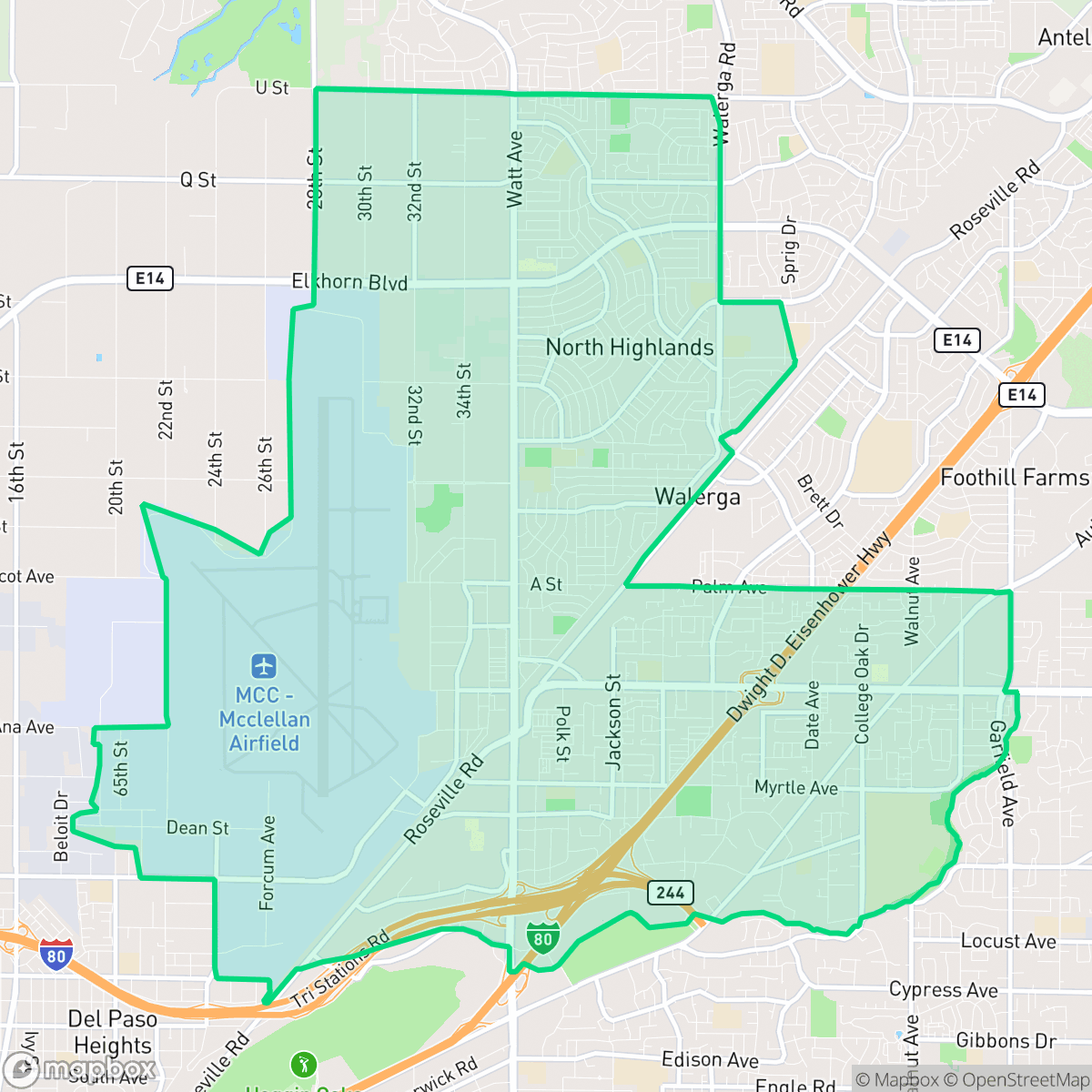
About North Highlands
North Highlands, a census-designated place in Sacramento County, was historically defined by its transition from agricultural land to a vital support community for McClellan Air Force Base. Established in 1935 as the Pacific Air Depot, the base became a major logistics and maintenance hub that spurred rapid residential development throughout the mid-20th century. Following the base's closure in 2001 under the Base Realignment and Closure process, the area underwent a significant transformation, with the former military installation successfully redeveloped into the McClellan Business Park. Today, the neighborhood maintains a distinct identity shaped by this military heritage, anchored by landmarks like the Aerospace Museum of California. The community is characterized by its diverse population and its role as a key regional logistics and commercial corridor along Watt Avenue.
The neighborhood features a distinct suburban-industrial character defined by a mix of residential streets, large-scale warehouses, and expansive open areas. The demographic profile is notably diverse, encompassing a balanced range of young adults, families, and seniors. Residents benefit from a layout that prioritizes pedestrian connectivity, with well-established sidewalk networks that make local navigation easier than in many other parts of the city. The presence of large central parks and athletic fields provides ample opportunity for outdoor recreation and pet owners, contributing to a steady, active suburban rhythm.
Neighborhood Scores Across 15 Qualities
Neighboring structures vary from closely packed apartment complexes and mobile homes to detached houses with modest yard gaps. According to iHuus data, this level of privacy is slightly lower than the city average due to the presence of high-density housing interspersed with standard suburban lots.
Established sidewalk networks and low-traffic residential loops provide safe pedestrian routes throughout the area. This level of connectivity is notably higher than the Sacramento average, though large arterial roads and the nearby freeway can act as barriers to movement.
Standard tract housing and multi-family complexes define the landscape, offering a more consistent and tidy visual environment than the city average. While yard sizes are generally modest, some properties feature private or shared pools.
Large central parks, athletic fields, and green corridors provide ample space for walking pets. According to iHuus data, the availability of public green space here is notably higher than the city average.
A combination of open airfield land and scattered residential pockets provides a more open, less dense environment than the typical city layout. Residents will find a landscape characterized by significant grey infrastructure, large-scale warehouses, and expansive undeveloped spaces.
A mix of residential streets and light industrial units creates a more active environment than the city average. While various dining and social spots are present, the area remains largely car-dependent for most errands.
Frequent noise from nearby railroad tracks and heavy freeway traffic is a consistent feature of this area. According to iHuus data, acoustic comfort in North Highlands is slightly below the city average.
Air quality levels here typically fluctuate between acceptable and unhealthy ranges. According to iHuus data, these conditions are consistent with the average seen throughout the city.
Predominantly residential and light commercial uses characterize this area, offering much less industrial activity than the city average. While most streets are free of heavy warehouses, residents should note the proximity to a nearby Superfund site which may impact local environmental considerations.
Health insurance enrollment among North Highlands residents is slightly lower than the Sacramento average, according to iHuus data.
Political leanings in this area trend liberal, which is slightly more pronounced than the city average according to iHuus data.
Residents live alongside a balanced variety of young adults, families, and seniors. This demographic spread is slightly more varied than the average found in the rest of the city, according to iHuus data.
Flood risk levels remain undetermined due to a lack of detailed federal studies for this specific area. According to iHuus data, the risk profile is slightly higher than the average for the city.
Address-Level Insights for North Highlands


iHuus Neighborhood Intelligence Insights
Get address-level neighborhood insights for North Highlands
- Street-level scores — see how individual blocks compare, not just neighborhood averages
- Micro-zone boundaries — identify quiet pockets, flood boundaries, and walkable clusters before you visit
- 15 dimensions in full — walkability, noise, air quality, school quality, insurance coverage, population age profile, urban/rural index, and more
- Boundary risk alerts — know if your address sits near a block boundary where scores drop, the kind of detail no listing will ever mention
- School insights — individual school ratings and insights, not just district-level data
- Compare before you commit — side-by-side data across neighborhoods, down to block precision
No credit card required
North Highlands Rankings
School Districts Serving North Highlands
School Insights for North Highlands
Below average outcomes; significant attendance and academic challenges.
School Insights
See what's really behind every school rating near North Highlands
- Individual school ratings — each school's own score with outcome context, not just a district average
- Enrollment & class size data — student-to-teacher ratio and how it compares to the state average
- Full demographics breakdown — ethnicity and gender composition for every school in the enrollment zone
- Every school in the district — all schools within the enrollment boundary ranked by rating, not just the closest one
- Grade levels & benchmarks — elementary through high school, with below/above state-average flags
No credit card required