Parkway-South Sacramento, Lemon Hill
Updated · 39,988 residents
Parkway-South Sacramento is a diverse, suburban neighborhood defined by a mix of residential tracts and established sidewalk networks that make it more walkable than many surrounding areas. While residents benefit from accessible healthcare and a steady, community-focused rhythm, the area experiences notable noise from nearby freeway and rail traffic.
Key Highlights
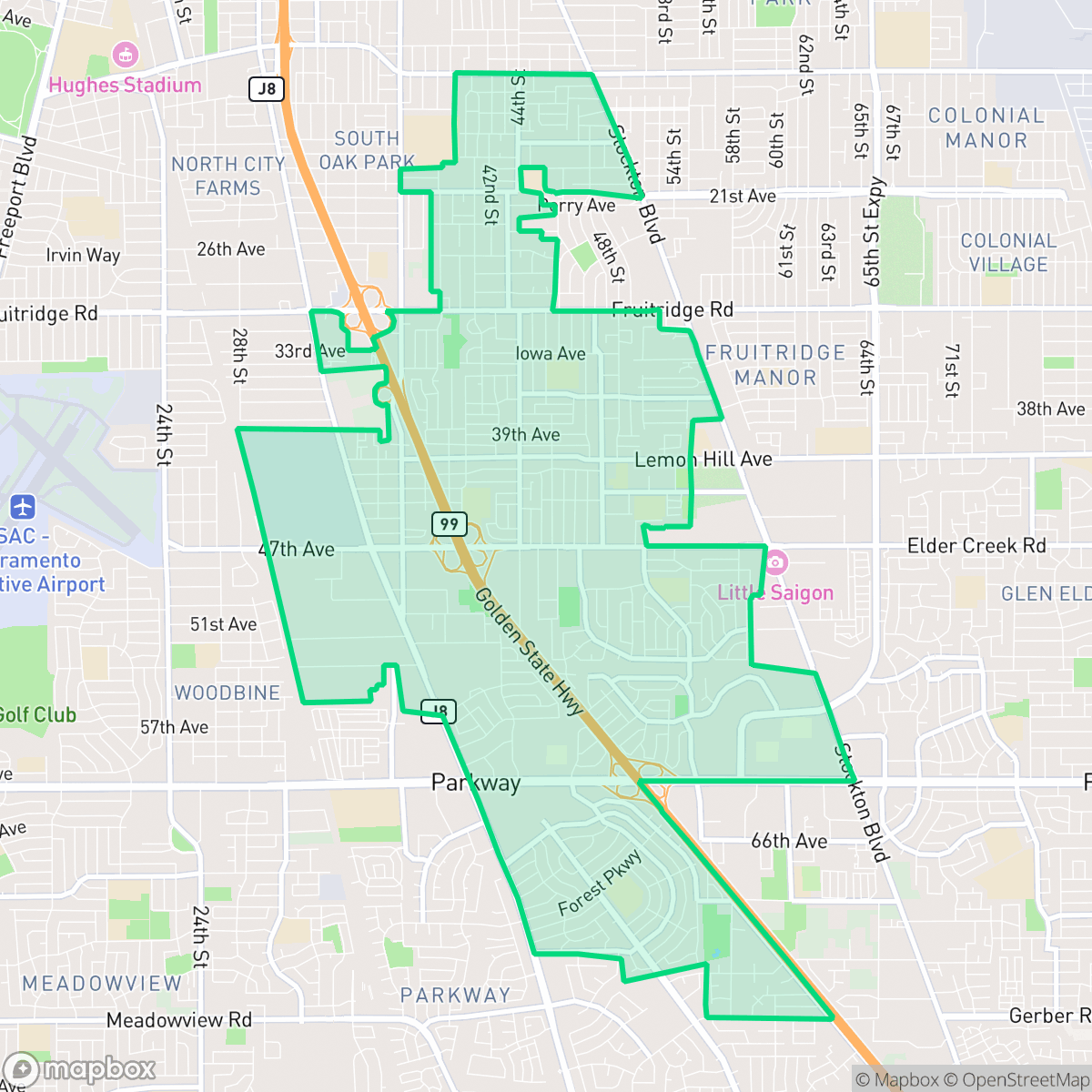
About Parkway-South Sacramento
The area formerly designated as the Parkway-South Sacramento census-designated place developed as a suburban expansion south of Sacramento, anchored by the historical importance of Stockton Boulevard, which served as a segment of U.S. Route 99. Its growth was accelerated by the proximity of the Southern Pacific and Western Pacific railroads, which facilitated regional transit. The neighborhood experienced significant residential development during the 1940s and 1950s, followed by rapid growth in the 1960s with the construction of regional shopping centers like the Florin Mall. The area, which includes the Lemon Hill community, transitioned from agricultural and grazing land into a diverse, working-class residential district. Before its 2010 dissolution into smaller CDPs, the region served as a central hub for South Sacramento’s post-war suburban transformation, defined by its mix of residential, retail, and industrial infrastructure.
The neighborhood serves as a central residential hub in South Sacramento, characterized by a suburban landscape of standard tract housing and apartment clusters. It maintains a strong liberal political identity and a balanced demographic profile, ranging from young families to retirees. Residents enjoy a consistent sidewalk network that supports pedestrian activity, though the overall atmosphere remains car-dependent for most daily errands. The area offers a stable environment with better-than-average health insurance coverage for its inhabitants.
Living in this community involves balancing the benefits of a well-connected street grid against the realities of high ambient noise levels from local transit corridors. The area sits within a 500-year floodplain, and prospective residents should consider the proximity to both high-performing and distressed school districts. It is well-suited for those seeking an established community that offers a blend of suburban privacy and urban accessibility.
Neighborhood Scores Across 15 Qualities
Residential spacing is consistent with the city average, featuring a mix of detached suburban homes and denser apartment clusters. While some areas offer small backyard buffers, other pockets contain closely packed structures with minimal separation between neighbors.
Consistent sidewalk networks and low-traffic residential streets provide safe pedestrian routes throughout much of the area. While the highway and large commercial blocks can create barriers, walking conditions are slightly better than the city average according to iHuus data.
Uniform tract housing and apartment complexes define the landscape, featuring consistent rooflines and small yards. This visual character is typical for the city.
Access to public parks and green corridors for pet walking is consistent with the city average. While many areas feature sidewalks with grassy verges and proximity to sports fields, some residential zones rely primarily on private fenced yards.
Residential patterns here feature a blend of single-family homes and low-density developments that align with the city average for urban-rural balance. According to iHuus data, the landscape consists of a mix of suburban housing tracts and occasional commercial or institutional structures.
A balanced mix of residential life and light industrial uses creates a steady atmosphere that is slightly more active than the city average. While various dining and social hubs are present, much of the area remains car-dependent with limited walkable business density.
Frequent acoustic disturbances from nearby railroad tracks and freeway traffic characterize this area. According to iHuus data, noise levels are slightly higher than the Sacramento city average.
Air quality in this area fluctuates between acceptable and unhealthy levels, aligning with the typical levels found throughout Sacramento. Sensitive individuals should monitor local conditions, as occasional periods of concern may occur according to iHuus data.
Industrial presence is minimal and limited to occasional light commercial uses, making the area slightly cleaner of heavy industrial hazards than the city average. According to iHuus data, residents can expect a landscape dominated by residential and institutional spaces without significant warehouse or manufacturing activity.
Health insurance accessibility is notably higher in this area than the city average, according to iHuus data. Residents may find more stability in healthcare access compared to many other parts of Lemon Hill.
Voting patterns and census indicators reflect a deeply liberal political leaning, which is consistent with the broader Sacramento area according to iHuus data.
A balanced mix of young adults, families, and seniors characterizes the area, representing a demographic spread slightly more varied than the city average according to iHuus data.
Some residual flood risk exists within the area as it sits within a 500-year floodplain. According to iHuus data, this level of safety is lower than the average for the city of Lemon Hill.
Address-Level Insights for Parkway-South Sacramento


iHuus Neighborhood Intelligence Insights
Get address-level neighborhood insights for Parkway-South Sacramento
- Street-level scores — see how individual blocks compare, not just neighborhood averages
- Micro-zone boundaries — identify quiet pockets, flood boundaries, and walkable clusters before you visit
- 15 dimensions in full — walkability, noise, air quality, school quality, insurance coverage, population age profile, urban/rural index, and more
- Boundary risk alerts — know if your address sits near a block boundary where scores drop, the kind of detail no listing will ever mention
- School insights — individual school ratings and insights, not just district-level data
- Compare before you commit — side-by-side data across neighborhoods, down to block precision
No credit card required
Parkway-South Sacramento Rankings
School Districts Serving Parkway-South Sacramento
School Insights for Parkway-South Sacramento
Below average outcomes; significant attendance and academic challenges.
School Insights
See what's really behind every school rating near Parkway-South Sacramento
- Individual school ratings — each school's own score with outcome context, not just a district average
- Enrollment & class size data — student-to-teacher ratio and how it compares to the state average
- Full demographics breakdown — ethnicity and gender composition for every school in the enrollment zone
- Every school in the district — all schools within the enrollment boundary ranked by rating, not just the closest one
- Grade levels & benchmarks — elementary through high school, with below/above state-average flags
No credit card required