Pedley, Jurupa Valley
Updated · 17,571 residents
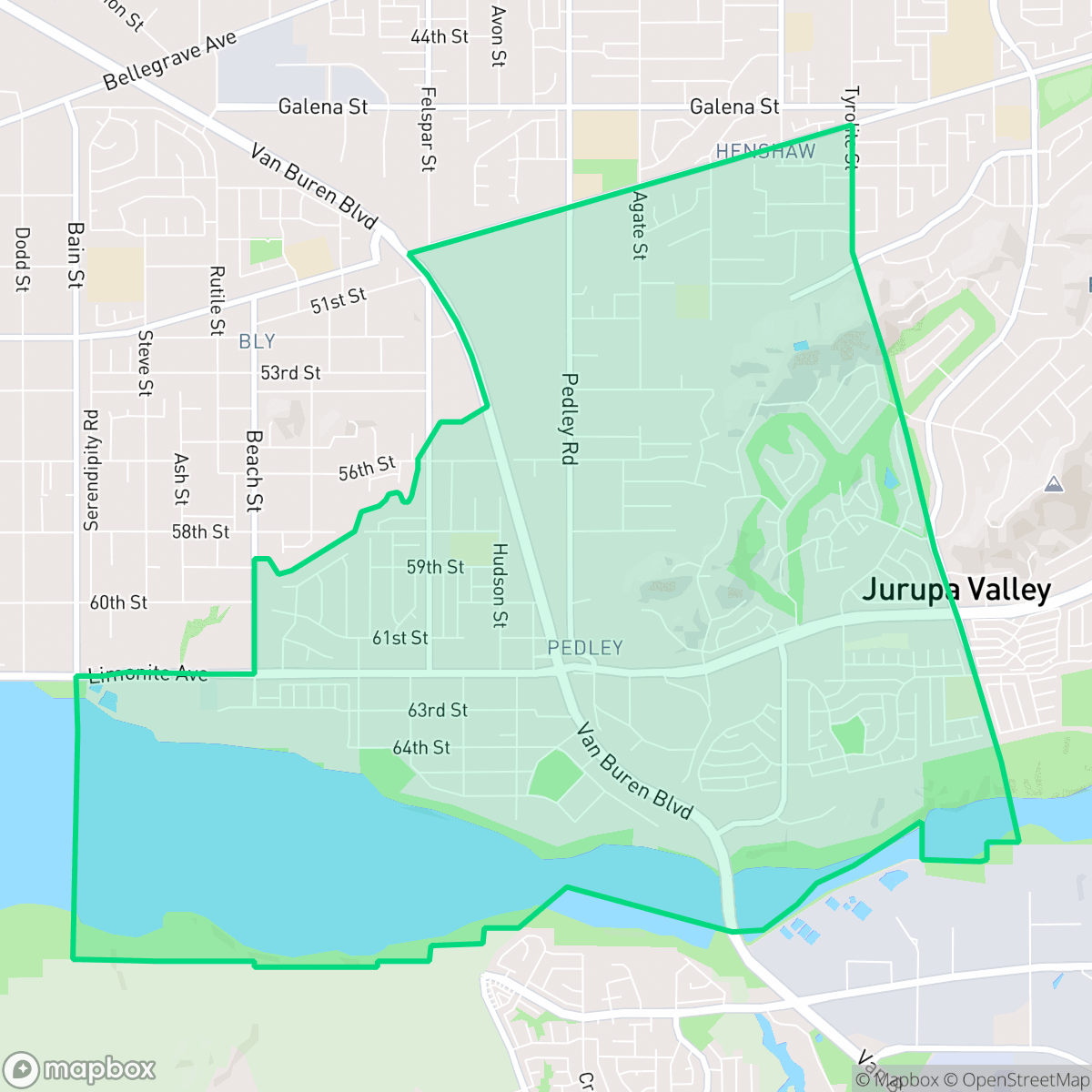
Pedley is a suburban neighborhood in Jurupa Valley defined by a blend of residential tract housing and industrial logistics centers. While the area offers a complete sidewalk network for pedestrians, residents typically rely on personal vehicles to access local dining and commercial services.
Key Highlights
About Pedley
The Jurupa Valley neighborhood of Pedley traces its origins to 1903 or 1904, when the San Pedro, Los Angeles and Salt Lake Railroad established a switch and station there. The community was named after William Pedley, an English cricketer who served as manager of the San Jacinto Land Company and engineered the local irrigation system. Historically, Pedley's development was tied to the railroad and local industry; its northern edge featured the Bly Wye, a rail junction connecting to the Crestmore Cement Mill and a rock quarry that supplied stone for San Pedro Harbor. A defining local landmark is the concrete viaduct railroad bridge crossing the Santa Ana River, once celebrated as the longest concrete railroad bridge in the United States. Formerly a census-designated place, Pedley became part of the newly incorporated city of Jurupa Valley in 2011.
The neighborhood functions as a dense suburban environment that integrates residential life with active light industrial zones. The landscape is marked by standard tract housing, often featuring private pools and small yards, situated near major logistics warehouses and regional infrastructure like the local wastewater treatment facility. According to iHuus data, the area maintains a balanced urban and rural feel, where suburban streets transition into open spaces and rail corridors.
Livability in this part of Jurupa Valley involves balancing accessibility with industrial proximity. While the neighborhood provides a consistent sidewalk network, the limited density of local businesses necessitates car travel for most daily errands. Prospective residents should note the acoustic environment, which is primarily influenced by road traffic, alongside the presence of heavy logistics hubs. Education options are provided through several school districts, including Alvord, Jurupa, and Riverside, which offer a variety of programs ranging from dual language immersion to career technical education.
Neighborhood Scores Across 15 Qualities
Residential spacing offers a moderate level of separation between neighbors, which is slightly higher than the Jurupa Valley average. Some pockets feature higher density with narrow side yards and closer proximity between homes.
Pedestrian infrastructure is consistent with the city average, featuring sidewalks on residential streets and safe crossings. Some areas offer a complete sidewalk network that connects directly to local commercial centers.
Larger homes and frequent upscale amenities, such as private backyard pools, contribute to a visual profile that is more attractive than the Jurupa Valley average. According to iHuus data, the area features many well-kept properties with spacious driveways and organized streetscapes.
Wide green verges and a public park with walking paths provide good opportunities for pet owners. According to iHuus data, these accessible outdoor spaces make the area slightly more dog friendly than the Jurupa Valley average.
Open land and scattered homes characterize this area, providing a slightly more rural atmosphere than the rest of Jurupa Valley. Residents will find a landscape defined by a mix of large industrial blocks, utility zones, and transitional suburban plots.
A steady rhythm of residential life meets occasional local services and dining, offering a slightly more active atmosphere than the Jurupa Valley average. While some pockets feature accessible amenities, much of the area remains low-density and car-dependent.
A steady hum from nearby busy streets is noticeable, though acoustic comfort remains higher than the Jurupa Valley average according to iHuus data.
Air quality remains consistently good with rare instances of elevated readings. This level of air cleanliness is in line with the Jurupa Valley average, according to iHuus data.
While many areas are predominantly residential, certain sections contain large logistics warehouses, salvage yards, and a wastewater treatment plant. This level of industrial activity is slightly higher than the Jurupa Valley average according to iHuus data.
Health insurance accessibility in Pedley is roughly in line with the Jurupa Valley average. According to iHuus data, a significant portion of the local population remains without coverage.
Political leanings in this area are split relatively evenly between conservative and liberal perspectives. This distribution is notably more moderate than the more conservative lean found across the rest of Jurupa Valley.
Residents live alongside a balanced spread of young adults, families, and older individuals, reflecting a demographic profile that is very similar to the Jurupa Valley average.
Flood risk in this area is significantly higher than the Jurupa Valley average. Residents should prepare for potential challenges regarding elevated insurance costs and coastal hazard considerations.
Fire hazards in this area are significantly higher than the Jurupa Valley average. Residents should prepare for extreme wildfire conditions and prioritize maximum protection measures according to iHuus data.
Address-Level Insights for Pedley


iHuus Neighborhood Intelligence Insights
Get address-level neighborhood insights for Pedley
- Street-level scores — see how individual blocks compare, not just neighborhood averages
- Micro-zone boundaries — identify quiet pockets, flood boundaries, and walkable clusters before you visit
- 15 dimensions in full — walkability, noise, air quality, school quality, insurance coverage, population age profile, urban/rural index, and more
- Boundary risk alerts — know if your address sits near a block boundary where scores drop, the kind of detail no listing will ever mention
- School insights — individual school ratings and insights, not just district-level data
- Compare before you commit — side-by-side data across neighborhoods, down to block precision
No credit card required
Pedley Rankings
School Districts Serving Pedley
School Insights for Pedley
Below average outcomes; significant attendance and academic challenges.
School Insights
See what's really behind every school rating near Pedley
- Individual school ratings — each school's own score with outcome context, not just a district average
- Enrollment & class size data — student-to-teacher ratio and how it compares to the state average
- Full demographics breakdown — ethnicity and gender composition for every school in the enrollment zone
- Every school in the district — all schools within the enrollment boundary ranked by rating, not just the closest one
- Grade levels & benchmarks — elementary through high school, with below/above state-average flags
No credit card required