Foothill Farms, Foothill Farms
Updated · 19,109 residents
Foothill Farms is a dense suburban community in Sacramento County characterized by mid-century tract housing and a consistent network of sidewalks. While the neighborhood offers good pedestrian access on local streets, residents often experience significant road noise and a car-dependent lifestyle typical of the region.
Key Highlights
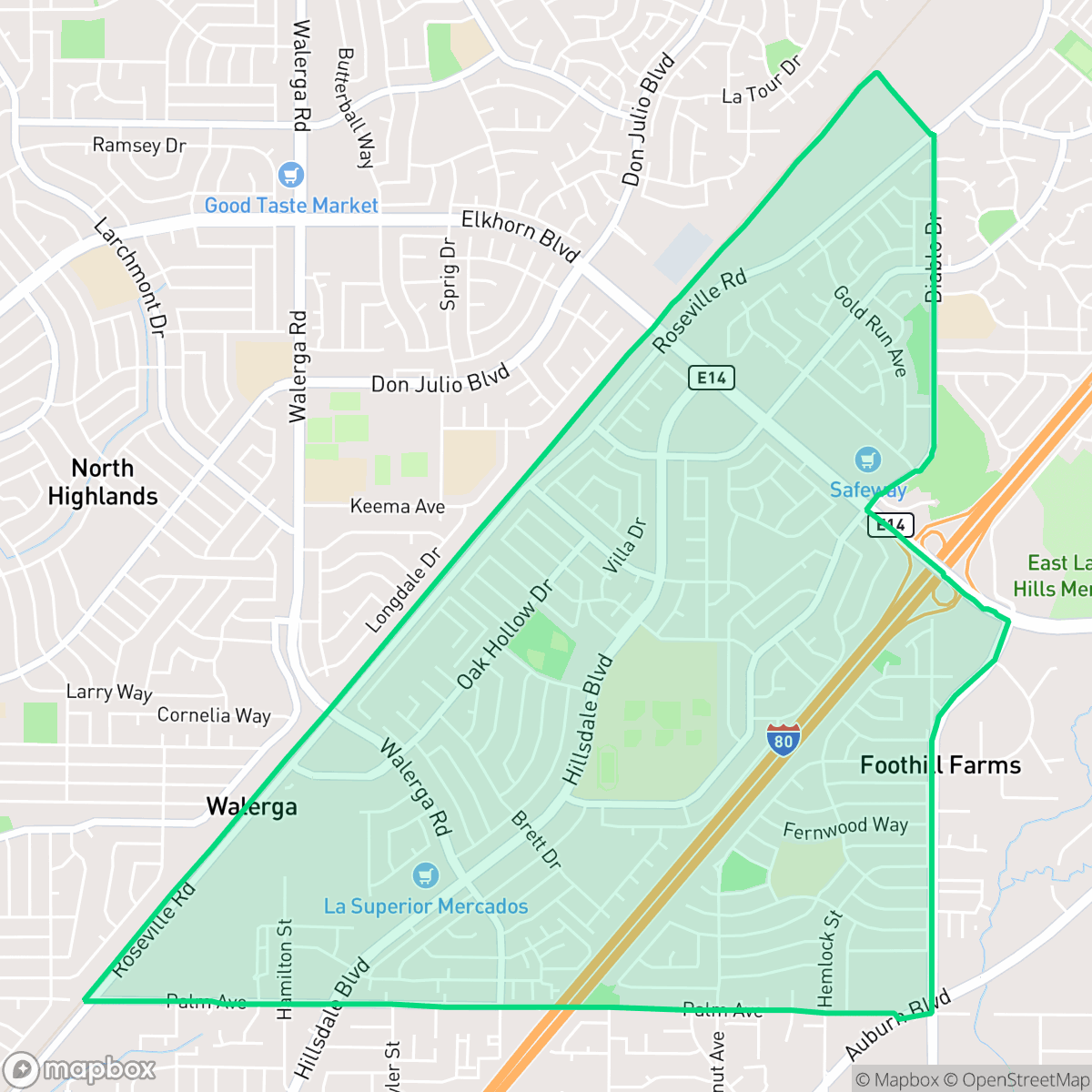
About Foothill Farms
Foothill Farms, an unincorporated community in Sacramento County, California, developed primarily in response to the influx of military personnel and families connected to nearby McClellan Air Force Base starting in the mid-20th century. The neighborhood is historically divided into two distinct sections: "Old Foothill Farms," established in the 1950s with ties to Carmichael, and "New Foothill Farms," founded a decade later adjacent to North Highlands. While its early growth was spurred by the post-WWII military boom, the area historically faced challenges from decades of underinvestment and discriminatory redlining. In 2024, the community gained its own Community Planning Advisory Council (CPAC) to provide local representation and guide revitalization efforts, such as converting older commercial centers into mixed-use housing.
The area features a mix of single-family homes and apartment complexes, reflecting its development history tied to the nearby McClellan Air Force Base. According to iHuus data, the community maintains a balance of residential and light commercial spaces, though the prevalence of arterial roads and proximity to major highways contributes to a notable acoustic footprint. Residents benefit from a well-established sidewalk network that supports local walking, although the overall environment remains oriented toward vehicular transit. Prospective residents should consider the trade-offs between the neighborhood's established infrastructure and its current acoustic environment. While the area provides access to local green spaces and highly-rated educational options like Pioneer TK-8, it faces challenges regarding fire safety and moderate flood risk. The community is best suited for those seeking a traditional suburban environment with proximity to Sacramento's transit corridors, provided they are comfortable with the noise levels associated with a dense, road-adjacent setting.
Neighborhood Scores Across 15 Qualities
Residential spacing is consistent with the city average, featuring a mix of detached homes with small yards and denser apartment structures. According to iHuus data, some areas offer private fenced backyards while others feature shared walls or minimal separation between houses.
Residential streets feature a consistent sidewalk network and safe crossings, matching the city average for walkability. While low-traffic cul-de-sacs and school pathways are easy to navigate, major highways and arterial roads can act as barriers to movement.
Uniform tract housing and apartment complexes define the landscape, characterized by consistent roof designs and modest yard sizes. This area maintains a level of visual variety that is typical for the city.
Access to dog walking areas is average for the city, featuring a mix of central public parks and school fields alongside residential streets with narrow sidewalk verges. While many homes offer fenced private yards, public green space varies depending on the specific pocket of the neighborhood.
A balanced landscape of single-family homes, apartment complexes, and commercial strips characterizes this area. According to iHuus data, the blend of residential and light industrial zones is consistent with the city average.
Local activity remains steady but subdued, reflecting a suburban character that is slightly more tranquil than the city average. While various dining and social hubs are accessible, the area is primarily car-dependent with limited walking options between destinations.
Frequent noise from nearby freeways and railroad lines characterizes this area. According to iHuus data, acoustic comfort levels are slightly lower than the city average.
Air quality levels in this area are consistent with the city average, featuring a mix of acceptable and unhealthy days that may occasionally concern sensitive groups according to iHuus data.
Heavy industrial presence is minimal, though some residents may experience noise or traffic from nearby warehouses and utility substations. According to iHuus data, the neighborhood features fewer large-scale industrial hazards than the city average.
Health insurance access is high among residents, performing closely to the city average according to iHuus data.
Political leanings in this area trend more liberal than the average for the city. According to iHuus data, a liberal majority exists here with a modest opposing presence.
Residents live alongside a balanced mix of young adults, families, and older individuals. This demographic spread is largely consistent with the average across the city, according to iHuus data.
Flood risk levels in this area are currently undetermined due to a lack of detailed studies from FEMA. According to iHuus data, the safety profile for flooding is slightly lower than the average for the city.
Address-Level Insights for Foothill Farms


iHuus Neighborhood Intelligence Insights
Get address-level neighborhood insights for Foothill Farms
- Street-level scores — see how individual blocks compare, not just neighborhood averages
- Micro-zone boundaries — identify quiet pockets, flood boundaries, and walkable clusters before you visit
- 15 dimensions in full — walkability, noise, air quality, school quality, insurance coverage, population age profile, urban/rural index, and more
- Boundary risk alerts — know if your address sits near a block boundary where scores drop, the kind of detail no listing will ever mention
- School insights — individual school ratings and insights, not just district-level data
- Compare before you commit — side-by-side data across neighborhoods, down to block precision
No credit card required
Foothill Farms Rankings
School Districts Serving Foothill Farms
School Insights for Foothill Farms
Below average outcomes; significant attendance and academic challenges.
School Insights
See what's really behind every school rating near Foothill Farms
- Individual school ratings — each school's own score with outcome context, not just a district average
- Enrollment & class size data — student-to-teacher ratio and how it compares to the state average
- Full demographics breakdown — ethnicity and gender composition for every school in the enrollment zone
- Every school in the district — all schools within the enrollment boundary ranked by rating, not just the closest one
- Grade levels & benchmarks — elementary through high school, with below/above state-average flags
No credit card required