Richmond Heights/East Richmond, East Richmond Heights
Updated · 8,359 residents
East Richmond Heights is a quiet, densely suburban neighborhood known for its high walkability and clean air. While the area offers a stable, diverse community, residents should be aware of significant environmental challenges, including high fire and flood risks and notable traffic noise from nearby transit corridors.
Key Highlights
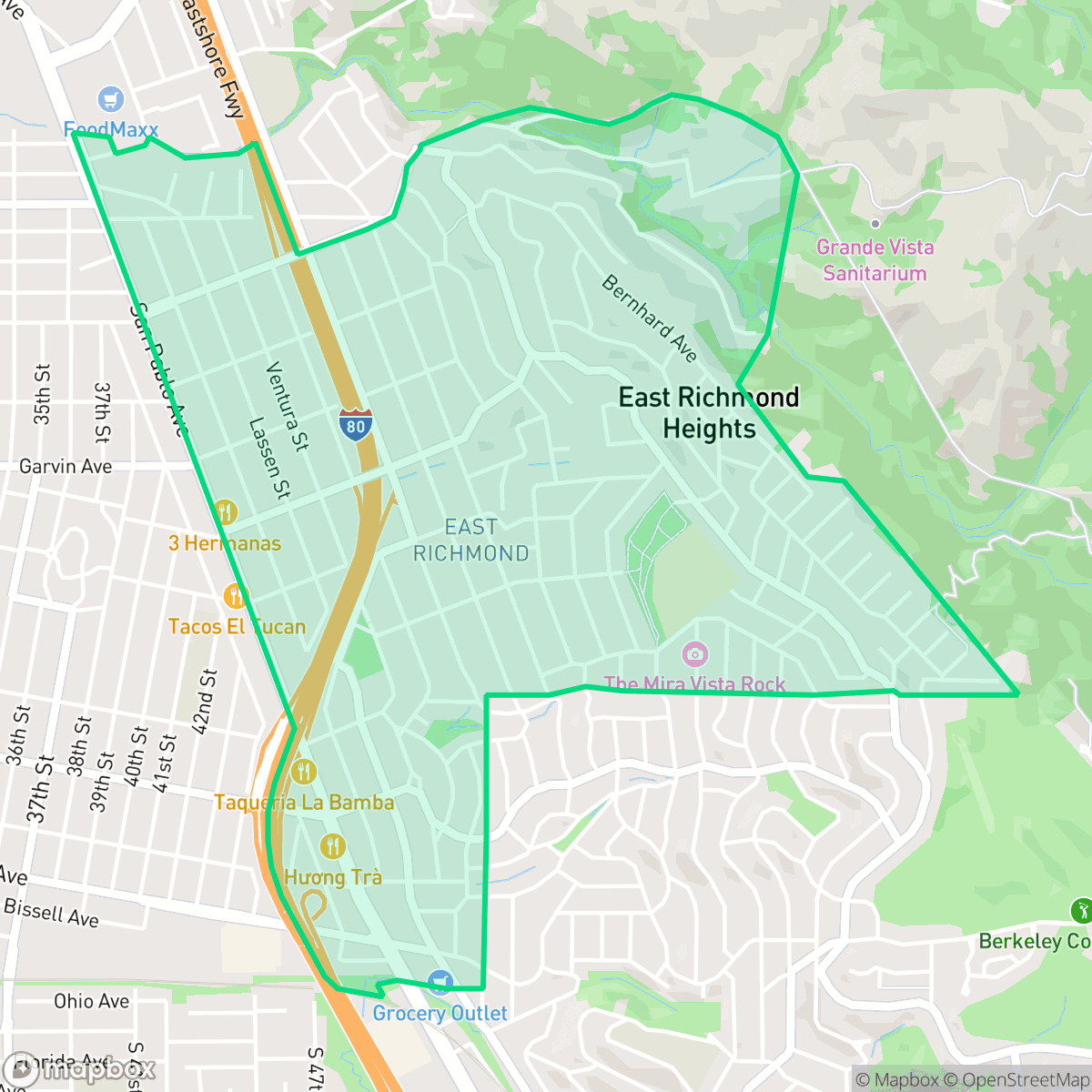
About Richmond Heights/East Richmond
East Richmond Heights is characterized by a steady, suburban rhythm with a mix of single-family homes and multi-story residential structures. The area is highly accessible for pedestrians, featuring an extensive network of sidewalks and clear crossings that facilitate movement throughout the neighborhood. Residents benefit from consistently clean air quality and a strong sense of community, with a population that spans a diverse range of age groups and political leanings. The neighborhood maintains a quiet atmosphere, though its proximity to major transit routes creates a car-dependent landscape in certain pockets. Living in this neighborhood involves specific trade-offs, particularly regarding environmental safety and noise levels. The area faces substantial risks related to fire and flooding, and the proximity to railroad tracks and major freeway corridors results in frequent traffic noise. Furthermore, the local school district, West Contra Costa Unified, faces ongoing challenges with fiscal instability and academic performance. The neighborhood is best suited for those who prioritize pedestrian access and a quiet residential lifestyle while remaining mindful of the necessary safety considerations.
Neighborhood Scores Across 15 Qualities
Residential buildings and houses are situated with mixed spacing, often resulting in closer proximity between neighbors than the typical city average. Some areas feature tightly packed housing units, while other blocks maintain more standard suburban separation.
Continuous sidewalks and low-traffic residential patterns make navigating the area on foot easy. According to iHuus data, the sidewalk network is slightly more comprehensive than the city average, featuring clear crosswalks and pedestrian bridges over the highway.
Streetscapes range from large homes near the golf course to more uniform, standard tract housing. According to iHuus data, the overall visual appeal is slightly below the city average due to the prevalence of smaller lots and simpler architectural styles in certain sections.
Walking routes for pets are constrained by narrow sidewalks and limited public parks, though proximity to the local golf course and certain residential streets provide some greenery. According to iHuus data, pet-friendly features in this area are below the city average.
Residential blocks consist of single-family homes and multi-story structures integrated with large commercial lots. This built environment aligns closely with the typical urban-rural balance found across the rest of the city.
Residential life here moves at a steady, subdued pace with a slightly higher level of activity than the city average. While some pockets offer diverse dining and social hubs, much of the area remains a calm, car-dependent landscape characterized by suburban streets and green spaces.
Frequent noise from nearby railroad tracks and heavy freeway traffic characterizes this area. According to iHuus data, acoustic comfort is lower here than in the rest of the city.
Air quality remains consistently high with rare instances of elevated readings. This level of cleanliness is nearly identical to the city average, according to iHuus data.
Residential life remains largely undisturbed by heavy industry, though some areas near the freeway and large retail warehouses experience increased commercial traffic. According to iHuus data, the area contains slightly more industrial-adjacent activity than the city average.
Nearly all residents are covered by health insurance, a rate that is consistent with the city average according to iHuus data.
Voting patterns and census indicators reflect a deeply liberal political leaning that is consistent with the rest of the city.
Residents live alongside a balanced mix of young adults, families, and seniors. This demographic variety is largely consistent with the broader city average according to iHuus data.
Located within a designated floodplain, this area faces significant flood risks that may necessitate flood insurance. According to iHuus data, these risks are consistent with the broader city average.
Fire safety risks in this area are significant and consistent with the city average. According to iHuus data, the neighborhood lacks the protective features found in more secure zones.
Address-Level Insights for Richmond Heights/East Richmond


iHuus Neighborhood Intelligence Insights
Get address-level neighborhood insights for Richmond Heights/East Richmond
- Street-level scores — see how individual blocks compare, not just neighborhood averages
- Micro-zone boundaries — identify quiet pockets, flood boundaries, and walkable clusters before you visit
- 15 dimensions in full — walkability, noise, air quality, school quality, insurance coverage, population age profile, urban/rural index, and more
- Boundary risk alerts — know if your address sits near a block boundary where scores drop, the kind of detail no listing will ever mention
- School insights — individual school ratings and insights, not just district-level data
- Compare before you commit — side-by-side data across neighborhoods, down to block precision
No credit card required
Richmond Heights/East Richmond Rankings
School Districts Serving Richmond Heights/East Richmond
School Insights for Richmond Heights/East Richmond
Below average outcomes; significant attendance and academic challenges.
School Insights
See what's really behind every school rating near Richmond Heights/East Richmond
- Individual school ratings — each school's own score with outcome context, not just a district average
- Enrollment & class size data — student-to-teacher ratio and how it compares to the state average
- Full demographics breakdown — ethnicity and gender composition for every school in the enrollment zone
- Every school in the district — all schools within the enrollment boundary ranked by rating, not just the closest one
- Grade levels & benchmarks — elementary through high school, with below/above state-average flags
No credit card required