Spanish Bay, Del Monte Forest
Updated · 91 residents
Spanish Bay is a quiet, rural-feeling enclave in the Del Monte Forest, defined by its links-style golf course and luxury townhome community. While the area offers high dog friendliness and access to top-tier schools, residents experience notable noise from road traffic and a serene, low-liveliness atmosphere.
Key Highlights
About Spanish Bay
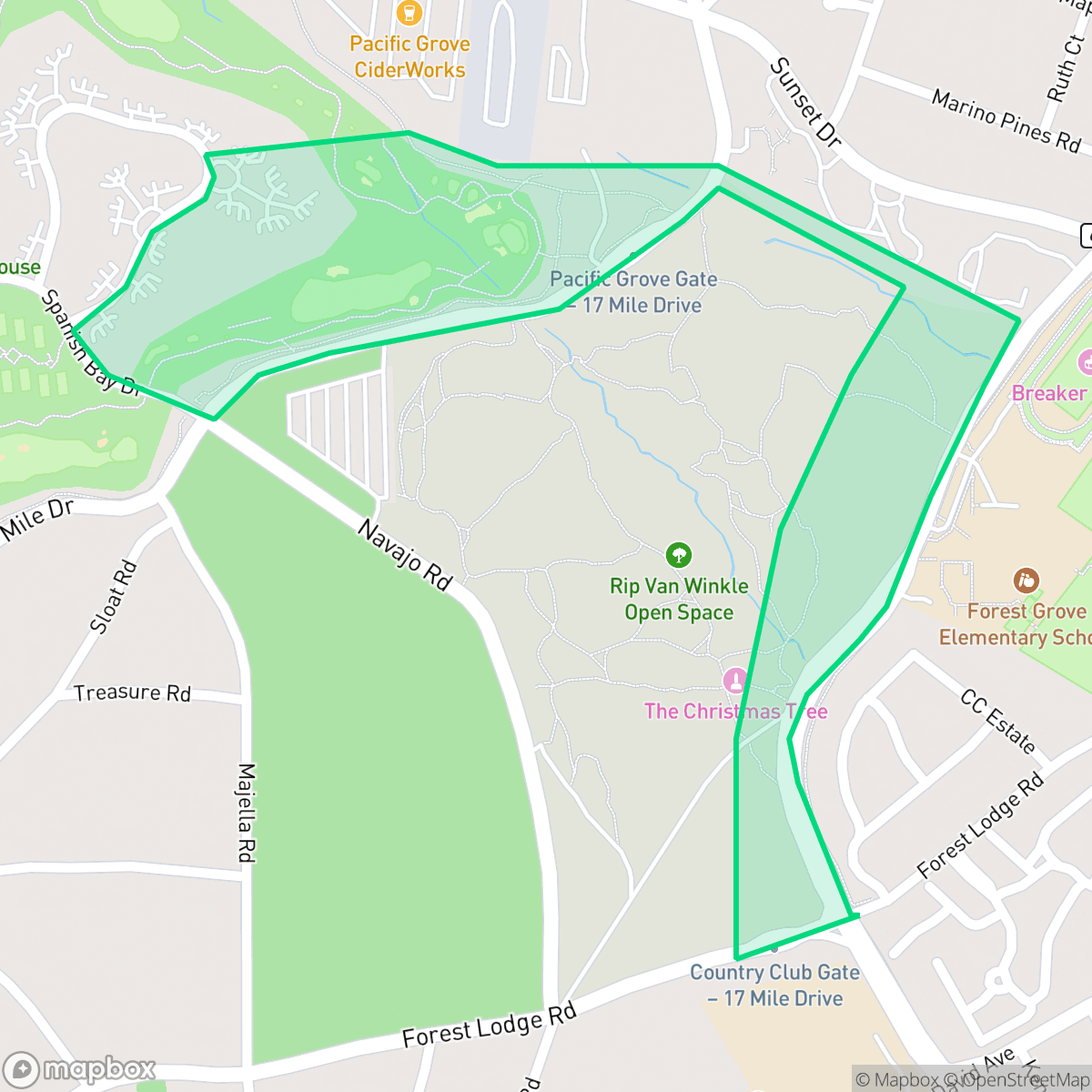
Located in the northwest corner of the Del Monte Forest, the Spanish Bay neighborhood is named for Spanish explorer Gaspar de Portolá, whose expedition camped here in 1769. From the 1880s until 1973, the coastal landscape was heavily altered by industrial sand mining operations. Its modern identity emerged in the late 1980s through an extensive environmental restoration project by the Pebble Beach Company, which reconstructed the fragile dunes. This effort paved the way for the 1987 opening of The Links at Spanish Bay—a Scottish-style course designed by Robert Trent Jones Jr., Tom Watson, and Sandy Tatum—and the adjacent Inn at Spanish Bay. The neighborhood’s residential sector is defined by 'The Residences at Spanish Bay,' an exclusive enclave of luxury townhomes built starting in 1990 that overlook the fairways and the Pacific coastline.
The area serves as a secluded residential pocket within the Del Monte Forest, characterized by its expansive green spaces and proximity to the Pacific coastline. It functions as a quiet, car-dependent environment where the pace of life remains slow and deliberate. Residents benefit from high levels of health insurance coverage and a strong sense of community stability, supported by the proximity of the highly-rated Pacific Grove Unified School District.
Living here involves specific trade-offs, particularly regarding acoustic comfort, as road traffic noise is a persistent factor in the local environment. While the neighborhood boasts excellent conditions for dog owners and a high degree of separation from industrial activity, those seeking a vibrant urban center may find the limited local services and quiet atmosphere restrictive. According to iHuus data, the area is best suited for individuals or families who prioritize a peaceful, nature-adjacent lifestyle over walkability or immediate access to commercial amenities.
Neighborhood Scores Across 15 Qualities
Residential spacing varies between dense multi-family units and detached single-family homes with moderate yard buffers. This level of privacy is roughly comparable to the surrounding area according to iHuus data.
Established sidewalk networks connect residential blocks to local schools and commercial hubs safely. According to iHuus data, the connectivity in this area is notably higher than the city average.
Manicured properties and large custom homes provide a high-status visual environment, though the area sits slightly below the city average for overall visual variety. According to iHuus data, the presence of extensive institutional facilities and spacious estates defines the landscape.
Abundant forested trails and wide, green verges provide excellent exercise opportunities for pets. While the area offers many safe paths, the overall level of dog friendliness is slightly below the city average.
Open land and woodland areas are frequent throughout the neighborhood, providing a more semi-rural atmosphere than the more densely developed city average. According to iHuus data, the area features scattered homes integrated with high canopy cover.
A mix of serene, rural landscapes and suburban pockets provides more activity than the typical area. While the setting is largely car-oriented, residents have access to several dining options and services near the water.
Audible disturbances from nearby transit corridors are frequent, making the area slightly noisier than the Del Monte Forest average according to iHuus data.
Residential, educational, and light commercial zones comprise the entire area with no detected warehouses or heavy industry. This lack of industrial proximity is consistent with the surrounding region, according to iHuus data.
Health insurance coverage is high among residents in this area, though it sits slightly below the regional average according to iHuus data.
Voting patterns and census indicators reflect a predominantly liberal leaning, which is notably more pronounced than the average for the surrounding city area.
Residents live among a diverse range of age groups, including young adults, families, and seniors. This age distribution is slightly more varied than the average seen across Del Monte Forest, according to iHuus data.
Residual flood risk exists as the area falls within a 500-year floodplain; however, safety levels remain higher than the city average according to iHuus data.
Fire hazards in this area are notably higher than the typical level found in nearby coastal communities, requiring adherence to standard mitigation and preparedness measures. According to iHuus data, the surrounding vegetation and topography present a more significant risk than the regional average.
Address-Level Insights for Spanish Bay


iHuus Neighborhood Intelligence Insights
Get address-level neighborhood insights for Spanish Bay
- Street-level scores — see how individual blocks compare, not just neighborhood averages
- Micro-zone boundaries — identify quiet pockets, flood boundaries, and walkable clusters before you visit
- 15 dimensions in full — walkability, noise, air quality, school quality, insurance coverage, population age profile, urban/rural index, and more
- Boundary risk alerts — know if your address sits near a block boundary where scores drop, the kind of detail no listing will ever mention
- School insights — individual school ratings and insights, not just district-level data
- Compare before you commit — side-by-side data across neighborhoods, down to block precision
No credit card required
Spanish Bay Rankings
School Districts Serving Spanish Bay
School Insights for Spanish Bay
Below average outcomes; significant attendance and academic challenges.
School Insights
See what's really behind every school rating near Spanish Bay
- Individual school ratings — each school's own score with outcome context, not just a district average
- Enrollment & class size data — student-to-teacher ratio and how it compares to the state average
- Full demographics breakdown — ethnicity and gender composition for every school in the enrollment zone
- Every school in the district — all schools within the enrollment boundary ranked by rating, not just the closest one
- Grade levels & benchmarks — elementary through high school, with below/above state-average flags
No credit card required