Newbury Park, Casa Conejo
Updated · 45,601 residents
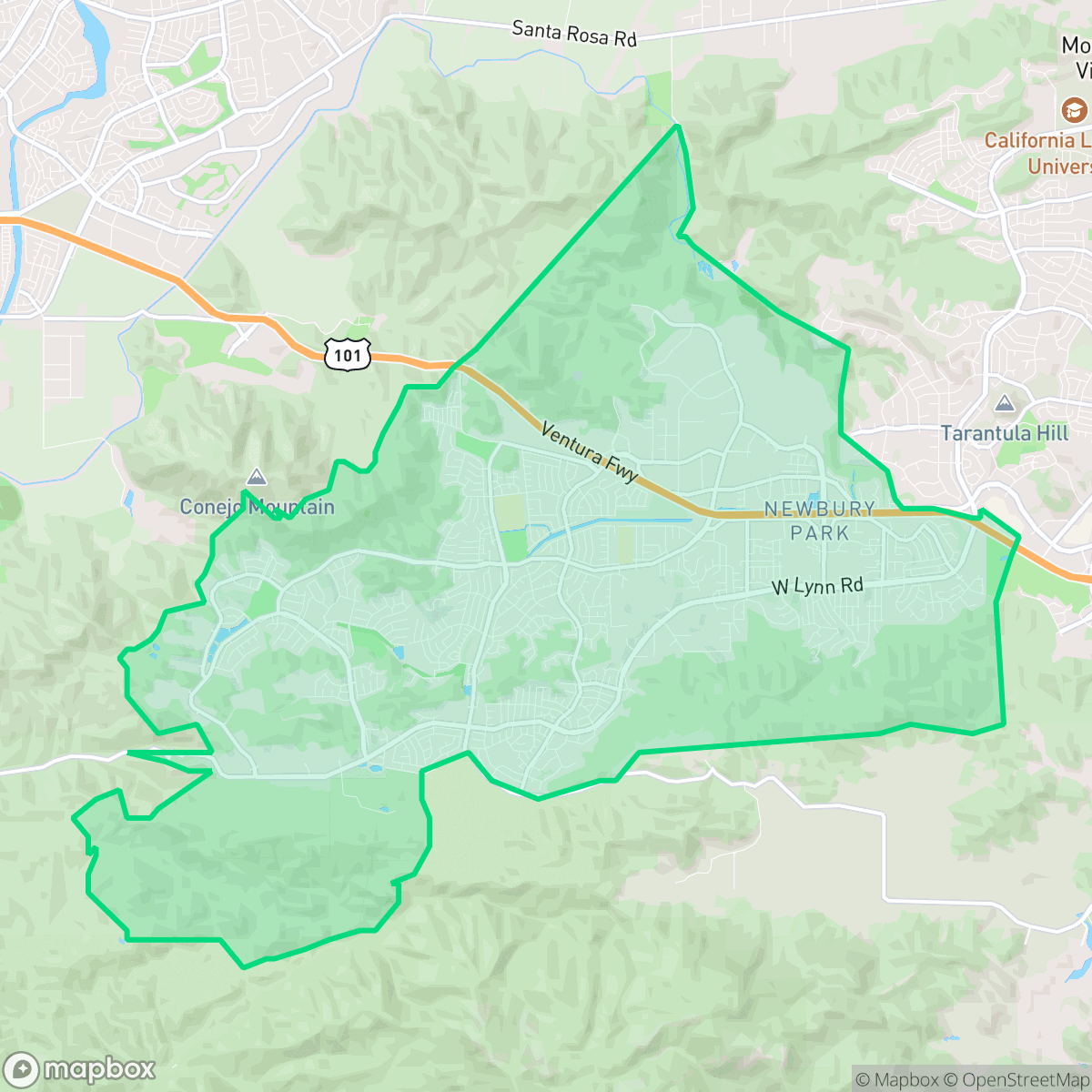
Newbury Park in Casa Conejo is a serene, pedestrian-friendly community defined by its upscale, manicured residential streets and proximity to open rolling hills. While residents enjoy exceptional air quality and a highly walkable environment, the area experiences frequent noise from nearby transit corridors and requires awareness of extreme fire safety conditions.
Key Highlights
About Newbury Park
Casa Conejo, an unincorporated community located within Newbury Park, holds a distinct identity as the area's first planned residential development, with construction beginning in 1960. Unlike much of the surrounding Newbury Park area, which was annexed by the City of Thousand Oaks, Casa Conejo has remained an unincorporated 'island' within the city limits, maintaining a unique small-town character. Developed by Louis Lesser Enterprises, the neighborhood is notable for its street names, which were derived from the names of the developers' family members, including Lesser, Malat, and Rudman. The community, whose name translates to 'Rabbit House,' occupies land that was once part of the historic Rancho El Conejo, a Spanish land grant. Today, it remains a close-knit residential enclave that has consistently resisted efforts to be absorbed into the broader municipal governance of Thousand Oaks.
This neighborhood offers a semi-rural aesthetic characterized by expansive open spaces and well-maintained residential clusters. The area is highly accessible for pedestrians, featuring an extensive network of sidewalks and signalized crossings that connect the community. Residents benefit from clean air and a balanced demographic profile, with a visual landscape marked by large homes and private backyard pools that contribute to an upscale, quiet atmosphere. The lack of industrial facilities ensures that the community remains focused on residential living, providing a tranquil environment for those who prioritize a slower pace of life.
Living in this area involves specific trade-offs, particularly regarding environmental and infrastructure factors. While the neighborhood is highly desirable for its layout, it is subject to notable noise from adjacent freeways and rail lines. Furthermore, the region is situated in a zone with extreme fire risk, requiring residents to maintain proactive safety measures. Educational needs are served by a variety of school districts, including the well-regarded Conejo Valley Unified and Pleasant Valley Elementary systems. The area is best suited for individuals and families who value a quiet, walkable, and visually appealing environment while remaining prepared for the realities of living in a high-fire-hazard zone.
Neighborhood Scores Across 15 Qualities
Residential spacing is consistent with the city average, featuring detached homes with small side yards and private fenced backyards. Privacy levels vary across the area, ranging from higher-density apartment living to more spacious estates with significant buffers.
Extensive sidewalk networks and signalized crossings make navigating residential streets very safe for pedestrians. While a central freeway corridor divides the area, the connectivity remains slightly above the city average according to iHuus data.
Large homes, manicured landscaping, and a high density of private backyard pools contribute to a visual character that is slightly above the city average. According to iHuus data, the area features a mix of spacious estates and well-maintained residential communities.
Connected green spaces, wide sidewalks, and local parks provide an environment that is more dog friendly than the city average. According to iHuus data, many residential blocks feature grass parkways and buffered paths that are well-separated from main roads.
Significant natural open space and rolling hills characterize this area, offering a more open landscape than the typical suburban density found elsewhere in the city. According to iHuus data, the neighborhood features frequent patches of woodland and undeveloped terrain interspersed with residential clusters.
Low-density residential streets and vast open spaces create a much more tranquil environment than the city average. Most areas lack a dense commercial character, though a few scattered dining and social hubs provide local utility for those with a car.
Frequent noise from nearby freeways and rail lines characterizes this area. According to iHuus data, acoustic comfort levels are slightly lower than the city average.
Air quality remains consistently high with negligible health concerns, matching the average seen throughout the city.
Industrial presence is minimal here, with no warehouses or heavy manufacturing facilities detected in the area. This neighborhood maintains a slightly cleaner profile regarding industrial proximity than the city average according to iHuus data.
Health insurance accessibility is widespread throughout the area, though slightly lower than the average seen across the rest of the city according to iHuus data.
Political views in this area are distributed relatively evenly between conservative and liberal leanings, representing a more balanced ideological split than the city average according to iHuus data.
A diverse range of age groups resides here, representing a demographic spread that is slightly more varied than the Casa Conejo average. According to iHuus data, the community features a stable mix of young adults, families, and older residents.
Flood risk levels in this area are higher than the city average, though FEMA has not yet completed a detailed study to fully classify the hazard level. According to iHuus data, the specific vulnerability of this neighborhood remains undetermined.
Extreme fire risk characterizes this area, necessitating maximum protection measures. This level of danger is consistent with the city average according to iHuus data.
Address-Level Insights for Newbury Park


iHuus Neighborhood Intelligence Insights
Get address-level neighborhood insights for Newbury Park
- Street-level scores — see how individual blocks compare, not just neighborhood averages
- Micro-zone boundaries — identify quiet pockets, flood boundaries, and walkable clusters before you visit
- 15 dimensions in full — walkability, noise, air quality, school quality, insurance coverage, population age profile, urban/rural index, and more
- Boundary risk alerts — know if your address sits near a block boundary where scores drop, the kind of detail no listing will ever mention
- School insights — individual school ratings and insights, not just district-level data
- Compare before you commit — side-by-side data across neighborhoods, down to block precision
No credit card required
Newbury Park Rankings
School Districts Serving Newbury Park
School Insights for Newbury Park
Below average outcomes; significant attendance and academic challenges.
School Insights
See what's really behind every school rating near Newbury Park
- Individual school ratings — each school's own score with outcome context, not just a district average
- Enrollment & class size data — student-to-teacher ratio and how it compares to the state average
- Full demographics breakdown — ethnicity and gender composition for every school in the enrollment zone
- Every school in the district — all schools within the enrollment boundary ranked by rating, not just the closest one
- Grade levels & benchmarks — elementary through high school, with below/above state-average flags
No credit card required