Canyon Country, Agua Dulce
Updated · 67,670 residents
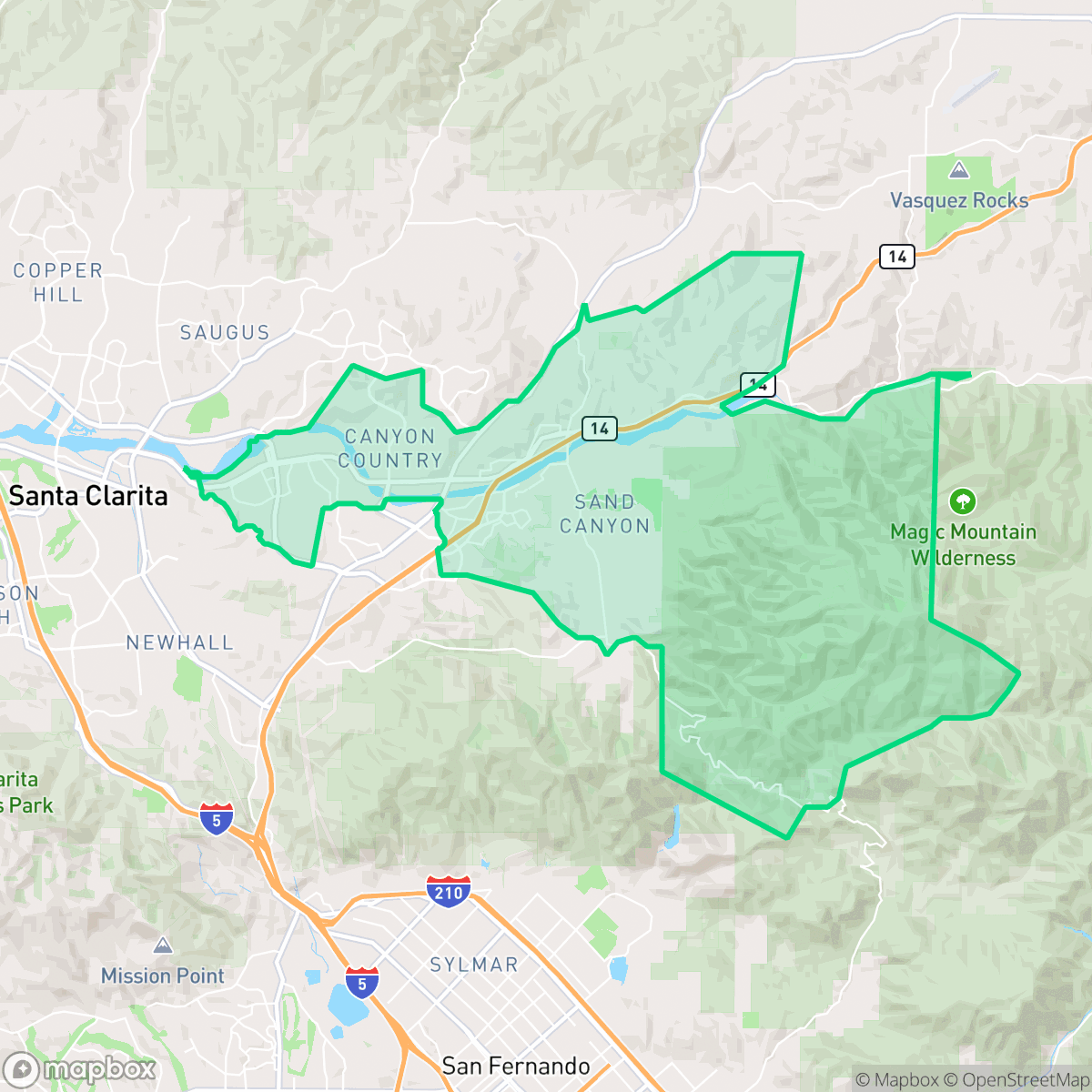
Canyon Country is a semi-rural residential community defined by its expansive hillsides and proximity to the Angeles National Forest. The area features extensive sidewalk networks for pedestrians, though residents should be prepared for high noise levels from transit routes and significant wildfire risks.
Key Highlights
About Canyon Country
Canyon Country, the largest neighborhood within the city of Santa Clarita, was historically known as 'Solemint,' a name derived from the combination of Soledad and Mint Canyons. Originally a rural area defined by mining and ranching, it transitioned into a residential community during the 1960s and 1970s through major suburban developments by the Newhall Land Company. The area’s heritage includes the Sterling Borax Mine, which operated in Tick Canyon from 1908 to 1921, and the historic Lang Station, where a gold spike was driven in 1876 to complete the transcontinental rail connection between San Francisco and Los Angeles. In 1987, Canyon Country merged with Newhall, Saugus, and Valencia to incorporate as the city of Santa Clarita. It remains a diverse community characterized by its varied topography and proximity to the Angeles National Forest.
This neighborhood offers a spacious and scenic environment characterized by large residential lots and well-maintained landscaping. Residents enjoy exceptionally clean air and a tranquil, low-density atmosphere that feels removed from the typical suburban bustle. The community supports a diverse population, ranging from young families to seniors, and benefits from a robust internal network of paths and sidewalks that makes local navigation highly accessible for those on foot.
Living in the area requires careful consideration of environmental factors, as the landscape is subject to elevated wildfire and flood risks that may necessitate specific insurance coverage. While the neighborhood provides a serene residential experience, it is also notable for higher noise levels stemming from nearby transit corridors and flight paths. Prospective residents have access to several high-performing school districts, including Saugus Union and William S. Hart, though daily errands typically require a vehicle due to the low-density, spread-out nature of the local development.
Neighborhood Scores Across 15 Qualities
Residential spacing varies between detached homes with private yards and more densely packed clusters. This level of separation is notably lower than the city average, as some areas feature shared walls or closely situated structures.
Extensive sidewalk networks and clear pedestrian crossings throughout residential areas provide much higher walkability than the city average. While major highways can act as barriers, the internal path networks and residential street connectivity are notably robust according to iHuus data.
Large residential lots with well-manicured landscaping and frequent private pools characterize much of the area, though the overall visual appeal is slightly below the city average. Some sections feature more standard suburban density and shared community amenities.
Abundant sidewalks and access to surrounding hillsides and dry riverbeds provide reliable exercise areas for pets. While walking options are plentiful, the area offers fewer large formal parks than the city average, according to iHuus data.
Expansive hillsides and undeveloped terrain characterize this area, providing a more open and natural environment than the more densely developed city average. Residents will find a mix of scattered residential pockets nestled within vast, undeveloped canyon and woodland spaces.
A tranquil, low-density environment prevails here, offering much more peace and open space than the city average. While some pockets feature localized dining and social hubs, much of the area remains quiet and largely residential, often requiring a car for most errands.
Frequent noise from nearby flight paths or major transit routes characterizes this area. According to iHuus data, acoustic comfort is notably lower than the average for the surrounding city.
Air quality remains exceptionally clean with minimal pollutants, performing significantly better than the average for the surrounding area. According to iHuus data, the atmosphere is consistently fresh and presents very little health concern for residents.
Industrial presence is minimal, consisting primarily of light commercial use and municipal utilities. While there is slightly more exposure to logistics or warehouse-style activity than the city average, the area remains largely free of heavy manufacturing or hazardous industrial sites.
Health insurance accessibility is strong in this area, with coverage rates notably higher than the city average according to iHuus data.
Political leanings in this area lean toward liberal values, which is a notable departure from the much more conservative profile seen across the rest of the city.
A balanced mix of young adults, families, and seniors characterizes the community. This demographic variety is slightly lower than the city average, according to iHuus data.
Significant flood risk exists due to the area's location within a designated floodplain; according to iHuus data, this level of risk is slightly higher than the city average and often necessitates flood insurance.
Wildfire hazards are exceptionally high in this area, representing a much more significant danger than typically found elsewhere in the city. Residents must prioritize maximum fire protection measures and emergency preparedness due to this elevated level of risk, according to iHuus data.
Address-Level Insights for Canyon Country


iHuus Neighborhood Intelligence Insights
Get address-level neighborhood insights for Canyon Country
- Street-level scores — see how individual blocks compare, not just neighborhood averages
- Micro-zone boundaries — identify quiet pockets, flood boundaries, and walkable clusters before you visit
- 15 dimensions in full — walkability, noise, air quality, school quality, insurance coverage, population age profile, urban/rural index, and more
- Boundary risk alerts — know if your address sits near a block boundary where scores drop, the kind of detail no listing will ever mention
- School insights — individual school ratings and insights, not just district-level data
- Compare before you commit — side-by-side data across neighborhoods, down to block precision
No credit card required
Canyon Country Rankings
School Districts Serving Canyon Country
School Insights for Canyon Country
Below average outcomes; significant attendance and academic challenges.
School Insights
See what's really behind every school rating near Canyon Country
- Individual school ratings — each school's own score with outcome context, not just a district average
- Enrollment & class size data — student-to-teacher ratio and how it compares to the state average
- Full demographics breakdown — ethnicity and gender composition for every school in the enrollment zone
- Every school in the district — all schools within the enrollment boundary ranked by rating, not just the closest one
- Grade levels & benchmarks — elementary through high school, with below/above state-average flags
No credit card required